Researchers to construct 18th century printing press for modern-day publishing
Posted on Monday 10 September 2018
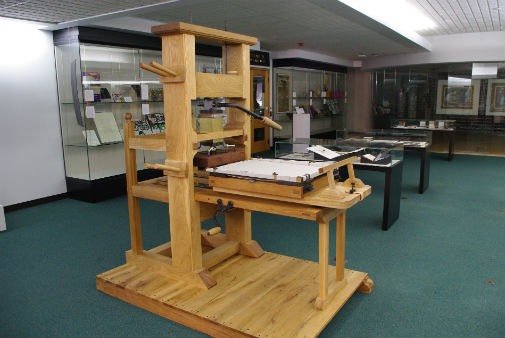
The reconstructed Gent Press will be similar to this reproduction wooden press, currently housed in the Cary Graphic Arts Collection at the Rochester Institute of Technology.
The Thin Ice Press will be housed at the University of York’s Department of English and Related Literature in a specially designed printing studio. The studio also features four operational iron presses from across the centuries.
The replica press is based on a historic printing machine that once belonged to the enterprising Thomas Gent. The wooden press, now owned by Scarborough Museum, has deteriorated over time, but the team are using it as the basis for their reconstruction, alongside some rare eighteenth-century plans, recently unearthed by the author and librarian Edward Potten.
Students at the University and members of the public will be able to work with researchers and visiting printers to explore the press and try their hand at producing their own publications. The team aim to raise £10,000 through a crowdfunding campaign to help them bring the wooden printing press back to life.
Printing legacy
Professor Helen Smith, Head of the University of York’s Department of English and Related Literature, said: “York is a fitting location to base the Thin Ice Press due to its vibrant printing history, still visible in the ‘printer’s devil’ of Stonegate.
“Thomas Gent was born in 1693 and during his lifetime published more than 60 works. He famously brought his printing press out onto the frozen River Ouse, during the great freeze of 1740, where he printed souvenirs for the eager crowds.
“One of his wooden printing presses still survives, which is really remarkable, but it is sadly in a poor condition and no longer able to print. Through this project we hope to bring the historic letterpress community of York back to life and demonstrate how much the printing press impacted society, and how much the printed book continues to matter today.”
Important invention
The common press is often considered to be one of humankind’s most important inventions. The wooden common press and movable type, like that used by Thomas Gent, sparked a revolution in communication and culture in the mid-15th to late 18th centuries, allowing information and ideas to be circulated on a scale that had never been possible before.
The research team aims to raise £5,600 by the Friday, 14 September 2018. To donate to the project visit the University’s crowdfunding platform, YuStart, here: https://yustart.hubbub.net/p/thinicepresslaunch/