
Understanding the library experience of postgraduate researchers
Posted on Thursday 11 June 2026

In Spring 2026 we invited twelve postgraduate researchers (PGRs) to participate in our research project about their information searching behaviours. We aimed to:
- Determine the extent to which PGRs are engaging with Library systems and services in their information searching behaviours
- Consider ways to adjust our communications with PGRs to meet their specific needs and to speak to their research process more effectively
- Gather general feedback about how PGRs use the Library
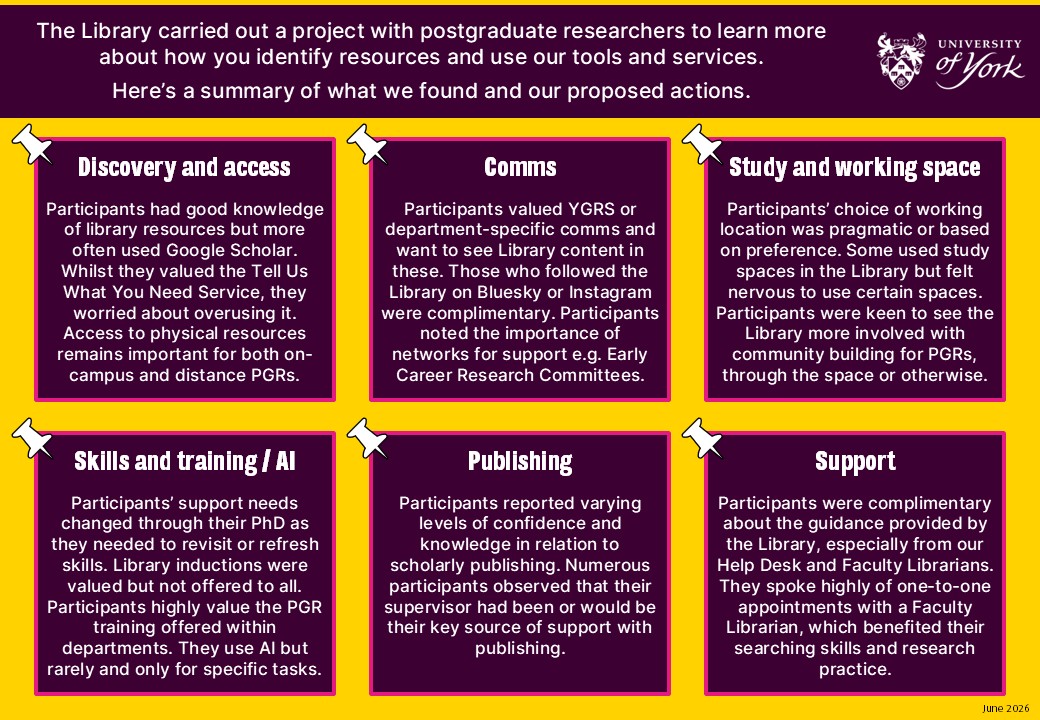
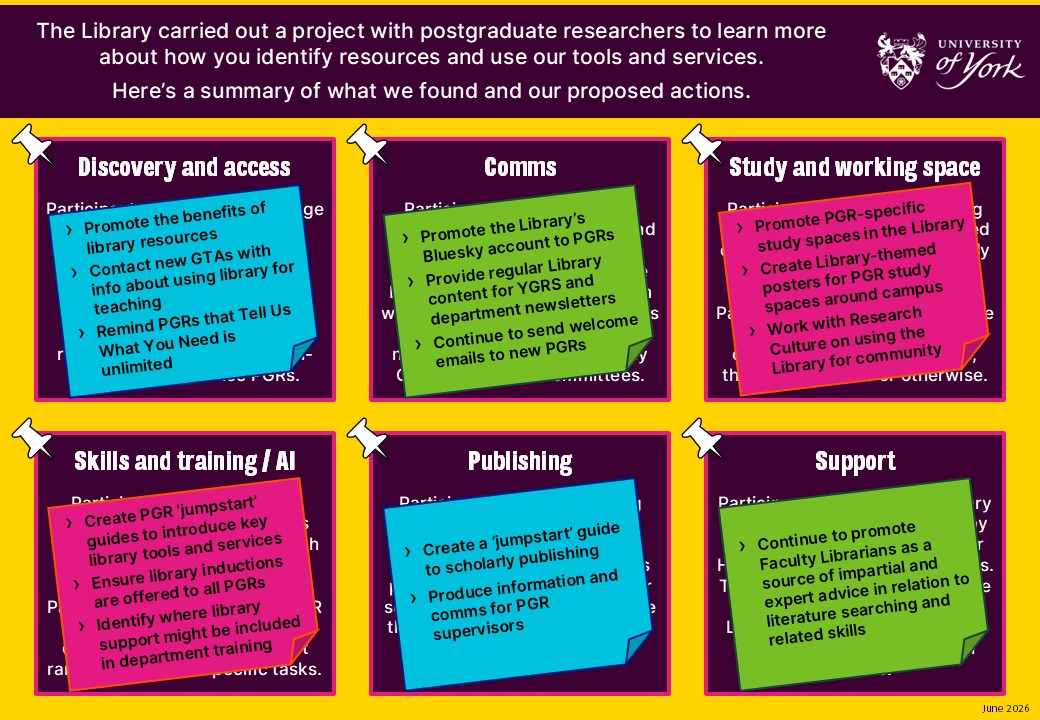
We identified six key themes in the research which you can read about below or in this visual summary of our findings and actions. You are also welcome to read our full report.
Our findings
Our proposed actions
Discovery and access
Participants had good knowledge of library resources but more often used Google Scholar. Whilst they valued the Tell Us What You Need Service, they worried about overusing it. Access to physical resources remains important for both on-campus and distance PGRs.
We will:
- Promote the benefits of library resources
- Contact new GTAs with information about using the library for teaching
- Remind PGRs that Tell Us What You Need is unlimited
Comms
Participants valued York Graduate Research School (YGRS) or department-specific comms and want to see Library content in these. Those who followed the Library on Bluesky or Instagram were complimentary. Participants noted the importance of networks for support e.g. Early Career Research Committees.
We will:
- Promote the Library’s Bluesky account to PGRs
- Provide regular Library content for YGRS and department newsletters
- Continue to send welcome emails to new PGRs
Study and working space
Participants’ choice of working location was pragmatic or based on preference. Some used study spaces in the Library but felt nervous to use certain spaces. Participants were keen to see the Library more involved with community building for PGRs, through the space or otherwise.
We will:
- Promote PGR-specific study spaces in the Library
- Create Library-themed posters for PGR study spaces around campus
- Work with Research Culture on using the Library for community
Skills and training / AI
Participants’ support needs changed through their PhD as they needed to revisit or refresh skills. Library inductions were valued but not offered to all. Participants highly value the PGR training offered within departments. They use AI but rarely and only for specific tasks.
We will:
- Create PGR ‘jumpstart’ guides to introduce key library tools and services
- Ensure library inductions are offered to all PGRs
- Identify where library support might be included in department training
Publishing
Participants reported varying levels of confidence and knowledge in relation to scholarly publishing. Numerous participants observed that their supervisor had been or would be their key source of support with publishing.
We will:
- Create a ‘jumpstart’ guide to scholarly publishing
- Produce information and comms for PGR supervisors
Support
Participants were complimentary about the guidance provided by the Library, especially from our Help Desk and Faculty Librarians. They spoke highly of one-to-one appointments with a Faculty Librarian, which benefited their searching skills and research practice.
We will:
- Continue to promote Faculty Librarians as a source of impartial and expert advice in relation to literature searching and related skills
We will use the findings from the project to produce PGR-specific guidance and insights which will benefit postgraduate researchers for many years to come. We are hugely grateful to our participants for their time and for the enthusiasm they showed during our research. One participant commented that they “couldn't really ask for much more” from the Library; it is our hope that through this research we can anticipate the needs of PGRs and ensure that the Library continues to be a vital source of support at every stage of their research journeys.