

PGCert Safety Critical Systems Engineering
Understand the core aspects of how complex products and services undertake tasks that pose a risk to human lives, and become a practitioner in keeping people safe.
Year of entry: 2027 (September)
This course will provide you with the educational background required to become a leader in the field of safety critical systems engineering, whether you are currently a practising - or aspiring - professional in this area.
Develop expertise in systems safety and risk management: Understand how technology, people and organisations interact to influence the safety of products and services. Develop the skills to assess risks, evaluate safety assurance processes and understand how safety is maintained throughout a product or service lifecycle.
Build practical skills through real-world scenarios: Apply systematic thinking to complex safety challenges across multiple domains. Explore a range of scenarios that will challenge your existing knowledge, develop your professional judgement and strengthen your ability to make informed, ethical decisions.
Learn from cross-industry expertise and experience: Benefit from the extensive research and industrial experience of course tutors, alongside insights from safety professionals across aerospace, military, automotive, railway and nuclear industries. Gain a broad understanding of systems safety and its application across different sectors.
Study in modern facilities at the heart of our computing community: You'll learn in the purpose-built Ian Wand Building, with access to software and hardware laboratories, collaborative learning spaces
This course is also available as an MSc in Safety Critical Systems Engineering or a PGDip in Safety Critical Systems Engineering.
The Institute for Safe Autonomy
This dedicated facility on the University's Campus East provides workspace for up to 100 people, a rooftop lab, and specialist robotics design and testing equipment.Course content
The course is taken on a part-time basis over either one or two years. This means it is very flexible and can easily fit in around work commitments.
Modules are delivered through set teaching weeks and you will be required to attend campus for some face-to-face teaching during teaching weeks. You'll undertake intensive teaching sessions based on lectures, case-studies and exercises. Additionally, for each module, you will need to undertake some self-study before and after face-to-face teaching.
Find out the dates the modules are running.
Modules
Core modules
- Foundations of System Safety Engineering - A
- Foundations of System Safety Engineering - B
- Hazard and Risk Assessment
- System Safety Assessment
- Safety Case Development and Review
Option modules
You will study two option modules. Examples can be found below. Some option module combinations may not be possible. The options available to you will be confirmed after you begin your course.
- Computers and Safety
- AI and Autonomous Systems Safety
- Security for Safety-Critical Systems
- Human Factors for Safety
Notes for PG Cert (part-time, 1 year or 2 years) (60 credits): 60 credits from taught modules (40 credits core, 20 credits optional). No project module.
Our modules may change to reflect the latest academic thinking and expertise of our staff, and in line with Department/School academic planning.
Learning outcomes
Every course at York is built on a distinctive set of learning outcomes. These will give you a clear understanding of what you will be able to accomplish at the end of the course and help you explain what you can offer employers. Our academics identify the knowledge, skills, and experiences you'll need upon graduation and then design the course to get you there.
Learning outcomes for this course
- Employ system safety thinking throughout the life cycle of a system or service using a broad, systematic imaginative anticipation of safety risks, causes and consequences.
- Contribute to the development of safe systems and services by ensuring that proper consideration is given to safety issues as part of systems engineering processes.
- Evaluate and assure specific aspects of the safety of systems and services by employing analysis techniques respecting each techniques' strengths and limitations.
- Effectively communicate with technical and non-technical stakeholders about system safety problems and their solutions in a clear and organised manner.
- Operate as a safety-critical system safety professional, by developing awareness of key legal and ethical issues relating to system safety, appreciating how safety critical systems can affect society and the environment.
Fees and funding
Annual tuition fees
| UK (home) | International and EU |
|---|---|
| TBC | TBC |
Additional costs
Text books and resources will be available to you through the University of York library and electronic copies of all course materials are provided. You will need to arrange and pay for your own accommodation and travel to York for face-to-face teaching. Costs associated with this will vary depending on your location and the standard of accommodation you book.
Teaching and assessment
You’ll work with world‐leading academics who’ll challenge you to think independently and excel in all that you do. Our approach to teaching will provide you with the knowledge, opportunities, and support you need to grow and succeed in a global workplace.
Teaching format
The course is delivered by taught modules that include an intensive, York-based face-to-face element. Teaching methods include lectures and seminars, interspersed with case study exercises which take place in groups of 6-8 students. For most modules, pre-recorded materials for private study will also be provided. After the York-based taught element, students are expected to complete assessments for each module.
Teaching location
The Department of Computer Science is based on Campus East. Teaching takes place in a range of locations on Campus East.
About our campus
Our beautiful green campus offers a student-friendly setting in which to live and study, within easy reach of the action in the city centre. It's easy to get around campus - everything is within walking or pedalling distance, or you can always use the fast and frequent bus service.
Assessment and feedback
Each module has associated assessments.
This means that you undertake the assessments in your own time away from the University following the taught element of the module. The assessments, and any associated work packages, are designed to consolidate and further deepen your knowledge, skills and approaches to the subject matter covered in the module. Of course, they are also designed to assess your progress.


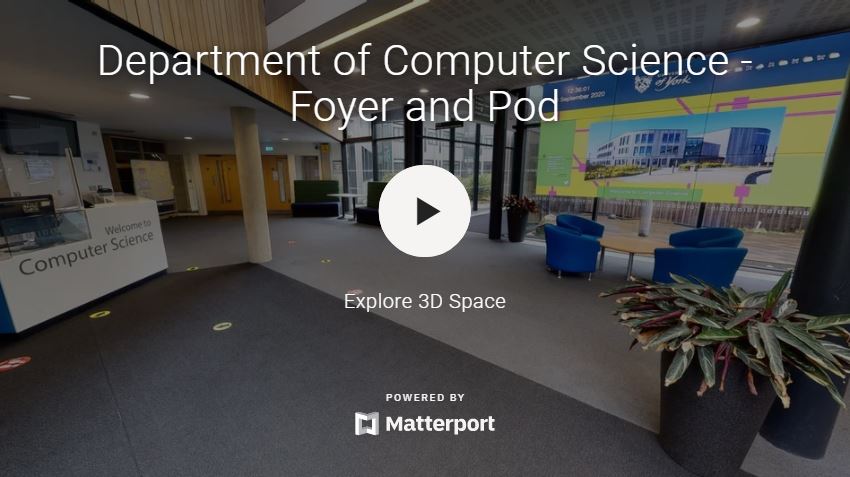
Virtual tours
Take a virtual tour of one or our modern, dedicated facilities.
Careers and skills
The vast majority of people who undertake this course are already working in industrial fields such as aeronautical engineering, automotive, energy and power generation, nuclear, maritime and military. Undertaking this course will equip you to progress within these fields.
Career opportunities
- Safety engineer / advisor
- Independent safety assessor
- Safety manager
- Software safety consultant
Transferable skills
- Information-retrieval
- Numeracy
- Time management

Accelerate your professional network. We'll connect you with the guidance, industry links and experiences to help you stand out and find your career advantage.
Entry requirements
| Qualification | Typical offer |
|---|---|
| Undergraduate degree | 2:2 or equivalent in a numerate, technical discipline. This course is specifically directed at those with several years of industrial experience. |
| Other qualifications and experience | If you do not have a first degree but instead have relevant industrial experience, your application will be considered on a case by case basis. Applicants who do not meet these requirements are encouraged to take some of the PG Cert modules on a short course basis before applying for the PG Cert. Information about short courses in systems safety engineering and how to book. |
| Other international qualifications | Equivalent qualifications from your country |
English language
If English isn't your first language you may need to provide evidence of your English language ability. We accept the following qualifications:
| Qualification | Minimum requirement |
|---|---|
| IELTS (Academic and Indicator) | 6.5, minimum 6.0 in each component |
| Cambridge CEFR | B2 First: 176, with 169 in each component |
| Oxford ELLT | 7, minimum of 6 in each component |
| Oxford Test of English Advanced | 136, minimum 126 in each component |
| Duolingo | 120, minimum 105 in all other components |
| LanguageCert SELT | B2 with 33/50 in each component |
| LanguageCert Academic | 70 with a minimum of 65 in each component |
| Kaplan Test of English Language | 478-509, with 444-477 in all other components |
| Skills for English | B2: Merit overall, with Pass with Merit in each component |
| PTE Academic | 60 with 52 in Listening, 53 in Reading, 65 in Speaking, and 59 in Writing |
| TOEFL | 4.5, with 5 in Listening and 4.5 in each other component |
| Trinity ISE III | Merit in all requirements |
For more information see our postgraduate English language requirements.
If you haven't met our English language requirements
You may be eligible for one of our pre-sessional English language courses. These courses will provide you with the level of English needed to meet the conditions of your offer.
The length of course you need to take depends on your current English language test scores and how much you need to improve to reach our English language requirements.
After you've accepted your offer to study at York, we'll confirm which pre-sessional course you should apply to via You@York.
Next steps
Contact us
Get in touch if you have any questions
Department
Discover York

We offer a range of campus accommodation to suit you and your budget, from economy to premium.

Explore campus and city life and hear what our current students have to say about living here.

Lively, full of culture and beautiful, York is regularly voted one of the best places to live and visit in the UK.

Find out more about York. Chat to staff and students and take the tour, on campus or online.