
Industry applications and technologies
Our Technologies and Expertise
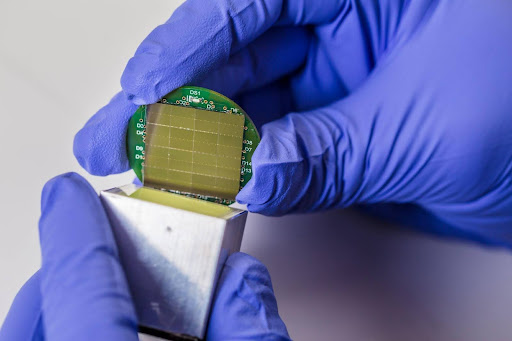
Technology: Flexible alpha detector
- The challenge: Measuring alpha radiation coming from curved surfaces and challenging geometries.
- How we meet it: Our patent-protected, mechanically flexible alpha radiation detector technology.
- Contact us to learn more.

Technology: Fluidic radiation characterisation
- The challenge: Determining bulk activity, energy spectra, isotope presence, and equilibration status of alpha- and beta-emitters in liquids.
- How we meet it: Our patent-pending solution, combining fluidic hardware with novel data analytics.
- Contact us to learn more.
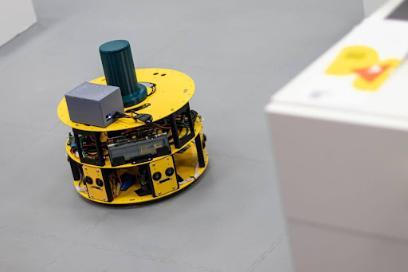
Technology: 3D gamma source localisation
- The challenge: Locating a gamma-emitting source in an unknown 3D space in a cost-efficient manner.
- How we meet it: Radiation detectors combined with autonomous, intelligent robotics.
- Contact us to learn more.
Technology: Next-generation proton beam therapy
- The challenge: Reducing damage to healthy tissue whilst maintaining therapeutic dose.
- How we meet it: Our in-development solution, controlling advanced beam parameters to achieve unparalleled improvements.
- Contact us to learn more.
-387x247.png)
Technology: Quantum-entangled PET medical imaging
- The challenge: Significantly increasing the information gathered from positron emission tomography (PET) medical imaging.
- How we meet it: Our patented method of exploiting quantum entanglement of back-to-back gamma photon pairs.
- Contact us to learn more.
Our expertise
- Supporting the entirety of our industry applications work is our deep understanding of fundamental nuclear physics.
- High level expertise in Monte Carlo simulation of radiation transport - especially with Geant4 - underpins our detector development work.
- Detector development and characterisation is enabled by our expertise in all aspects of radiation detector technology from scintillators to semiconductors.
Working with us
Entry point to the wider university offering
The Nuclear Physics Group is part of the School of Physics, Engineering and Technology. This structure enables us to work effortlessly with colleagues across electronic engineering, materials science, robotics, and autonomous systems. A partnership with the Nuclear Physics Group is a partnership with the University of York and our appetite to solve problems.
An experienced partner
Having developed detectors for international physics experiments for many years, and with a growing portfolio of successful industry engagements and projects, you can rest assured that we will either have a solution to your problem or ideas for how we can solve the problem together.
Access to our facilities
We have world-class facilities for detector development and characterisation, including:
- Analogue and digital data acquisition systems
- All classes of radioactive sources including thermal/fast neutron sources
- Highly collimated gamma-ray beam scanning system for detector characterisation
- Large vacuum chambers and temperature-regulated chambers
How to work with us
As an academic group at the University of York, we are experts in carrying out world-leading research. However, we also have a successful track record of working with industry and there are numerous ways in which you could work with us, ranging from contractual to collaborative.
Contract research
If there is a piece of radiation detection work you would like to outsource (e.g., simulation of detector performance across a range of geometries), we can very likely carry this out for you.
Consultancy
If you need input from the UK’s largest nuclear physics group for your challenges in radiation detection (or more fundamental physics), we can provide this expertise.
Technology transfer
If any of our technologies would fit into your commercial activity (e.g., using our flexible alpha detector to monitor contamination inside pipes), we would be happy to discuss how to best make that happen.
Collaborative research
We would be keen to learn about your specific industry needs and innovate alongside you. There are a number of funding opportunities for industry-academia partnerships, and we can discuss the options available.
As an academic group at the University of York, we are experts in carrying out world-leading research. However, we also have a successful track record of working with industry and there are numerous ways in which you could work with us, ranging from contractual to collaborative.
Studentship support
Having an appropriately skilled workforce is incredibly important, and we are proud of our role in training the next generation of nuclear physicists. If you would like to help us mould the talent of the future (which could become your future hire!) then get in touch.
The above list is non-exhaustive, but gives an indication of how you could work with the Nuclear Physics Group at the University of York. Any idea is worth a conversation, so contact us today.
Our industry team
Dr Mikhail Bashkanov

Mikhail is a Lecturer and a leading scientist in the field of exotic particles. His extensive work on detector construction and hadron beams has been extended into applied areas, focusing on cancer treatments (external beam therapies, mixed beam therapies, etc.) and novel approaches of medical isotope production for both treatment and imaging.
Dr Julien Bordes

Julien is a Research Software Engineer specialising in Geant4, a platform for simulating the passage of radiation through materials. He works with academic institutions and companies from a variety of industries (including medical, nuclear safety, and oil and gas). His simulations are invaluable in guiding the development of new technologies and to aid in the understanding of experimental results.
Dr Jamie Brown

Jamie is a Postdoctoral Research Associate in experimental nuclear physics. He specialises in the development and operation of radiation detector systems for medical and industrial applications, as well as fundamental science. He has many years of experience working with a variety of semiconductor- and scintillator-based detector technologies in academic and industrial settings.
Dr Christian Diget

Christian is a Senior Lecturer in the group. He has over 20 years of experience in nuclear physics, specialising in nuclear astrophysics, and he is a national leader in nuclear physics public engagement. Christian’s industry work focuses on detector development for nuclear medicine - adapting nuclear astrophysics expertise to solve problems here on earth.
Dr Adam Featherstone

Adam is a Knowledge Exchange & Commercialisation Fellow, with a background in medical imaging research, intellectual property (IP) commercialisation, and partnership management. For the Nuclear Physics Group, Adam oversees a portfolio of applications-focused projects and seeks out industry challenges which can be met. For industry, Adam works with partners to define commercially relevant work packages that make use of the group’s expertise. He provides professional support to all academia-industry relationships.
Professor David Jenkins

David is Head of the Nuclear Physics Group. He has twenty-five years’ experience in experimental nuclear physics. Over the last decade, he has increasingly applied his skills to industry applications, in particular, detector development in the areas of nuclear security, nuclear decommissioning and medical imaging. David is an internationally recognised expert in radiation detection methods and has recently published a book on the subject.
Dr Pankaj Joshi
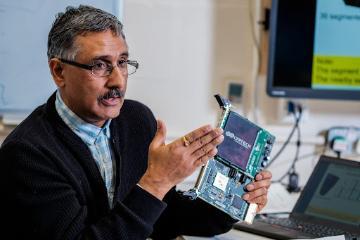
Pankaj is a Senior Technical Specialist who manages our detector development laboratories and also acts as our radiation protection supervisor (RPS). He brings twenty-five years of experience in detector development and nuclear instrumentation.
Professor Dan Watts

Dan is a Professor in the group and runs research at electromagnetic beam facilities such as Jefferson Laboratory in the USA. He leads applied projects in quantum-entanglement (including in positron emission tomography - PET - imaging) and develops new methods for in-patient imaging alongside next-generation proton therapy. He also works on new imaging methodologies for particle beams built on emerging laser-plasma acceleration techniques.
Contact us
Contact details
Please contact the industry team with any queries or requests at np-partnerships@york.ac.uk