Protection of saltmarshes is vital for climate change mitigation, researchers warn
Posted on Wednesday 22 May 2024
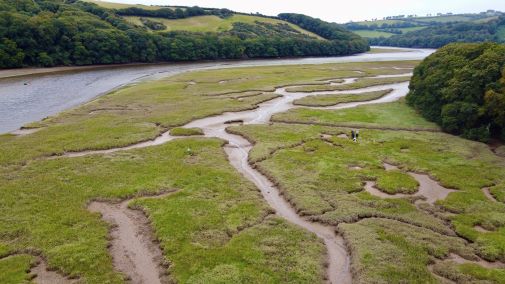
Occupying more than 450km² of the UK coastline, saltmarshes capture and store large quantities of carbon, which makes them one of the UK’s most important coastal ecosystems.
They provide a natural climate regulation service through the long-term storage of organic carbon in their soils. Year by year, saltmarshes accumulate thin layers of sediments that are rich in carbon from the plants that grow and die there, as well as from adjacent sources on land (via rivers) and at sea. As this organic carbon is buried in the waterlogged soils, decomposition is slowed, keeping carbon out of the atmosphere.
The new study, led by the universities of St Andrews and York and published in Science of the Total Environment follows an assessment of the total amount of saltmarsh carbon in the UK published in 2023.
Slower accumulation
Researchers looked at the density of organic carbon in 21 saltmarshes around the UK, using specialist dating techniques to work out when and how quickly the sediments accumulated.
They found that although UK saltmarshes store 5.2 million tonnes of carbon, rates of new carbon accumulation are much slower than expected, and similar to sequestration rates in UK forests.
Growing pressure
The researchers’ findings underscores the value of these expansive carbon reserves, particularly considering the prolonged timeframe required for their formation.
While the annual accumulation rate of carbon in UK saltmarshes may be lower than previously thought, this study emphasises the critical role these ecosystems play in storing vast amounts of carbon and highlights the growing pressure they are under from a changing climate, sea-level rise and increasing anthropogenic disturbance.
Untapped potential
Professor Roland Gehrels, Head of the Environment and Geography Department at the University of York, and a researcher on the project, added: “With the speed of climate change accelerating at an alarming rate, this deeper understanding of saltmarshes and their untapped potential for carbon sequestration has never been more urgent. The low accumulation rates demonstrated in this study really highlight that if lost, these carbon stores will take centuries to build up again.”
Dr Ed Garrett, assistant professor at the University of York and joint lead author of the new study, said: “We found the accumulation of organic carbon was far lower than global estimates, which means the contribution of northern European saltmarshes, such as those in the Humber Estuary, has likely been significantly overestimated.”
Technical challenges
Dr Craig Smeaton, lecturer in Geography & Sustainable Development at the University of St Andrews, and the lead author of the study, said: “Understanding the true carbon storage capacity of saltmarshes at the scale of the UK has been a major technical challenge, involving a large multidisciplinary team of researchers. We are excited to have published the first national organic carbon accumulation assessment for Great Britain”.
The project’s principal scientist, Professor William Austin at the University of St Andrews, added: “While restoring and creating new saltmarshes offers a potential boost for climate,people and biodiversity and may be valuable to counteract habitat loss, there has never been a more important time to protect the vulnerable organic carbon already stored in existing saltmarshes.
Urgent protection
“This must be a priority for the UK and elsewhere because the protection of existing habitats (and carbon stores) offers climate benefits from avoided greenhouse gas emissions which are several times more significant than those gained from new accumulation of organic carbon in these ecosystems.”