A good night’s sleep may help to generate false memories, a new study reveals
Posted on Monday 11 December 2023
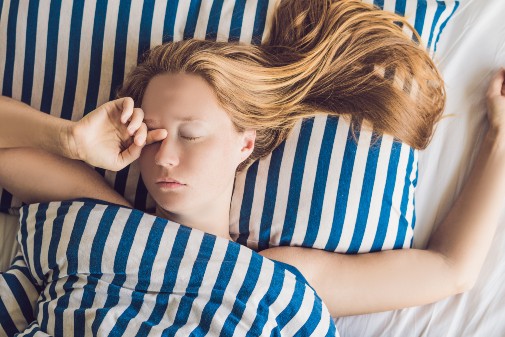
In psychological experiments, false memories often arise when people are given a list of related words to memorise, and falsely remember a word being there that would have fit the category but in fact was missing.
Lure words
As part of this study, published in the journal Royal Society Open Science, researchers from the University of York’s Department of Psychology tested 488 participants on their ability to recall a list of words 12 hours after seeing them, with some of the participants being allowed to sleep in the 12-hour interim.
They found that those who had slept remembered more of the words on the list than those who had not, but they were also more likely to give words that weren't on the list, but were related.
The related incorrect words are known as "lure words". If a list contained words like nurse, hospital and sick, the false memories may include lure words like doctor.
Random errors
Dr Matthew Mak, first author of the study and researcher at the University of York, said: “Participants may falsely recall the lure words because ‘Doctor' presumably represents the gist of the wordlist, and humans are known to often rely on gist encoding.
“Also, words in our mind are stored in association with each other, so seeing those medical-related words may automatically activate 'doctor', making participants felt like they had seen this word before."
Co-author Professor Gareth Gaskell, from the University of York, added: "We found that participants who had slept had better memory for the lists in terms of better recall of the words in the lists. But their errors were also revealing—they made fewer random errors (intrusions), and more errors that suggest that they had learned the gist of the lists."
"Memories in some ways are more about our future than our past. They exist to provide knowledge about our past that can be applied in a generalised way to help us to deal with future events. Future events won't be identical to the past events, so a gist-like representation might actually be more useful than a 'perfect' detailed representation. So what sleep might be doing is helping us to store memories in a gist-like way that can then be better applied to our future interactions."
Limitations
The authors do recognize several limitations of their study, namely that all participants were aged between 18 and 25, and that the tests were performed online, meaning that other distractions and environments could not be controlled.
However, they hope that their research paves the way to new discoveries regarding sleep's role in memory.
Professor Gaskell added: "Our study provides a rich new body of evidence to help determine the contribution of sleep”.