Global cooling caused diversity of orchids species, study confirms
Posted on Monday 10 July 2023
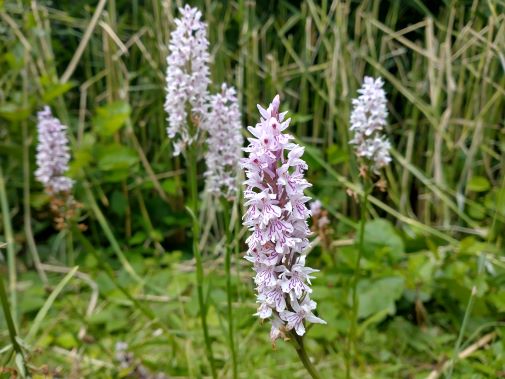
A researcher at the University of York, in collaboration with the Milner Centre for Evolution at the University of Bath, examined the role of climate on diversity of species, and how our current changing climate might affect biodiversity in the future.
Natural selection
Orchids are one of the largest families of plants with around 28,000 species growing across the world and known for their huge variety of different-sized and shaped flowers. So researchers asked the question - why are there so many?
Charles Darwin studied orchids as a model for evolution through natural selection, proposing that they evolved an array of different flowers gradually over time to attract specific pollinators.
However, scientists at the universities of York and Bath studying almost 1500 species of terrestrial orchids, found that rather than evolving gradually over thousands of years, these plants diversified relatively quickly due to changes in global temperature.
Global cooling
Analysing more than 2.5 million records, they compiled a family tree showing relationships between the species and used statistical models to test how changes in climate during the Earth’s history might have driven the formation of new species.
They found evidence that most of the species appeared during the last 10 million years, coinciding with global cooling, as calculated from geological records.
Modelling the probability of different drivers of speciation suggested that global cooling is 700 times more likely to influence the speciation of orchids than time alone.
Organisms evolve
Dr Katie Davis, from the Department of Biology at the University of York, said: "Our findings show the importance of considering evolution over geological time scales.
“Understanding how organisms evolve in response to global environmental change has important implications for conservation and we can only know this by looking at the deep evolutionary history.”
The research suggests that conservation strategies can’t rely on preserving a few species or areas of land to protect evolutionary diversity, but should be based on conserving as much as possible.
Different pollinators
Dr Jamie Thompson, from the Milner Centre for Evolution at the University of Bath, said: “Darwin proposed that orchids adapted gradually through natural selection to attract different pollinators, but our data show that it’s more complicated than that.
“There was an explosion of diversity in terrestrial orchids across the globe within the last 10 million years, with all the major lineages of these plants emerging at roughly the same time.
“We found this correlated with global climate change so that more species emerged as the climate cooled, giving the first evidence of global cooling driving speciation in these plants.”
Findings
The researchers also found that the speciation rate – how quickly new species arise – wasn’t dependent on how many species there were, to begin with.
The findings are published in the prestigious journal Proceedings of the National Academy of Science USA (PNAS).