Archaeology student finds exceptionally rare fragment from Roman bottle
Posted on Monday 22 July 2019
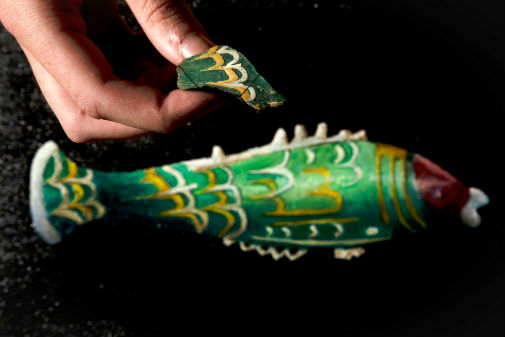
Peter Moore discovered a fragment from a 1,800 year-old glass fish at the National Trust’s Chedworth Roman Villa in Gloucestershire.
The shard of intricately decorated glass is so rare it took experts from around the world two years to identify it.
Wealth and influence
Peter discovered the fragment while part of a team carrying out a dig to understand more about the north wing of the villa. The glass fish may have been used to hold exotic perfume and was unearthed thousands of miles away from where it was made - in an area around the Black Sea in what is now Ukraine.
Nothing like it has ever been found in Britain and the discovery sheds new light on the wealth and influence of the ex-inhabitants of Chedworth.
Peter, from the Department of Archaeology, said: "When it appeared, the first wipe of the surface showed the colour and it quickly became apparent it was something special.
"Excavating anything at Chedworth and knowing that you are the first person to gaze upon it for at least 1,800 years is a feeling that never tires, the memory of recovering this piece of glass certainly will not."
Mystery
The glass piece was found in the summer of 2017 but had to be sent to a leading Roman glass expert, the late Professor Jennifer Price, who sought advice from other experts to solve the mystery of where it came from.
It was eventually found to match a fish shaped bottle that had been restored from many pieces, which is housed in the Corning Museum of Glass, New York.
By comparing the two samples, Prof Price concluded the piece came from near the tail of the glass fish.
The only other example of such a fish-shaped Roman bottle comes from a 2nd century burial in Crimea.
Exotic
The Chedworth bottle has been made with an unusual technique, with the decoration laid on top of the blue-green surface to create scales in loops of white and yellow, and it is likely the fish's open mouth formed the opening of the small vessel.
Nancy Grace, the National Trust archaeologist who led the work to investigate the find, said: "People have been enchanted by it, but it has also been a long and difficult journey.
"To have found that it is the only one of its type so far discovered in Roman Britain adds to our knowledge of the importance of Chedworth Roman Villa.
"Other objects found at the villa show it was home to somebody of wealth and status.
"That such an exotic thing was brought from so far away underlines that the occupants were in touch with the furthest regions of the Roman Empire and wanted to show off that influence. It is amazing that a small fragment has told us so much."