Ancient lake reveals a colourful past
Posted on Thursday 25 January 2018
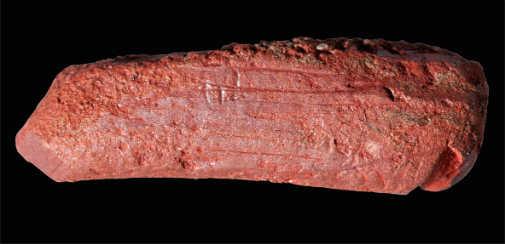
The crayon revealed a sharpened end. Pic Credit: Paul Shields/University of York
The ochre crayon was discovered near an ancient lake, now blanketed in peat, near Scarborough, North Yorkshire. An ochre pebble was found at another site on the opposite side of the lake.
The pebble had a heavily striated surface that is likely to have been scraped to produce a red pigment powder. The crayon measures 22mm long and 7mm wide.
Ochre is an important mineral pigment used by prehistoric hunter-gatherers across the globe. The latest finds suggest people collected ochre and processed it in different ways during the Mesolithic period.
Collaboration
The ochre objects were studied as part of an interdisciplinary collaboration between the Departments of Archaeology and Physics at the University of York, using state-of-the-art techniques to establish their composition.
The artefacts were found at Seamer Carr and Flixton School House. Both sites are situated in a landscape rich in prehistory, including one of the most famous Mesolithic sites in Europe, Star Carr.
A pendant was discovered at Star Carr in 2015 and is the earliest known Mesolithic art in Britain. Here, more than 30 red deer antler headdresses were found which may have been used as a disguise in hunting, or during ritual performances by shamans when communicating with animal spirits.
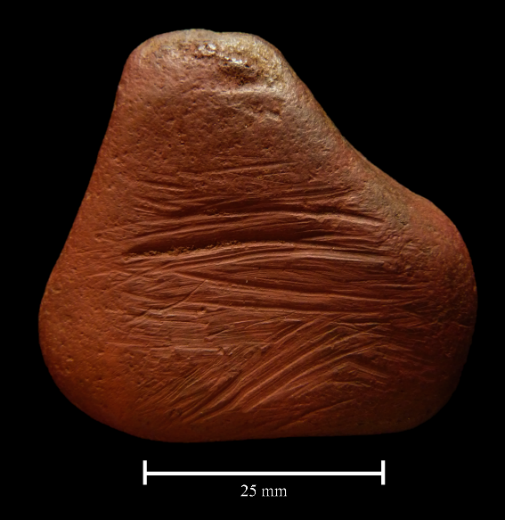
The ochre pebble revealed a heavily striated surface. Pic Credit: Paul Shields/University of York
Lead author, Dr Andy Needham from the University of York’s Department of Archaeology, said the latest discoveries helped further our understanding of Mesolithic life.
He said: “Colour was a very significant part of hunter-gatherer life and ochre gives you a very vibrant red colour. It is very important in the Mesolithic period and seems to be used in a number of ways.
“One of the latest objects we have found looks exactly like a crayon; the tip is faceted and has gone from a rounded end to a really sharpened end, suggesting it has been used.
“For me it is a very significant object and helps us build a bigger picture of what life was like in the area; it suggests it would have been a very colourful place.“
Artistic
The research team say Flixton was a key location in the Mesolithic period and the two objects help paint a vibrant picture of how the people interacted with the local environment.
“The pebble and crayon were located in an area already rich in art. It is possible there could have been an artistic use for these objects, perhaps for colouring animal skins or for use in decorative artwork,” Dr Needham added.
The study, which involved collaboration with the Universities of Chester and Manchester, is published in the Journal of Archaeological Science: Reports.