
CHE achieves Green Impact platinum
Posted on Thursday 25 June 2026
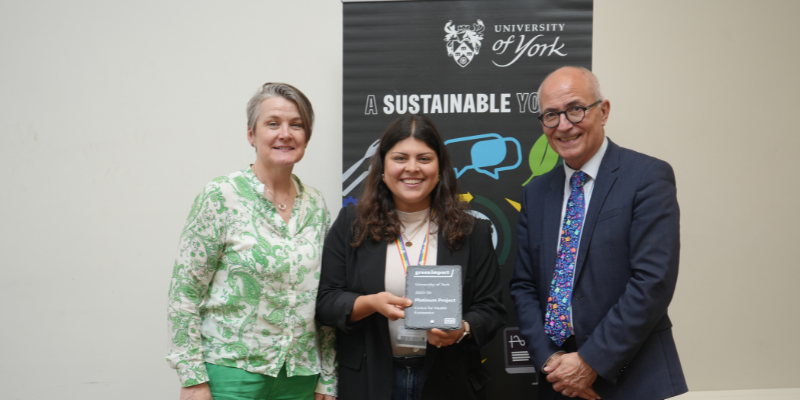
We are proud to announce that CHE has been awarded platinum status in the annual Green Impact Awards, recognising our commitment to sustainability and environmental responsibility.
The achievement was announced at the University’s annual Green Impact Awards ceremony, which brought together around 80 staff, students and sustainability representatives from across the University, as well as Vice-Chancellor, Charlie Jeffery. The event celebrated collective efforts to embed sustainability into everyday working practices across departments.
The award reflects CHE’s successful completion of the Green Impact programme, a nationally recognised sustainability accreditation scheme that encourages teams to improve environmental practices through structured actions, reflection, and continuous improvement.
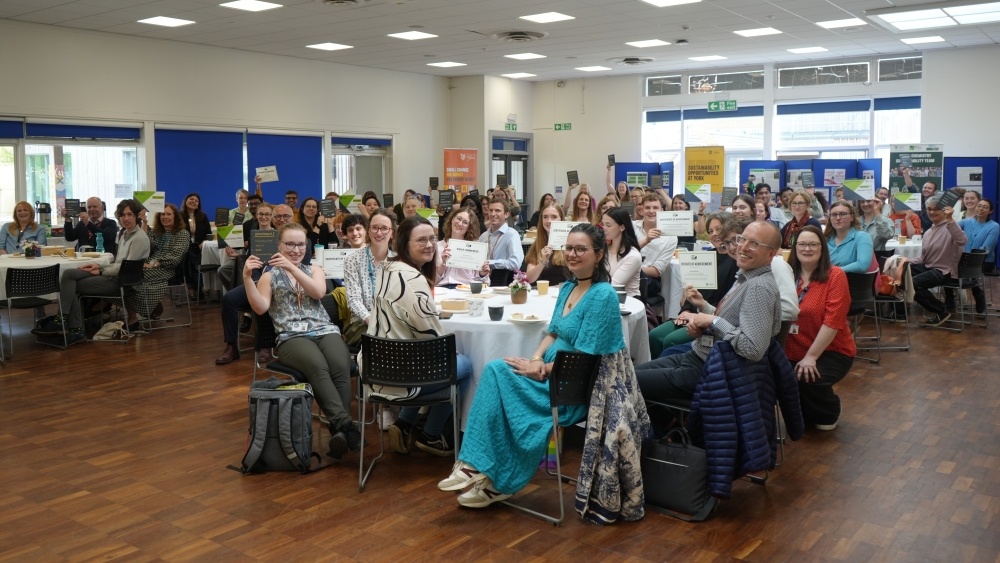
CHE’s sustainability project on AI
CHE’s Green Impact project, Reducing Our AI and Digital Impact (ROADI), explored the environmental impact of artificial intelligence (AI), particularly general-use large language models (LLMs).
The project was led by CHE’s Green Impact Group, comprising academic and professional services staff across CHE. It aimed to raise awareness in CHE and across the University of York of how the use of AI contributes to carbon emissions, water scarcity, and e‑waste, as well as sharing some practical, minimal effort changes that can reduce the environmental impact yet not restricting the effective use of AI.
The CHE Green Impact team first reviewed existing evidence on AI’s environmental impact and then distilled this into clear, accessible guidance for staff. The team produced a collection of useful resources, including two A4 posters (“How does AI affect the environment?” and “Tips for good AI practice”), an accompanying accessible text‑only guide and information guide.
The materials were shared across CHE and circulated across University communication channels, including staff networks and sustainability groups.
A CHE departmental survey captured the department’s baseline AI usage and staff’s willingness to adopt the suggested methods to reduce emissions. Based on the survey responses, our Green Impact team was able to estimate that widespread adoption could reduce CHE’s annual emissions by approximately 62 kg CO₂, or up to 3,879 kg CO₂ annually if adopted across the wider University.
The ROADI project raised awareness, initiated debate about sustainable AI use, and created reusable resources that can be replicated by other departments at the University and other organisations.
About Green Impact
Green Impact is a sustainability accreditation programme designed to support staff and students in building more environmentally responsible workplaces. Teams complete a structured workbook of actions or projects across areas such as energy use, waste reduction, travel, digital sustainability, and procurement.
Performance is recognised through a tiered award system: bronze, silver, gold, platinum, and diamond (awarded to teams achieving Platinum for five consecutive years).