Skip to content Accessibility statement

Improved amaranth varieties for smallholder farmer nutrition and livelihoods

Context

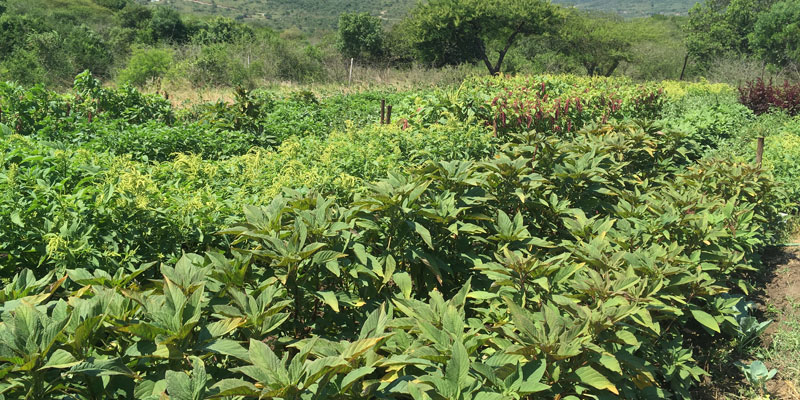
In Sub-Saharan African, amaranths are viewed as a traditional crop with potential to contribute to sustainable and healthy food systems. It is one of the most commonly consumed African leafy vegetables, is drought-tolerant and grows well in low input agricultural systems. However, amaranth has not been fully domesticated and the traits that have been targeted are those relevant to grain crops. Realising the potential of amaranths to enhance nutrition, dietary diversity, smallholder livelihoods and climate-resilient agriculture, will require the development of improved lines suitable for different agro-ecologies.

The research

We are working with the Agricultural Research Council in South Africa and the World Vegetable Center in Taiwan to use a combination of genetics, genomics, metabolite profiling, field trials and participatory plant breeding to develop new amaranth varieties with improved nutritional content and agronomic traits, such as yield and water use efficiency. 

We have generated a pangenome from three species of amaranth and identified genomic and phenotypic variation between eight lines of amaranth which are the parents of a MAGIC population. Field trials with this MAGIC population are identifying regions of the genome underlying beneficial traits and informing the breeding programme.

Project activities and publications

A chromosome-level Amaranthus cruentus genome assembly highlights gene family evolution and biosynthetic gene clusters that may underpin the nutritional value of this traditional crop

An inter-specific Amaranthus pangenome captures genetic variation potentially underlying key leafy vegetable traits in this underutilised crop

Featured researcher

Katherine Denby

Professor Denby is interested in plant disease resistance and plant-pathogen interaction, and in novel approaches for engineering or breeding improved crop varieties tolerant to environmental stress and disease.

View profile