Skip to content Accessibility statement

The function and organisation of the pyrenoid

Context

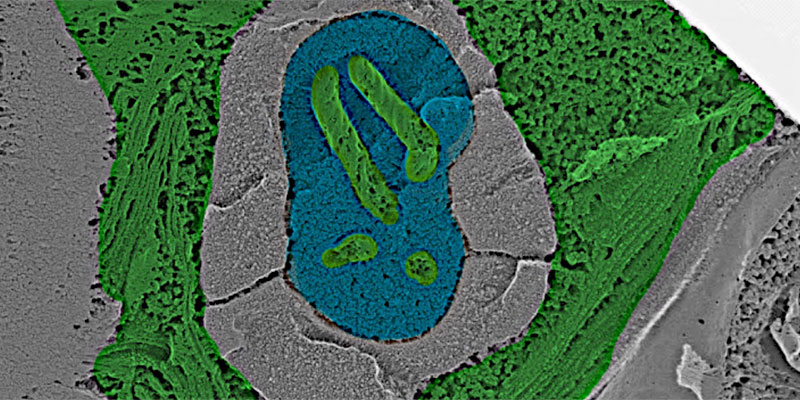
Algae have evolved highly efficient mechanisms to concentrate CO2 from their environment for fixation by the enzyme Rubisco. At the centre of these CO2-concentrating mechanisms (CCMs) is an enigmatic organelle called the pyrenoid, where the cell accumulates CO2 around tightly packed Rubisco. The engineering of a pyrenoid- based CCM into crops has the potential for yield increases up to 60 per cent.

The research

Our research focuses on advancing our knowledge of pyrenoid structure and function across diverse algae to enable pyrenoid engineering in plants.

To date we have shown that the pyrenoid is a liquid-liquid phase separated organelle that can rapidly dissolve and recondense during cell division and changes in CO2 concentration. Central to these liquid-like properties, and key components for current plant engineering efforts, are disordered repeat proteins that link Rubisco together to form the pyrenoid. We have recently identified a new Rubisco linker protein that can assemble some plant Rubiscos into proto-pyrenoids making it an exciting component for ongoing plant pyrenoid engineering.

To enable assembly of a fully functional pyrenoid in plants additional structural and catalytic proteins are required; we are currently characterizing a range of recently identified pyrenoid proteins across diverse algae using cell physiology, biochemical and structural biology approaches.

Project publications

A promiscuous mechanism to phase separate eukaryotic carbon fixation in  the green lineage

A protein blueprint of the diatom CO2-fixing organelle

Featured researcher

Luke Mackinder

Professor Mackinder's research focuses on understanding the molecular basis of carbon fixation in algae and cyanobacteria. 

View profile