
Staff Spotlight - Dr Tian Gan
Posted on Sunday 25 January 2026
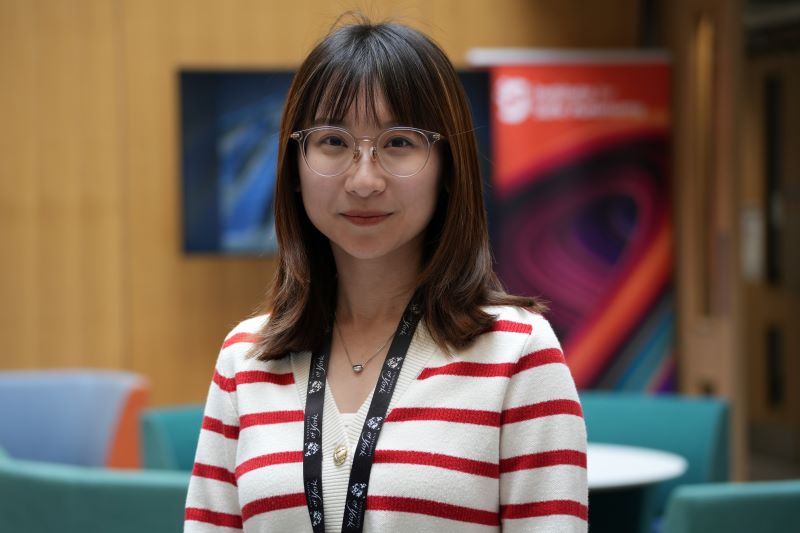
1. Can you tell us about your background and specialist research areas and how these influence your work at the CfAA?
I grew up in a coastal city, where ships and harbours are part of everyday life. After completing my undergraduate degree in Electronic Engineering, I undertook an internship working on port-side autonomy. This was my first exposure to how autonomous technologies are developed and tested in maritime operational settings.
My PhD focused on Reservoir Computing, a bio-inspired machine learning model. In simple terms, I explored how different materials and physical systems can be used as ML computational substrates capable of learning, predicting, and controlling the behaviour of complex, time-dependent systems. As reservoir computing and similar neural networks are often treated as “black boxes,” my work also made me think more deeply about how and why AI systems behave the way they do, especially under uncertainty.
These experiences led me to my current role at the CfAA. My work now focuses on the safe deployment of AI and machine learning in Maritime Autonomous Surface Ships (MASS), contributing to the continual safety assurance of ML-based situational awareness and collision detection avoidance systems within Continuous Development/Continuous Deployment (CI/CD) pipelines.
2. You previously worked on more theoretical models, what differences and challenges have you noticed moving into practical and real-world scenarios?
When working with more theoretical models many assumptions are often made to keep problems tractable such as clean data inputs or well-defined system parameters. These models are useful for understanding underlying behaviour, but they rarely capture the full complexity of real-world systems.
Moving into practical, real-world scenarios, the biggest difference is dealing with uncertainty at every level. Data is often imbalanced or biased, and systems have to operate in environments that change over time and cannot be fully controlled. In safety-critical settings, small modelling errors or unexpected interactions can have disproportionate consequences, which places much higher demands on robustness and reliability.
Another key challenge is integration. In practice, AI models are only one part of a much larger system that includes sensors, software, the human factor, and operational procedures. Ensuring that an AI component behaves sensibly when integrated with the rest of the system, and that its limitations are well understood and managed, is often more difficult than improving model performance in isolation.
These differences have reinforced the importance of systematic testing, assurance, and continuous monitoring. They have also shifted my focus from optimising models in ideal conditions, towards understanding how systems behave under realistic constraints, how failures can occur, and how confidence in system behaviour can be built and maintained over time.
3. You’ve been attending many maritime industry events over the last year, what are your main takeaways from your industry engagement?
Over the last year, I’ve attended a range of maritime events, from regulator-led discussions such as the UK Maritime and Coastguard Agency’s (MCA) meetings, to industry workshops at the Port of Tyne, London Maritime Week at the BT Tower, and visits to operational organisations such as the RNLI. I’ve also had the opportunity to engage more closely with industry through the Society of Maritime Industry, including joining its Futures Board.
A key takeaway from these engagements is that there is strong interest in AI and autonomy across the sector, but also a clear focus on safety, regulation, and operational practicality. Many conversations quickly move beyond technical capability to questions about responsibility and how new technologies can be introduced in a way that fits existing maritime practices.
Another recurring theme is the importance of grounding research in real operational needs. Industry stakeholders are dealing with legacy systems, complex environments, and cost and regulatory constraints, which highlights the need for assurance approaches that are practical, incremental, and aligned with how the maritime sector actually operates.
Through these experiences, I see the value of close collaboration between academia, industry, and regulators, and the importance of developing shared language and evidence around safety and trust as maritime autonomy continues to evolve.
4. What’s next for your work in maritime autonomy in 2026?
In 2026, my research will focus on advancing safety assurance for maritime autonomy at a time when the regulatory landscape is evolving. With the IMO MASS Code due to be published in May, followed by the Experience Building Phase (EBP), there is a valuable opportunity to contribute to defining what assurance evidence is needed, and how it can be generated, interpreted, and used in practice as autonomous systems move towards wider deployment.
A key part of my work will be integrating safety assurance frameworks such as SACE and AMLAS, alongside assurance tests such as Subjective Logic and Structural Causal World Models, into MLOps and CI/CD pipelines. This enables requirements and evidence from machine learning components, testing, simulation, and operational environments to be captured and updated systematically over time. This work also explores how insights from the EBP can feed into structured assurance arguments, helping to support both industry and regulators as experience with maritime autonomy grows.
Alongside my research, I will be contributing to wider discussions in the maritime community, including taking part in a panel discussion at the SMI Conference 2026, where I will help bring safety assurance into conversations around maritime autonomy. I am also involved in community-building activities, including organising the Workshop on Maritime Autonomous Systems and hosting a Society of Maritime Industry (SMI) Futures Board meeting at the CfAA in March. These activities help connect CfAA’s research in maritime with industry and regulatory perspectives, and ensure that assurance approaches remain grounded in real operational needs.
5. Finally, where can we find you outside of the CfAA?
Outside of CfAA, you’ll find me enjoying drinks with friends after work or during the weekend – I rarely say no to beers or cocktails (TMI: old fashioned is my current favourite :D!). When the weather allows, I enjoy spending time on water activities like windsurfing, paddleboarding and kayaking. I really enjoy travelling and exploring new places whenever I get the chance; most of the time, the joy even starts from planning the trip! I sometimes play tennis and bass; to be fair I’m not very good at either yet, but I’m working on them. Any chance we will have a CfAA band someday?