
The Growing Need for Assistive Robots
Posted on Thursday 19 March 2026
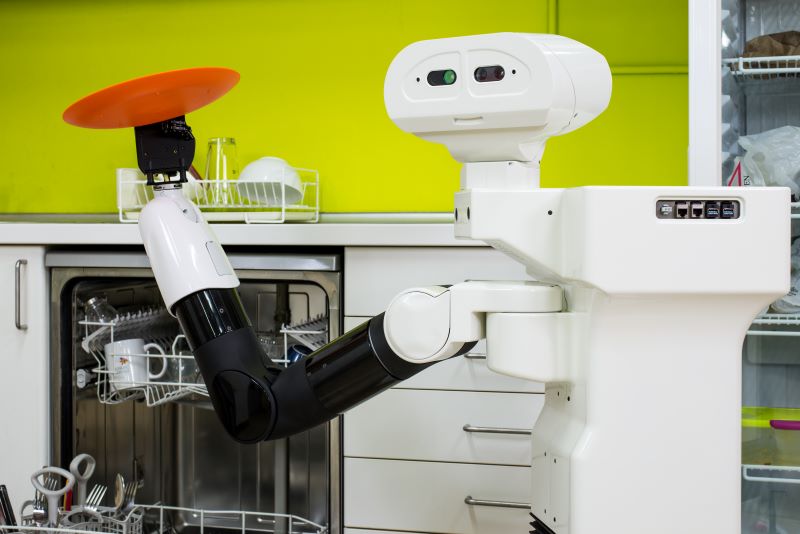
Across the globe populations are ageing, placing increasing pressure on healthcare systems. At the same time, many elderly individuals wish to maintain their independence and continue living at home for as long as possible. Assistive-care robots offer a promising solution. They can remind people to take medication, fetch objects, monitor safety, and provide step-by-step assistance with everyday tasks.
Unlike environments such as manufacturing, which are carefully controlled, homes are messy, unpredictable, and full of human activity. People move unpredictably, furniture gets rearranged, and objects appear in unexpected places. For robots to truly help, they must be able to adapt; continuously assessing risk, choosing safe paths, and adjusting their plans in real time.
Safe Navigation in Human-Centered Environments
In our work, Adaptive Planning for Assistive-care Robotic Missions, we address a deceptively simple question: how can a robot move from one place to another safely and efficiently?
This project began during the CfAA’s predecessor, the Assuring Autonomy International Programme, where the core research and experimental work were carried out. Since then, the work has been further developed and written up through the CfAA, culminating in the publication of this research.
Traditional robotic navigation systems focus primarily on efficiency; finding the shortest path between two points. However, in assistive-care settings safety is far more important than speed. For example, imagine a robot delivering pasta ingredients to the kitchen while a person is walking nearby. The shortest path might take the robot very close to the person, increasing the risk of collision. A slightly longer route may be much safer.
Our framework represents the home as a graph, a simple mathematical model made up of nodes and edges. Nodes represent locations in the environment (e.g., kitchen, bedroom), while edges represent possible paths between those locations. Each path has three properties: a) its distance, b) its level of risk, and c) the probability that the robot can successfully travel along it. This allows the robot to consider not only where it can go, but also how safe each route is likely to be.
For instance, a clear hallway might have a high probability of success, while a cluttered kitchen area may be riskier. A path close to a moving person might also temporarily become unsafe. By modelling the environment in this way, the robot can compare different routes and choose the one that best balances safety and efficiency.
One of the key innovations in our framework is a modified version of Dijkstra’s algorithm, a well-known method used to find the shortest path in a network. We extend this algorithm so that it can also identify the safest path, defined as the path with the highest probability of success. Interestingly, the safest path is not always the shortest. The robot therefore evaluates multiple options and selects the one that best supports the overall mission.
Beyond navigation, the framework also plans complete robotic missions involving several tasks across different locations of the environment. For example, a robot may need to collect ingredients, move between rooms, and assist the user while preparing a meal. The system determines the best order in which these tasks should be completed, balancing efficiency with safety.
To ensure reliability, the candidate navigation plans are analysed using probabilistic model checking, a formal verification technique. This method evaluates the likelihood that a robot will successfully complete its mission before the plan is executed, helping ensure that the robot behaves safely in uncertain environments.
Safety becomes even more complex when humans are involved. People may unexpectedly block paths or change direction. To address this, the framework includes a human predictive model that estimates where a person is likely to move and adjusts the risk levels of nearby paths. For example, if a person is expected to walk through the kitchen, routes through that area may be treated as riskier, encouraging the robot to choose an alternative path.
Importantly, the system does not rely on perfectly predicting human movement. The prediction is used mainly to improve efficiency and avoid unnecessary delays. If a person moves unexpectedly, the robot still relies on its onboard sensors and safety mechanisms to detect obstacles and prevent collisions in real time.
If the robot’s path becomes blocked, the system can also issue redirection requests, asking the person to reposition themselves (e.g., by saying “please move to the left” or “please wait on the right at a safe distance”). Such verbal prompts allow the robot to maintain safe distances and continue its task without physical intervention, following established principles of socially assistive robotics.
Evaluation in Real-World Settings
While these techniques enable safe planning in theory, it is important to evaluate how the framework performs in practice. To do so, we conducted both simulation experiments and real-world tests using a PAL Robotics TIAGo mobile robot operating in a home-like setting. The evaluation focused on scenarios inspired by everyday assistive tasks, such as supporting a user during simple meal preparation. In these scenarios, the robot needed to move between multiple locations in the environment, retrieve objects, and interact safely with a person sharing the same space.
The experiments tested the robot’s ability to plan safe navigation paths while completing multi-step missions involving several tasks distributed across different locations in the home. A key aspect of the evaluation was analysing how the system performs when human behaviour introduces different levels of uncertainty.
To study this, the experiments varied how predictable the human’s movement was. In some scenarios, the human followed a predictable path, allowing the robot to anticipate potential interactions more accurately. In others, the human’s movement was more uncertain or unpredictable, creating situations where the robot might encounter the person in unexpected areas of the environment. As the level of uncertainty increased, the planning problem became more challenging because certain paths became riskier.
The results showed that the framework was able to adapt its planning to these conditions. When human movement was predictable, the robot could select efficient routes while still maintaining safe operation. As uncertainty increased, the system favoured safer routes, even if they were longer, improving the probability of successfully completing the mission.
In situations where uncertainty became too high and no sufficiently safe path could be identified, the robot would avoid proceeding through a potentially dangerous route. Depending on the situation, it could first attempt to resolve the conflict by selecting an alternative path or by issuing a redirection request asking the person to move to a safer position. If no safe option was available, the robot would temporarily pause and wait until the situation became clearer, observing the human’s movement and re-planning once a safe path emerged.
In the real-world experiments with the TIAGo robot, the system successfully executed missions such as navigating between rooms, retrieving objects, and adapting its path when potential conflicts with a human were predicted. The robot maintained safe operation even when human behaviour did not exactly match the predicted model. The onboard sensors and safety mechanisms ensured collision avoidance, while the planning framework adjusted routes to minimise risk.
Impact and Future Work
Looking ahead, the potential impact of this research extends beyond assistive-care environments. The same adaptive planning framework could support robots working alongside people in a range of real-world settings, such as industrial workplaces where robots collaborate with human workers, or service roles in public spaces where safe navigation around people is essential.
Future work could expand testing to more complex scenarios, including environments with multiple robots and multiple humans interacting at the same time. This will help evaluate how well the approach scales and how reliably it performs under diverse real-world conditions.
Another promising direction is integrating machine learning techniques to further improve adaptability. For example, reinforcement learning could allow robots to learn better navigation strategies through experience in dynamic environments, while the existing planning framework maintains safety and reliability. Advances in deep learning may also enable more accurate prediction of human movements and intentions, helping robots respond more intelligently in uncertain situations. Over time, techniques such as transfer learning could allow the system to adapt to new environments with minimal retraining, making it easier to deploy across different applications.
Read the full paper in The International Journal of Robotics Research
Watch the ALMI video: