
Mapping safe maritime pilotage: Understanding complexity in maritime pilotage
Posted on Wednesday 4 February 2026
Remote pilotage in the maritime sector
There is growing research examining how technological systems can support maritime pilotage, including those that could enable the act of pilotage to be conducted remotely. This concept of pilotage could involve pilots using sensors and cameras on the ships themselves to gain the necessary information which could then be used to direct the navigation of ships when entering and manoeuvring in a mandatory pilotage area. However, the concept will changes how “work-is-done”, by reshaping interactions within the system and introducing new challenges that may, in some cases, increase risk.
Mitigating these risks requires science-based and objective decision support information for pilots’ organisations and authorities around the world. To that end, the CfAA is collaborating with the International Maritime Pilots’ Association (IMPA) on the first phase of the authoritative international study exploring and ground-truthing the concept of remote pilotage.
A maritime pilot boards a ship every 10 seconds somewhere in the world and for good reason. Maritime pilotage is a very effective public service, reducing navigation and environmental risk from ships significantly, and keeping cargo flowing efficiently around the world.”
Matthew Williams, Secretary General of the International Maritime Pilot's Association
How we are creating a pilotage “as is” model
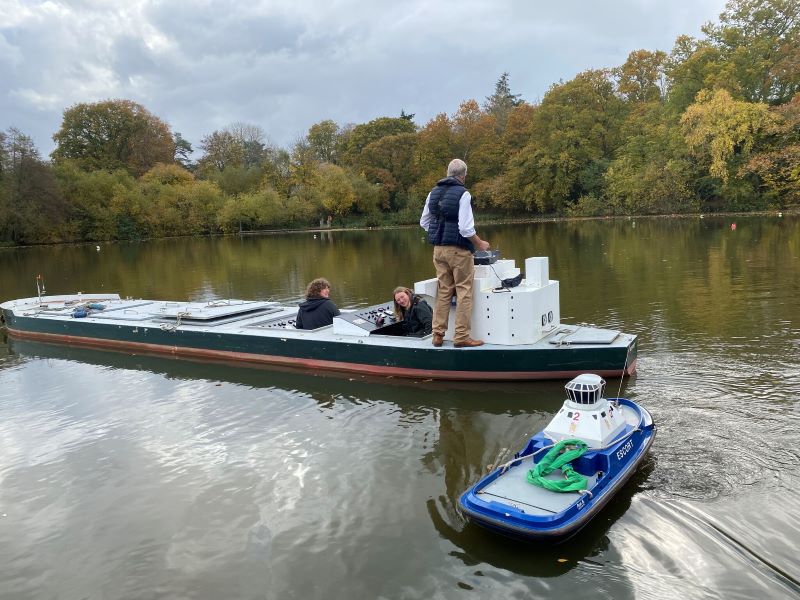
This starts by developing an “as is” model. To do this we are focusing on understanding the current sociotechnical interactions that occur during pilotage, and how this complexity contributes to systemic failures. This has been done through several concurrent approaches. Firstly, we looked at current documentation on the underlying processes involved with maritime pilotage. These documents were analysed using a work system model, which aims to highlight how different components within a system interact to produce outcomes (e.g. how people work within the physical environment or how external regulation influences how tasks are completed). This document review helped form an understanding of pilotage but may not fully represent the work system. To increase our understanding, we spoke to several fantastic pilots and visited Warsash Maritime School where we were able to experience the type of training pilots complete. A lucky few of us even had a shot in a scaled model! This provided us with a great foundation on which to build and we are continuing to speak with pilots to ensure our model accurately displays the interactions that occur before and during an act of pilotage.
What has our work revealed so far?
Work to develop the “as is” model is ongoing. However, we have already found some interesting results:
- Analysis of documentation highlighted that, during an act of pilotage, ship systems and equipment, including radar and electronic chart and information displays (ECDIS) aid the pilot in directing the navigation of the ship. Discussions with stakeholders highlighted potential challenges associated with variations in the type and layout of bridge equipment which vary depending on the ship.
- A key part of maritime pilotage is the master-pilot information exchange (MPX). This is a continuous process where the pilot and the master and bridge team exchange information to allow them to effectively discharge their respective responsibilities. The MPX starts with a structured briefing when the pilot first enters the bridge when essential information about the ship, the plan for the pilotage and any external factors that may influence the act of pilotage are shared. Both the analysis of the documentation and discussion highlighted several factors that can affect the MPX. These include the location of the pilot boarding area, ship navigation policies and procedures and approaches to bridge resource management. Another relates to ease of communication, where language barriers may slow and make exchanges more difficult.
- Other factors affecting the “as is model” include the effectiveness of pilotage regulations, the approach to training and certification of pilots, the existence of commercial pressures, and the management of fatigue, stress and incidents, particularly as pilot generally work alone.
What’s next for our collaboration?
Building this “as is” model has already revealed key interactions and challenges that occur during the act of pilotage. Work is ongoing and our analysis will continue to capture the full complexity of these interactions. For example, we want to understand the emergent risks associated with the maritime pilotage ‘as is’ model by applying the Safer Complex Systems (SCS) Framework, developed through the Lloyd’s Register Foundation Engineering X program. This will involve the analysis of accident reports and other information to develop a holistic understanding of the technology and human factors-related sources of risk within the wider management, operation, regulatory and governance contexts.
As Matthew Williams from IMPA says: “Understanding the causes of complexity in maritime pilotage is vital. We hope that this work will deliver a groundbreaking understanding of pilotage as a complex socio-technical system, and its sensitivity to changes in people, process and technology. We are very pleased that the team at the CfAA agreed to work with us on this”.
When completed, it is hoped the analysis will support in understanding how the introduction of remote pilotage may influence the interactions already seen within the work system, more on that soon!