

Does Vaping Increase the Risk of Dementia?
Project Outputs
Preliminary experiments are now underway, with early findings revealing the presence of several neurotoxic compounds in e-cigarette aerosols. These results reinforce our hypothesis and underscore the urgency of further investigation. As we expand our interdisciplinary approach, we remain committed to uncovering how chemicals present in e-cigarettes may silently shape neurological health across the lifespan.
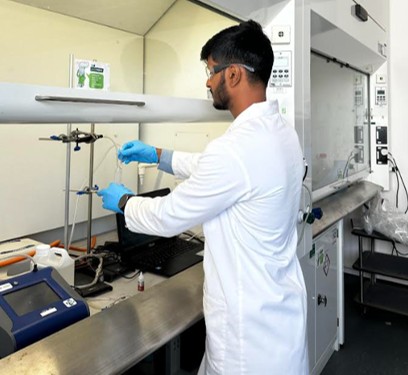
Pravardhan Hemanth Raj's Master’s Dissertation Project: E-Cigarette Characterization and Heavy Metal Analysis
Pravardhan’s interest in air pollution sparked his decision to explore the characterization of e-cigarettes for his MSc dissertation (2023–24), building on his broader curiosity about how analytical chemistry can be used to study environmental contaminants. The project was a strong fit, allowing him to combine his interest in pollutants with hands-on research.
Focusing on the analysis of heavy metals in e-cigarette aerosols and e-liquids, Pravardhan developed and refined methods to detect trace amounts of metals such as lead, cadmium, and nickel. He discovered that some devices exhibited higher levels of these metals than expected -findings with potential implications for both consumer health and future regulatory standards.
Beyond the academic impact, this work had personal and professional benefits: Pravardhan later wrote to say that the skills and experience gained through this project directly helped him secure a full-time role as a Laboratory Technician at IMERYS. This outcome is both a testament to the value of the research and a source of pride for all involved.

What we inhale doesn’t just affect our lungs - it may be shaping our brains in ways we’re only beginning to understand.
- Dr Darpan Das
Principal and Co-Investigators
Principal Investigator
Darpan Das (Dept of Environment and Geography)
Co-Investigators
Steven Quinn (School of Physics, Engineering and Technology)
Ines Hahn (Department of Biology)