
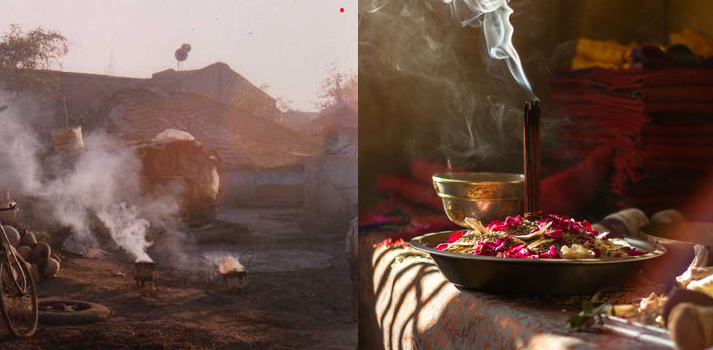
Air Quality in Homes of Global South
Context
Air pollution is the 4th leading health risk factor for early death worldwide. It is estimated that 1 in 8 deaths is due to air pollution, with death rates being highest in Global South (GS). Cities in the GS are amongst the most polluted cities in the world. While outdoor air quality in GS has been under focus for several decades now, the problem of indoor air quality (IAQ) gets frequently overlooked, in spite of the fact that humans spend the majority of their time indoors.
While there have been recent efforts towards developing recommendations for Europe, IAQ challenges in GS are quite distinct from those faced in the Global North and need dedicated attention (e.g. sources, building conditions, traditional practices).
Aims and Objectives
We have chosen Kolkata, an eastern Indian metropolitan city with 4.5 million population, suffering from high air pollution (13 times more than the WHO annual limit) (The Times of India aricle; Journal of Advanced Research in Medical Science & Technology article), as the study area for consultation aspect of the present project. Secondhand smoke is an important contributor to the deterioration of IAQ and Kolkata has been reported as the city with the highest number of smokers in the country (The Hindu article).
There are various diverse organisations in Kolkata and eastern India, who are our external partners - Research Institute (NEERI-Kolkata), Public Engineering and technology Institute (IIT (ISM) Dhanbad), Public Medical University (AIIMS-Kalyani), Private University (Adamas) and a grassroots level NGO (Climate Thinker).
In the present study, we will
(a) Conduct a literature review to identify the key sources influencing IAQ in India;
(b) Understand the key challenges associated with IAQ problems in India by organising multiple stakeholder engagement workshops
(c) Undergo participatory activity with vulnerable groups to quantify exposures and related health risks associated with IAQ in Indian homes.
While the present study is focussed in India, it is our aim to also invite multiple stakeholders from different cities of the GS, throughout the length of the study. If you are an organisation in the global south (particularly in South Asia or Africa) and are interested to be part of this/future projects, please complete this short enquiry form.
Project Outputs
Dr Darpan Das is attending the ‘Co-creating an Indoor Air Quality Study with Diverse Socio-Economic Groups of India’ event taking place on 7 August 2025, organised by Kolkata Zonal Centre of CSIR-NEER. He will give a keynote address at the brainstorming session titled "Indoor Air Quality, Human Health and Deployment of Low-Cost Sensors for Indoor Air Quality Monitoring: Indian Experience”, The event is part of the YESI Fellows network project funded by York Environmental Sustainability Institute (YESI) at the University of York, in collaboration with partners CSIR-NEERI, IIT ISM Dhanbad, Adamas University, AIIMS-Kalyani and The Climate Thinker.

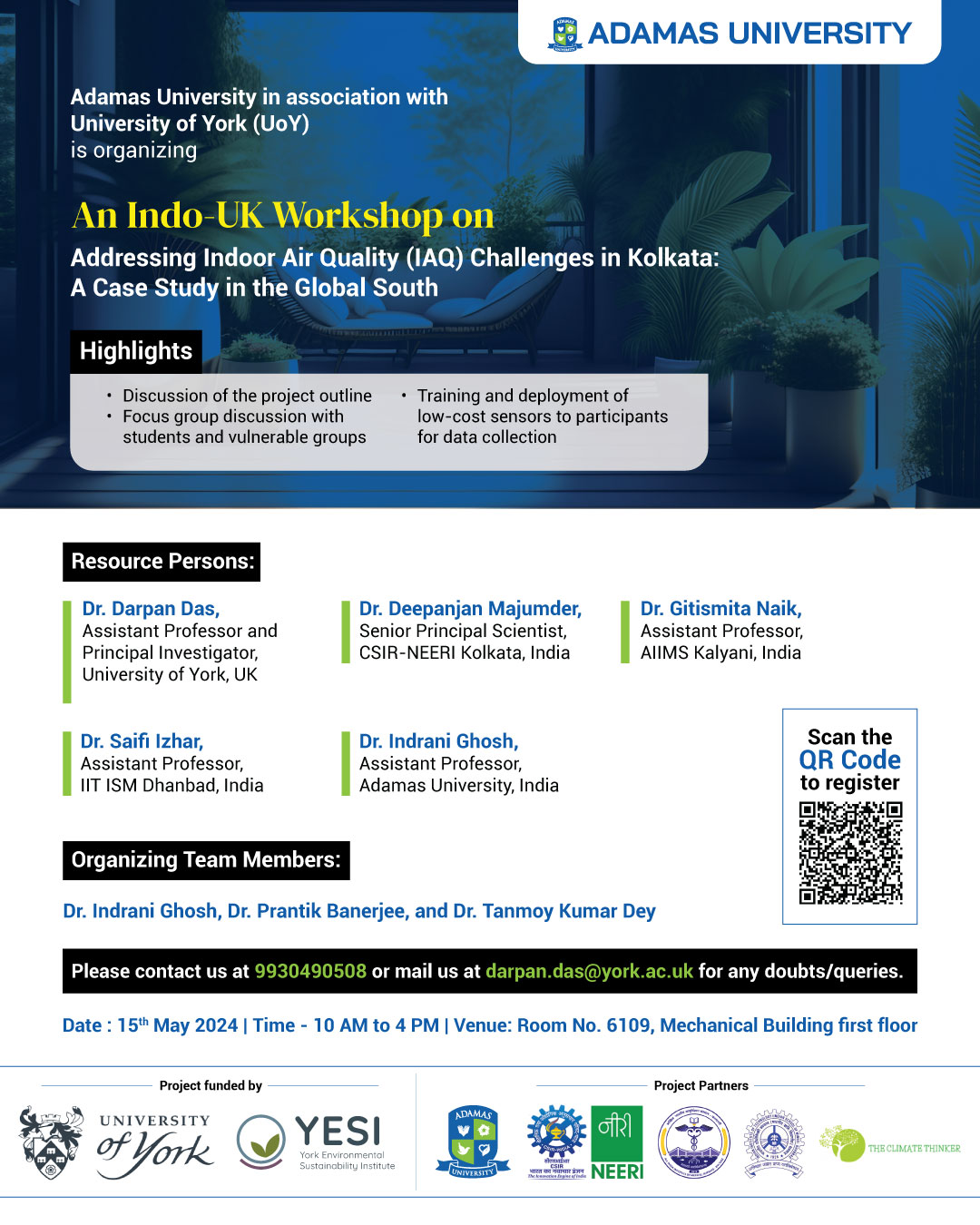
A film about these multiple stakeholder workshops addressing indoor air quality (IAQ) in Kolkata: a case study in the global south.

The YESI scheme was an extraordinary opportunity to start my research at UoY. Through this grant I established new relationships with partners in India for solving Indoor Air Quality (IAQ) problems.
- Dr Darpan Das
Project Partners


Principal and Co-Investigators
Principal Investigator
Dr Darpan Das, Department of Environment and Geography
Co-Investigators
Professor Nicola Carslaw, Department of Environment and Geography
Professor Kamran Siddiqi, Department of Health Sciences
External Partners
CSIR-NEERI (National Environmental Engineering Research Institute)
Indian Institute of Technology