
From Bradford to Belém
Posted on Tuesday 18 November 2025

Authors: Dr Kelli Kennedy and Dr Amy Barnes, University of York
Matching Local Evidence to Global Mandates
Week 1 at COP30 in Belém has been called to be the ‘truth COP’ and ‘implementation COP’, with calls for meaningful collaboration and two-way dialogue, particularly with local communities and indigenous peoples. Our recent co-produced project in Bradford shows that these are not just idyllic aspirations, but are the practical pre-conditions for successful climate action on the ground. What communities demand is precisely what global policy requires: valuing local knowledge with meaningful involvement to define climate priorities.
Community Voice for Policy Development
Bradford Council is developing its Climate Action Plan (CAP), aiming for an equitable transition. In partnership with Bradford Council, the Healthy Livelihoods team in the Department of Health Sciences at University of York, as part of their collaboration with the Bradford Health Determinants Research Collaboration, ran a co-production project to ‘evidence’ what communities want for climate action in Bradford. An innovation of the work was that the Council agreed to consider the evidence as part of the CAP creation process, giving a direct route to impact between communities and policymakers.
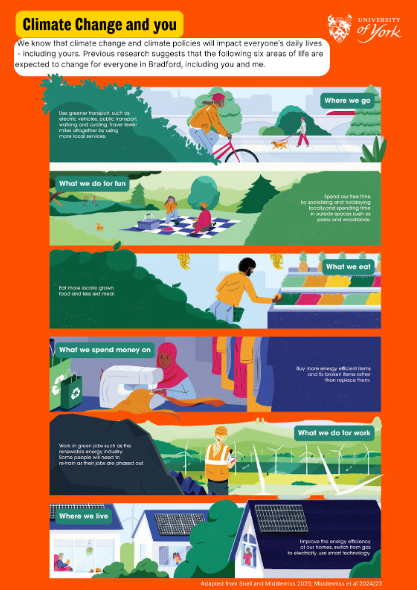
We adopted a Community-Based Participatory Research (CBPR) method, training six local residents as climate community researchers and running a three-part workshop series with 32 residents across two wards in Bradford - Bowling & Barkerend, and Tong. We deliberately reframed the discussion away from policies that felt ‘distant’ to people, and instead focused on the "Areas of Daily Life"—like where we go, what we eat, what we do for fun—to capture how climate issues truly impact residents (from the work of Middlemiss et al., 2023).
We supported the community researchers, with the resident participants, to co-produce two climate manifestos (covers shown below), highlighting each ward’s top four climate priorities. While Public Transportation, Families and Children and Schools and Education were shared priorities, Bowling & Barkerend also prioritised Housing, while Tong residents highlighted Community Safety as an important climate concern.
Throughout, participants acknowledged that it will take a collective, collaborative effort across sectors, actors and scales to make a just transition possible. For participants this included themselves, as well as private businesses, community groups, farmers, and schools amongst others, and government at all levels, from the local to the global.
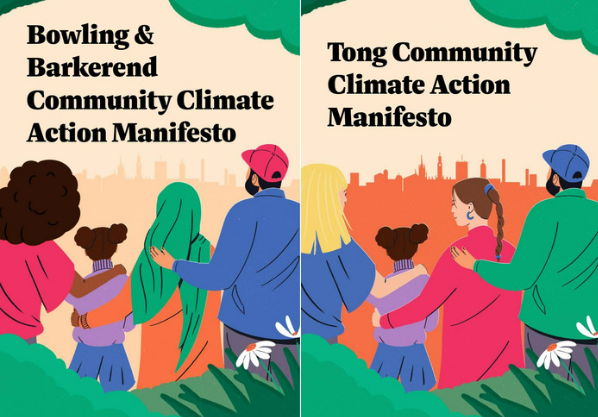
Check out the two manifestos and our full project report here
From Bradford to COP30: Actioning the Global Agenda
As researchers, we are watching COP30’s progression in Brazil. We are struck by the same lessons that we’re learning on the ground in Bradford as on the world’s stage: there is an urgency for local evidence and meaningful engagement with local communities, but this remains underdeveloped.
The global call for accelerated implementation and greater equity finds its blueprint in what we found in Bradford:
- Meaningful Collaboration is a Prerequisite: Our work in Bradford demonstrates that the greatest opportunity for policy buy-in lies in broadening the scope. Communities noted many actors need to be involved in the transition and these groups therefore need to be folded into climate dialogues: communities, police, Councils, public health officials, farmers, teachers and more. All these actors are essential partners in the climate transition, providing new avenues for genuine collaboration and approaches to difficult societal problems, such as community safety.
- Person-centric Dialogue Supports Engagement: Policy communication must lead with the immediate human benefit and effect—such as financial savings on energy bills or improved lighting and safety - and it is two-way dialogue that communities value, so that their evidence can demonstrably shape decision-making and action.
- Prioritising Social Pre-conditions: To deliver a truly Just Transition, policy must be based on community-defined socio-economic priorities, maximising the room for authentic engagement. Work in Bradford shows that valuing local knowledge is a key first step towards global success.
We would like to thank the residents, our community partners, climate community researchers, the Valuing Voices project, The York Policy Engine and the Bradford Health Determinants Research Collaboration (HDRC) for their collaboration.