Integrating museum records with contemporary citizen science data to uncover 166 years of tropical butterfly history
Posted on Wednesday 29 October 2025
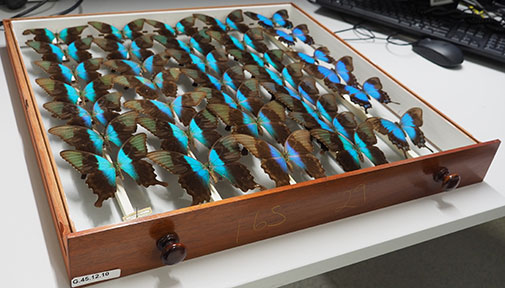
Dr Tiffany Ki, whose research focused on the swallowtail and satyrine butterflies, said the study was important in showing how museum collections can improve our understanding of long-term tropical biodiversity change.
Collaboration
The paper comes from Dr Ki’s PhD, which was based at the University of York in collaboration with the Natural History Museum, and which focused on the butterflies of Sulawesi (Indonesia).
One of the major outputs from the research was the construction of regional time series across 166 years (1857-2022), the longest tropical time series to date, through the integration of museum records with contemporary citizen science records.
The major findings from the research have now been published in the Proceedings of the Royal Society B.
Reshuffling
Rather than systematic declines in richness, Dr Ki and her team found evidence of reshuffling in community composition of all regions. Types of butterflies in different areas are shifting, some species are becoming more common, others are staying stable, and some are declining.
They also found that shorter-term directional changes (over a few decades) are not indicative of the long-term patterns, highlighting the difficulty for determining trends from short-term data and the importance of the kind of innovative approach that Dr Ki has taken.
Dr Ki said: “This work forms the basis for exciting fieldwork next summer, where with local collaborators, we will set-up a systematic monitoring design in two of the three regions studied and extend this unique time series to the present, allowing current and future biodiversity changes to be evaluated with over a century of historic data.”
Understand
Professor Colin Beale, one of the co-authors noted: “Using museum data to estimate trends over a 166 year time period allows us to understand biodiversity trends as never before. If there’s one lesson from this research I take away, it’s that biodiversity is always changing, but it is our choice to decide what sort of changes we want to see in the future.”
Dr Tiffany Ki studied in the University’s department of Biology and published her paper ‘Patterns of endemism in Sulawesi butterflies’ prior to her taking up a position in Cambridge.