New technology could open up gene therapies to more patients at less cost
Posted on Thursday 11 July 2024
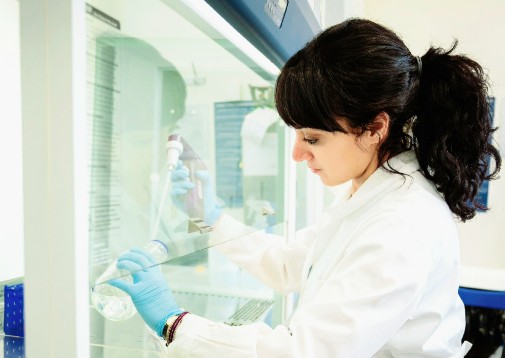
Dr Rasha Rezk and Professor David Kent, from the Centre for Blood Research at the University of York, have created the technology, which uses mechanical forces to help deliver gene modifying tools to the body’s cells. They are now scaling up the technology for clinical application through their new company, ForCell.
The new technology can open a cell through compression, in a similar way to how a french press plunger operates. This action temporarily opens the cell to deliver genetic information without damaging or altering the cell, as is the risk with current methods.
Currently the majority of gene therapy is administered by removing some cells from the body and correcting the genetic material using virus-based tools, before returning the cells to the patient. Such therapies already exist for a wide range of genetic disorders such as sickle cell disease and severe combined immunodeficiency (SCID) where genetic corrections can restore cell function.
Scientists use viruses as part of gene therapy methods because a virus has the ability to recognise the cell and is capable of delivering genetic information, but it can also activate the body’s immune system and poses a potential cancer-risk through integrating in the genome.
Dr Rezk said: “While there have been major advances on the cell biology side of gene therapies, the engineering side has been stuck with decades-old technologies, and the cost has become a significant issue, standing at around £1 million per dose in many cases.
“Our new company leverages mechanical forces to improve delivery and offers the potential to be completely virus-free while also bringing down costs considerably.”
Spinout potential
Dr Rezk presented her new technology at Creative Destruction Lab (CDL) in Toronto, which provides startups with access to business development support and funding from leading firms. She has also since been awarded a Royal Academy of Engineering Enterprise Fellowship, a twelve-month programme to support researchers transform engineering innovations into spinout companies.
Dr Rezk said: “We want to improve the clinical outcomes, whilst at the same time reducing the cost. Mechanically opening up the cell gives us the opportunity to do so in a routine way, and in a way that does not alter the cell identity.
“Our technology will provide an unprecedented opportunity to deliver gene-modifying tools in a safer and more economical fashion. The ability to adjust the application of forces on the cell also allows us to respond to different cell types and drugs.”
Scaling-up
The team has demonstrated that the technology works with a small number of cells in the laboratory, and the next stage of work is to scale it up so that millions of cells can be worked on using the same method, making it more affordable for health services and increasing the success rate of gene therapy for the patient.
More information about ForCell can be found on the website: https://forcell.co/.