Mediterranean hunter-gatherers relied on marine resources more than previously thought
Posted on Wednesday 22 February 2023
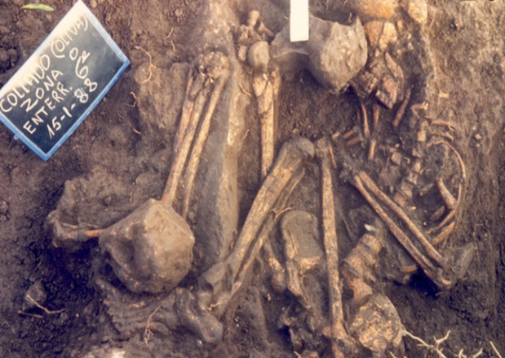
Led by the University of York’s BioArCh Centre, the study analysed the bones of 11 human individuals from one of the oldest Mesolithic cemeteries in the Mediterranean, at El Collado, Valencia, Spain.
The research revealed that the individuals, who lived around 9,500 and 8,500 years ago, had a strong coastal economy which included a considerable amount of marine life in their diet, including brackish fish and shellfish.
The study, led by Dr Maria Fontanals-Coll, from the University of York’s Department of Archaeology, looked at the origin of fishing in Mediterranean prehistory. Previously, it has been assumed that the Mediterranean Sea, due to its lower biological productivity, was incapable of supporting fishing economies during the Mesolithic period, similar to those in other parts of Europe, such as the Atlantic and Baltic.
Challenging
Dr Fontanals-Coll, said: “Our findings challenge the traditional view of Mediterranean prehistoric hunter-gatherers consuming fewer fish than their Atlantic counterparts.
“The evidence presented shows that the lower productivity in the Mediterranean basin didn’t have a major impact on the harvestable resources that constituted the diet of El Collado individuals.
“The extent to which humans relied on coastal resources in the past, is key to understanding not only long-term social and economic development, but also to assessing human health and the impact that humans had on the environment.
“These findings have implications for understanding how farming, which swept through the Mediterranean in the following Neolithic period, took hold.”
Modern populations
Professor Oliver Craig, Director of BioArCh at the University of York, said: “This study is part of a new wave of isotopic analyses conducted on single compounds that are challenging and changing our understanding of ancient human diet, allowing us to compare with modern populations, where the nutritional and health implications are already well explored.”
The study was funded by the European project Marie Skłodowska-Curie NEOMEDIS, in collaboration with the Spanish National Research Council (CSIC), the Universitat Autònoma de Barcelona and Sapienza University of Rome.
Human societies
André Colonese, researcher from the Universitat Autònoma de Barcelona, said: “This study adds to the growing consensus that coastal areas were crucial to human societies since prehistoric times. The foundations of coastal fisheries in the Mediterranean can be traced back to these early fishers, and the results of this paper strongly support such an argument”.
The new research uses high-resolution biomolecular techniques, like compound-specific isotope analysis of individual collagen amino acids (CSIA-AA), which allows greater accuracy in discriminating between land animals and marine life, crucial when assessing the degree of dietary change associated with the introduction of domesticated plants and animals in farming.


.jpg)