Deprived communities in England experience higher emissions of air pollution
Posted on Tuesday 22 August 2023
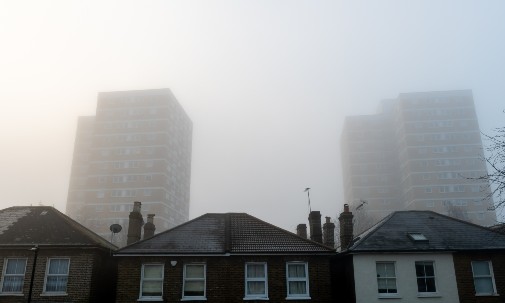
A team of scientists, from the University of York and the National Centre for Atmospheric Science, compared emissions of nitrogen oxides, also known as NOx, in England with data from the Index of Multiple Deprivation (IMD).
NOx are a class of air pollutants known to be harmful to human health, and the IMD is an index used by the UK Government to quantify deprivation across England.
A combination of factors such as income, employment, education, health, crime, barriers to housing and services, and living environment all contribute to the level of deprivation that a person or a place faces.
Health risk
While at a national level air pollution continues to reduce, poor air quality is still the greatest environmental risk to human health, and relates closely to where people live, study and work.
New research has revealed that, across England, people in the most deprived groups of society typically live in locations with the highest emissions of air pollution.
Dr Sarah Moller, from the University of York’s Department of Chemistry and National Centre for Atmospheric Science, said: “The inequalities in the distribution of emissions are particularly significant for nitrogen oxides. People experiencing the highest levels of deprivation often live closest to major roads, and in areas of high housing density. Densely populated areas expose residents to pollutants created by combustion from heating.”
All major sources
Deprivation-based inequality was found across all major NOx emission sources, such as transport, domestic and commercial heating, factories and power plants. This shows that sources of NOx, beyond road transport, are also important drivers of air pollution inequality.
Nathan Gray, the PhD researcher at the Wolfson Atmospheric Chemistry Laboratories at the University of York who carried out this research, said: “It is often assumed that people living in cities will be exposed to the highest levels of air pollution.
“Our research shows that while the difference in air pollution between the city and the countryside does drive inequalities, those in more deprived areas will likely have worse air quality regardless of whether they live in the city or more rural areas.”
Future policies
The UK’s air pollution in the coming few decades will be different to the recent or distant past – and it will change as energy supplies and transport systems are decarbonised, lifestyles and working practices evolve, and as new materials, products and processes are adopted.
Researchers hope that better understanding of NOx emissions across England will have important implications for future UK Government policies aimed at reducing inequalities in air pollution.
Dr Moller said: “Inequalities will persist in the future. Location plays such a large part in determining what emissions people are exposed to, and it is not yet clear how future policy will impact the level of inequality.”
Transport emissions
NOx emissions from road transport, the current largest single source of NOx emissions in most areas, are likely to reduce over time as the use of electric vehicles increases. However, this new research shows that inequalities in air pollution will continue despite a reduction in road transport emissions.
As inequalities are driven by the uneven distribution of emissions from a number of sources, future policies should recognise that reducing national vehicle emissions is not the only solution to reducing overall inequalities in air pollution.
Region-specific
Dr Moller said: “Some changes should be beneficial, such as reducing nitrogen dioxide concentrations from road vehicles. The future impact of other measures is less certain, for example choices around decarbonisation of domestic heating.
“Decarbonisation of domestic heating will impact inequalities in exposure – but whether this improves the situation or makes it worse will depend on which technology is chosen, and whether any emissions from alternative fuels are managed effectively.”
The research team suggests that region-specific emissions reduction strategies will be important in determining future emissions inequality, and that policies that focus on a range of emissions sources - not just road transport - need to consider their impact on that inequality.