School children support future conservation of red squirrels
Posted on Thursday 19 January 2023
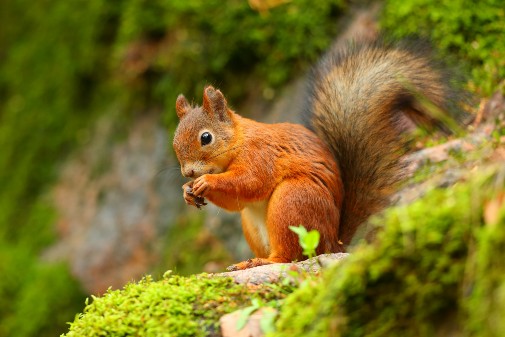
Through a new initiative at the University of York to engage young people and their teachers with real-world research, primary school children are helping experts investigate the biodiversity of red squirrel populations and the factors affecting squirrel anatomy, including their diet
Kim Chandler, PhD student from the Hull York Medical School at the University of York, said: “Children in primary schools across the country are getting involved by collecting squirrel food such as acorns, hazelnuts, and pine cones, from their local area and sending it to me to analyse.
Research
“My previous research identified that the changes in bite strength of some squirrels could have been brought about by their softer diets, reducing their ability to gnaw through the tough-to-crack nuts they eat naturally. So this new project is helping to determine what exactly the squirrels are eating.
“It's quite likely that these changes are responses to the softer diet of peanuts, which are likely to have occurred within the squirrel’s lifetime. To establish this, working with schools, I have been conducting research into the mechanical properties of different foods that squirrels eat.”
Conservation
The project, funded by the Royal Society, aims to give a better appreciation of the conservation strategies currently being enacted to preserve red squirrels in Great Britain and the important role the public can play in supporting these efforts.
Dr Philip Cox, PhD supervisor on the project from University College London, said: “Working with schools has been fantastic, introducing the ideas of conservation, extinction, and invasive species in the context of red squirrels. We hope that students will gain a greater understanding of the factors affecting species that are local to them, hopefully encouraging a lifelong interest in their local environment and science.”
Participating schools received a grant of up to £3k, to spend on equipment and consumables to help with the project, including camera traps or a 3D printer to allow other practical work beyond this project.
Aspirations
Sharon Pascoe, Head Teacher of a participating school in Wales, said: “Our ambitious and capable mini scientists at Fochriw Primary School are thoroughly engaged and enthusiastic about the squirrel project!
“It's more than a one-off learning experience for us with plans in place for sustainability of the STEM project. To work with the University, scientists and STEM Ambassadors is an excellent authentic learning opportunity.
“It broadens the horizons for our pupils and raises aspirations in an area of high deprivation. It's developed the pupils' scientific knowledge, understanding and skills. It's squirreltastic!”