Earliest art in British Isles discovered in Jersey
Posted on Wednesday 19 August 2020
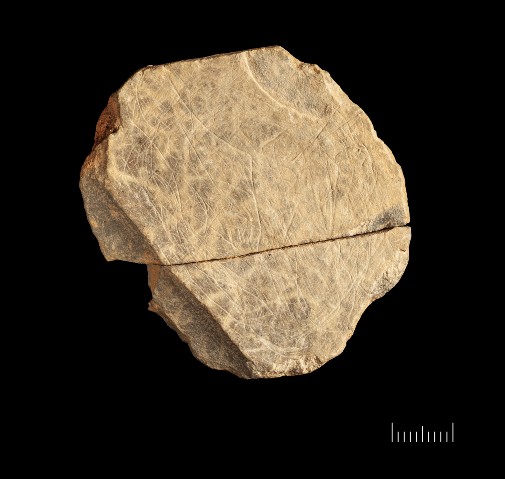
A team of archaeologists analysed ancient markings made on a group of flat stones, uncovered at Les Varines, Jersey, and believe they date from the late ice age – representing the earliest evidence of artistic expression discovered in the British Isles.
Between 2014 and 2018, ten fragments of the stones, known as plaquettes, were discovered extensively engraved with abstract designs. Since then, a team of archaeologists, involving researchers at the University of York, Newcastle University and the Natural History Museum, have been analysing the prehistoric etchings.
Hunter gatherer culture
The plaquettes are likely to have been made by the Magdalenians, an early hunter gatherer culture dating from between 23,000 and 14,000 years ago, the researchers say.
The Magdalenian era saw a flourishing of early art, from cave art and the decoration of tools and weapons to the engraving of stones and bones.
Examples of etched Magdalenian plaquettes have previously been discovered at sites in France, Spain and Portugal. Although Magdalenian settlements are known to have existed as far north-west as Britain, the engraved fragments represent the first evidence of artistic expression found in the British Isles and Ireland, seemingly predating cave art and engraved bone found previously at Creswell Crags, Derbyshire.
Exciting discovery
Dr Andy Needham, from the Department of Archaeology at the University of York, said: "This is an exciting discovery, not only for its geographical location, which extends the known range of plaquettes, but also for their discovery during a highly controlled excavation, providing a huge depth of contextual insight to support the understanding and interpretation of these important objects.
“The discovery raises the fascinating question of why we are not seeing plaquettes during the Magdalenian in locations further to the north and west, such as England or Wales, given their importance at Les Varines, which is geographically so close by."
The research and excavation team, which also included experts from the universities of St. Andrew’s, Strathclyde, Liverpool, Wales, as well as UCL Institute of Archaeology and the British Museum analysed the stones for traces of how the markings were made.
The analysis revealed that the plaquettes are engraved with groups of fine lines, thought to have been purposefully made using stone tools. The geometric designs are made up of a combination of straight lines more or less parallel to each other and longer, curved incisions. The research team say that the two types of marks are likely to have been produced using the same tools, possibly by the same engraver and in short succession, giving new insight into the processes used to create the ancient designs.
Rare evidence
Dr Chantal Conneller, Senior Lecturer, Newcastle University, said: “These engraved stone fragments provide exciting and rare evidence of artistic expression at what was the farthest edge of the Magdalenian world.”
The designs were only briefly viewed by their makers. Engraving soft stone creates a powder within the incisions that makes them visible. This swiftly disperses, meaning that the engravings are only clear at the moment of their making. “In this context, the act or moment of engraving, was more meaningful than the object itself.”
Dr Silvia Bello, Researcher at the Natural History Museum, London, added: “Microscopic analysis indicates that many of the lines, including the curved, concentric designs, appear to have been made through layered or repeated incisions, suggesting that it is unlikely that they resulted from the stones being used for a functional purpose. The majority of the designs are purely abstract, but others could depict basic forms such as animals, landscapes or people. This strongly suggests that the plaquettes at Les Varines were engraved for purposeful artistic decoration.”
The stones discovered at Les Varines, in the south east of Jersey, were found in an area thought to have been used as a hearth. Three of the fragments had been recovered from an area of granite slabs which may have served as paving, highlighting that the plaquettes were engraved in a domestic context.
Further information
Department of Archaeology Staff from the University of York were involved in this research. Dr Aimée Little analysed the plaquettes using microwear analysis to try to identify manufacturing traces, including surface preparation and potential colourants within engraved lines and Dr Andy Needham provided wider contextual insight into Magdalenian art and supported interpretation of the engraved surfaces to see if particular patterns or designs could be discerned.