Letters reveal Charles Dickens tried to place his wife in an asylum
Posted on Wednesday 20 February 2019
Until now, most accounts of the break-up of Dickens’s marriage in 1858 have given his side of the story.
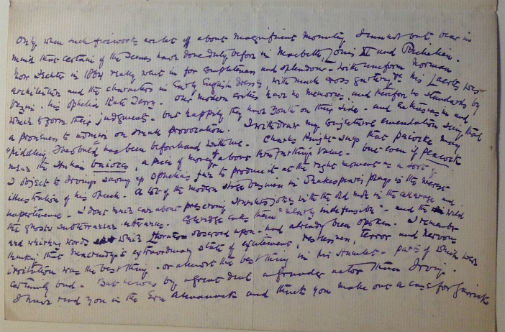
However, a new cache of letters unearthed and analysed by a University of York professor tells it for the first time from the point of view of his abandoned wife.
Enormous importance
The letters reveal Dickens’s attempts to have his wife incarcerated failed after a doctor found there was no evidence that Catherine suffered from a mental disorder.
The 98 letters are held at Harvard University.
Professor John Bowen, from the University of York’s Department of English and Related Literature, was given access to the letters and was the first to recognise their enormous importance.
“Biographers and scholars have known for years how badly Dickens behaved at this time, but it now seems that he even tried to bend the law to place his wife and the mother of his children in a lunatic asylum, despite her evident sanity.”
“What I discovered was both detailed and shocking, and to my knowledge, I was the first academic to transcribe and analyse these letters. It was a moment that made the hairs on the back of my neck stand up.”
The accusation comes in a letter from Edward Dutton Cook, Catherine’s next-door neighbour in Camden, north London, where she lived after her separation from Dickens. The letters were sent from Cook to his friend and fellow journalist William Moy Thomas.
Cook was already a friend of Dickens’s eldest son Charley, and he and his wife Lynda made a close friendship with Catherine. As Catherine was dying, she told them more and more about how Dickens had behaved 20 years earlier, after he met the young actress Ellen Ternan and decided to break up their long, hitherto happy marriage.
Detailed information
The letters give a convincing account of the break-up of the marriage, evidently directly from Catherine herself, an account that is full of detailed information about Dickens, Catherine and Ternan.
The crucial revelation comes in a letter from January 1879. Catherine was then very ill, taking twice-daily morphine injections to reduce her pain, and sometime around the New Year had evidently poured her heart out to Edward, Lynda, or both.
Cook writes: ‘He discovered at last that she had outgrown his liking. She had borne ten children and had lost many of her good looks, was growing old, in fact. He even tried to shut her up in a lunatic asylum, poor thing! But bad as the law is in regard to proof of insanity he could not quite wrest it to his purpose.’
Professor Bowen added: “We already knew of the existence of a letter in which Dickens said that his wife suffered from a mental disorder. People had wondered before if he was just suggesting that or trying to frighten her, but these new letters clinch it.
“Here we have it pretty much from the horse’s mouth. Most accounts of the break-up of the marriage are from his side, whereas this one is from hers.”
The letters also allowed Professor Bowen to name the likely candidate for the doctor who stood up to Dickens: Dr Thomas Harrington Tuke, superintendent of Manor House Asylum in Chiswick between 1849 and 1888.
Tuke was well known to Dickens, who exchanged several letters with him and was a guest at the christening of his son, but the friendship evidently cooled. By 1864, Dickens was calling him a “wretched Being” and a “Medical Donkey”.
Uncomfortable reading
“Something had clearly happened that caused Tuke, with whom Dickens had been on such friendly terms only a few years earlier, to be vilified in such a way; and it seems likely that it was his refusal to help in the plot against Catherine,” Professor Bowen added.
“Reading the material was quite difficult to be honest. Dickens is a literary great who I have studied and admired for many years but some of the letters made very uncomfortable reading.
“One of the positive stories to emerge was the behaviour of Tuke who had the courage to stand up to Dickens and say no, your wife is not insane.
“In some ways it is a ‘me too’ story about the power of elite men to coerce women. It is also a gaslighting story, manipulating someone into doubting their own sanity. And it is also a story about professionals standing up against the rich and powerful.”