
York mathematician wins prestigious international award for quantum foundations
Posted on Friday 21 November 2025
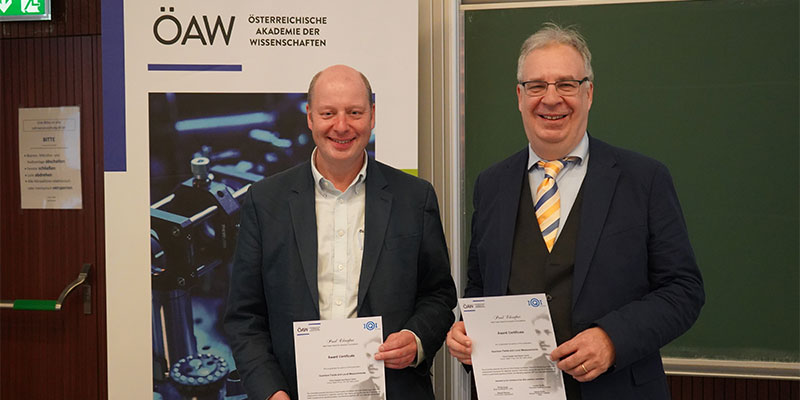
Professor Chris Fewster has won a top international prize for a paper that makes a "landmark contribution" to quantum physics.
Professor Fewster and his co-author, Professor Rainer Verch (University of Leipzig), were awarded the Paul Ehrenfest Best Paper Award for Quantum Foundations for the Year 2024. The academics received their award at a prize ceremony in Vienna on October 28, 2025.
The award, presented by the Institute for Quantum Optics and Quantum Information (IQOQI) Vienna, recognises outstanding and influential research contributions to the foundations of quantum physics.
The prize was given for their 2020 paper, Quantum Fields and Local Measurements, published in the journal Communications in Mathematical Physics.
The work provides a new, solid framework for understanding how measurements work in the context of relativistic quantum theory – a field that combines Einstein's theory of relativity with the counter-intuitive principles of quantum mechanics.
According to the award citation, the paper was recognised "in recognition of its landmark contribution to the foundations of relativistic quantum theory."
Professor Fewster, from the Department of Mathematics at the University of York, said: "I am honoured to receive the Paul Ehrenfest Award alongside my colleague, Rainer Verch. For decades, there was no theoretical description of measurements in relativistic quantum theory that was fully consistent with relativity. We sought to create a consistent framework that describes how local measurements work without violating fundamental principles, like the impossibility of sending signals faster than the speed of light.
“It’s really rewarding to see this work recognised by our peers as a significant step forward in understanding the foundations of our physical world."
The award citation also noted that the framework developed by Fewster and Verch "provides a solution to the superluminal signalling problem," a long-standing theoretical paradox where certain apparently reasonable quantum measurements appeared to allow for information to travel faster than the speed of light.
Their work resolves this issue by providing a practical and realistic way to describe the act of measurement. This brings the highly complex, abstract theory significantly closer to the more familiar, well-understood rules of standard quantum mechanics taught in textbooks, making it a much more useful tool for physicists.