
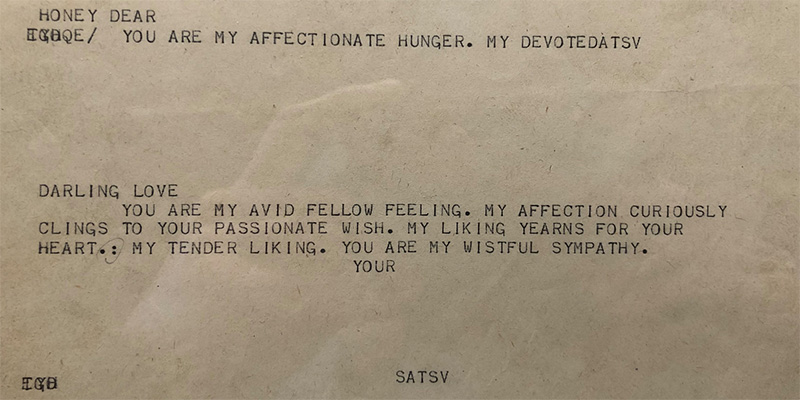
"YOU ARE MY WISTFUL SYMPATHY": Strachey, Turing, and (queer?) computer love
D/N/056, Derwent College, Campus West, University of York (Map)
Event details
Alan Turing is remembered for a great many things, including his persecution at the hands of a homophobic state and untimely death. He is less known outside history of computing circles for his contributions to early programming.
In this talk, I will discuss a programme written for Turing’s Mark 1 at Manchester by another gay man, Christopher Strachey, which used new machine capabilities to randomly generate love letters. After contextualising both men I will present and discuss this artefact from a variety of perspectives. It can be seen as a very early example of computer art, stochastic literature, programming novelty, and anti-heteronormative expression. And, yes, inevitably, as a precursor to modern natural language processing and AI.
Join me as I bring together all these things in an attempt to unite arts and humanities, science and innovation, and LGBT+ history—almost on Turing’s birthday!
Attendance
We will be hosting this event both in-person and online. Our venue, D/N/056, has space for 60 in-person attendees, and many more spaces online if you're joining via Zoom. Drinks and Canapés will be available after the lecture.
About the speaker
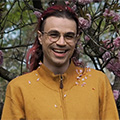
Dr Troy Kaighin Astarte
Troy Kaighin Astarte is a senior lecturer in computer science at Swansea University. After an undergraduate degree in computer science at Newcastle University, they completed a PhD on the history of programming language semantics in 2019. Their research work since has considered the history of computer science, and their future work studies the language of discourse of computer science from a historical and pedagogical perspective.
Troy is interested in using history to improve the diversity of computing and maths education and training graduates to be more socially aware. They are the editor-in-chief of IEEE Annals of the History of Computing.