
Model Discovery Engines & The C-SPIRIT Platform
To unlock the fundamental evolutionary rules of plant specialised metabolism, we must dissect the molecular laws governing chemical cyclisation, backbone decoration, intracellular transport, and ecological function. We utilise the petty spurge, Euphorbia peplus, as a compact, diploid model system to elucidate the biosynthesis of highly complex, polycyclic macrocyclic diterpenoids.
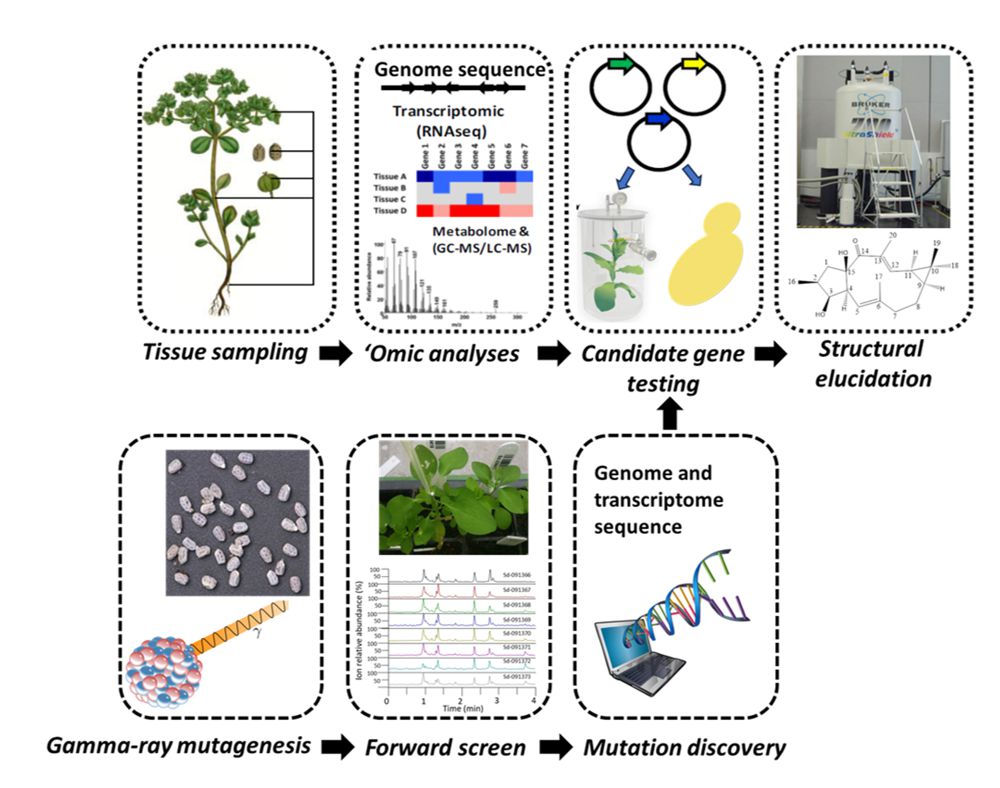
Building upon these peer-reviewed foundations, our E. peplus genomics platform now serves as a primary gene-discovery engine for C-SPIRIT (Center for Sustainable Plant Innovation and Resilience through International Teamwork). Supported by an international network of funding bodies including the NSF, UKRI, NSERC, SSHRC, NRF, and JST, this global consortium deploys our model-system insights to develop next-generation crop security solutions.
Our ongoing research within the international C-SPIRIT framework focuses on two high-level strategic tracks:
- Functional Elucidation of Defensive Traits: We leverage our forward-genetics and mutagenesis pipelines in E. peplus to link specific genomic architectures to defensive phenotypes. By investigating how specific macrocyclic diterpenoids alter plant-herbivore interactions, we aim to map the evolutionarily conserved mechanisms of natural chemical defence against widespread agricultural pests.
- Precursor-Optimised Expression Platforms: To translate these structural discoveries into scalable industrial and agricultural applications, our general approach involves moving candidate pathways into optimised heterologous hosts. We are developing versatile, cross-species biomanufacturing toolkits by engineering both plant (Nicotiana benthamiana) and microbial (Saccharomyces cerevisiae) expression platforms designed to bypass native metabolic bottlenecks and maximise target molecule yields.
These foundational expression systems provide a versatile, cross-species bio-manufacturing toolkit ready to scale up candidate antifeedant and antifungal diterpenoids, protecting vital global food security crops against widespread agricultural pests.
Publications
- Czechowski, T., Forestier, E., Swamidatta, S., Gilday, A.D., Cording, A., Larson, T.R., Harvey, D., Li, Y., He, Z., King, A.J., Brown, G.D., Graham, I.A. (2022). Gene discovery and virus induced gene silencing reveal branched pathways to major classes of bioactive diterpenoids in Euphorbia peplus. Proceedings of the National Academy of Sciences USA, 119: e2203890119.
- Czechowski, T., Li, Y., Gilday, A.D., Harvey, D., Swamidatta, S.H., Lichman, B.R., Ward, J.L., Graham, I.A. (2025). Evolution of linear triterpenoid biosynthesis within the Euphorbia plant genus. Nature Communications, 16: 5602, doi: 10.1038/s41467-025-60708-2.

Ian Graham
Professor Ian Graham is the Principal Investigator, focusing on the genomic architecture and metabolic pathway discovery of high-value plant molecules.

Tomasz Czechowski
Dr Tomasz Czechowski is a Senior Postdoctoral Researcher leading the experimental execution and multi-omics analysis for this research programme.