
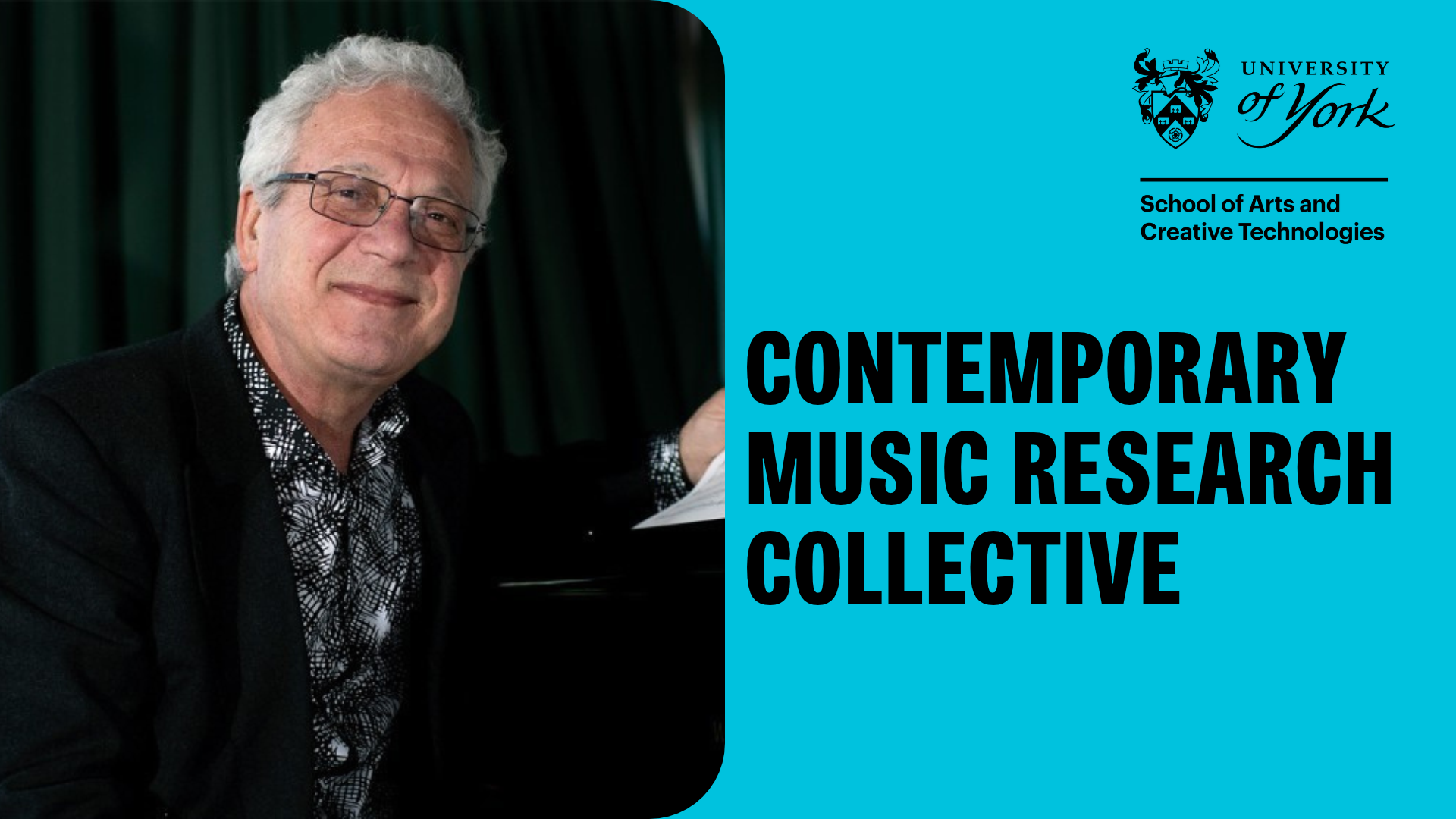
Atomistic Compression in a Static Modulation - Thomas Simaku
RCH/006, Ron Cooke Hub, Campus East, University of York (Map)
Event details
ALL WELCOME
An important characteristic of my musical language is putting together elements from disparate musical cultures, with particular emphasis on the music of the Balkans. Often, complex chordal structures or multi-layered textural formats are reduced to just one single note which becomes a kind of ‘atomistic compression’ with a magnetic quality, as it were, around which various colouristic elements orbit freely!
This drone-based type of linearity is a salient characteristic of the ancient musical aura of the Balkans, and I’ve been interested in it and the resulting heterophonic textures for some time now. This began in 1982 when I worked as music director in a remote town in Southern Albania, right at the border with Greece, and the first-hand experience I had there, working with some amazingly virtuoso folk musicians for three years, has had a lasting effect in my own music, which continues to this day. It was very interesting to read Ligeti’s comments in an interview with Stefan Niculescu published in the Romanian magazine Revista Muzica in 1993, where he said that “These types of drones, the origin of long and sustained sound that supports melismatic melodies can be found on a large scale especially in Southern Albania….” The deep historical roots and unique artistic value of Albanian folk Iso-Polyphony is recognised by UNESCO and was included on the Representative List of the Intangible Cultural Heritage of Humanity in 2005. My latest piece, "Atomistic Compression - String Quartet No 6" is a good example: Developed over several years now, a compositional device called ‘static modulation’ is central to obtaining seamless movement between harmonic fields. Particularly in this composition, with tonal centres prominently featured as pillars that hold together the entire sonic edifice, ‘static modulation’ allows for imperceptible shifts between harmonic areas sharing the same tone. The harmony itself features idiosyncratic formations where certain resonances of triadic tonality coexist with modal and chromatic constituents.
https://yorkconcerts.co.uk/whats-on/2026-27/quatuor-diotima-at-30/
Another example is "Soliloquy V - Flauto Acerbo" for recorders, which won the BASCA Award. This piece is primarily influenced by the virtuosity of folk musicians I experienced when I worked for three years in a remote town in Southern Albania, but there are no direct quotations from folk music here, or in other works of my mine for that matter! This piece is for recorders, whose sound is not unlike a folk instrument called fyell - typical in the Southern Albania. https://www.youtube.com/watch?v=rZzldS0tEFw
Can't join the event in person? See the event online instead.
About the speaker
Thomas Simaku is Professor of Composition at the University of York. His music has been reaching audiences all over Europe and the USA for many years, and it has been awarded a host of accolades for its expressive qualities and its unique blend of intensity and modernism.Winner of a number of prestigious awards such as Serocki International Prize and Lutoslawski Award, a three-year fellowship from the Arts & Humanities Research Council, Leverhulme Fellowship, DAAD Award at the ‘Hanns Eisler’ Academy in Berlin, University of York Anniversary Lectureship Award, Honourable Award from the Accademia di Lettere, Arti e Scienze in Rome and Honourable Mention at the Musical Personalities International Competition - Alexander Tansman. His CD portrait was released in 2008 on Naxos 21st Century Classics series and has received much critical acclaim. It reached the Best of Year list in the USA, as announced by the prestigious America Magazine Fanfare.
Thomas Simaku was the winner of the 2009 British Composer Award from BASCA (British Academy of Songwriters, Composers & Authors) with his work Soliloquy V – Flauto Acerbo. The judging panel ‘unanimously agreed that the winning work redefines the instrument in a visionary and entirely original way. They praised it for its virtuosity, depth of expression, and powerful imagination.'
Notable performances include those given by the Arditti Quartet, Kreutzer Quartet, Diotima Quatuor, English Northern Philharmonia, European Union Chamber Orchestra, Polish Radio Chamber Orchestra, Slovenian Radio-Television Orchestra, Amsterdam New Music Ensemble, Goldberg Ensemble, Tokyo Phonosphere Musicale, Copenhagen Sinfonietta, Insomnio Ensemble, Capricorn, Norwegian Medieval Trio, New Music Players, Concorde, and Austrian 'Ticom' Ensemble. Internationally renowned soloists such as Peter Sheppard Skaerved, Rohan de Saram, Neil Heyde, Garth Knox, Noriko Kawai, Ian Pace, Carlos Galvez, Sarah Leonard, Sarah Watts, Joseph Houston et al. have performed his solo pieces. Recently, his Klang Inventions was performed by Klngforum Wien.
Simaku's works have been performed throughout Europe, as well as in North America and the Far East, in festivals such as the ISCM World Music Days (‘95, ’99, ‘00, ‘01, ‘03, ‘04, ’05, ‘06 and '12), Huddersfield, Tanglewood, Avignon, Miami, Zagreb Biennale, Birmingham, Munich, Rome, Cagliari, Cologne, Weimar, Prague, Odense (Denmark), KlangSpectrum (Austria), Viitassari (Finland), etc. Broadcasts of his music include those by BBC Radio 3, Radio-France, ORF (Austria), SWR2 (Stuttgart), Deutschlandfunk (Cologne), MDR, ABC (Australia), Brazilian, Croatian, Danish, Dutch, Hellenic, Icelandic, Irish, Israeli, Polish, Portuguese, Swedish and Swiss national radio stations.
https://www.uymp.co.uk/composers/thomas-simaku/
https://nmc-recordings.myshopify.com/products/thomas-simaku-solo