
Creative AI for Sound and Music
RCH/006, Ron Cooke Hub, Campus East, University of York (Map)
Event details
ALL WELCOME
Creative AI for Sound and Music
Improvements to AI-based tools are closing the gap between creators and the generation of not just digital music or sound, but bespoke Digital Audio Workstations (DAWs), scores and software. This session presents some work in progress exploring the potential of creative AI techniques beyond the fixed media paradigm, with the aim of opening up a discussion around how practice and research in sound and music can engage with AI in its “big red button” era. We will present a project using chance operations with a Large Language Model (LLM), and an improvisation practice focused on Neural Audio Synthesis. We also invite your contributions.
Can't join the event in person? See the event online instead.
About the speakers
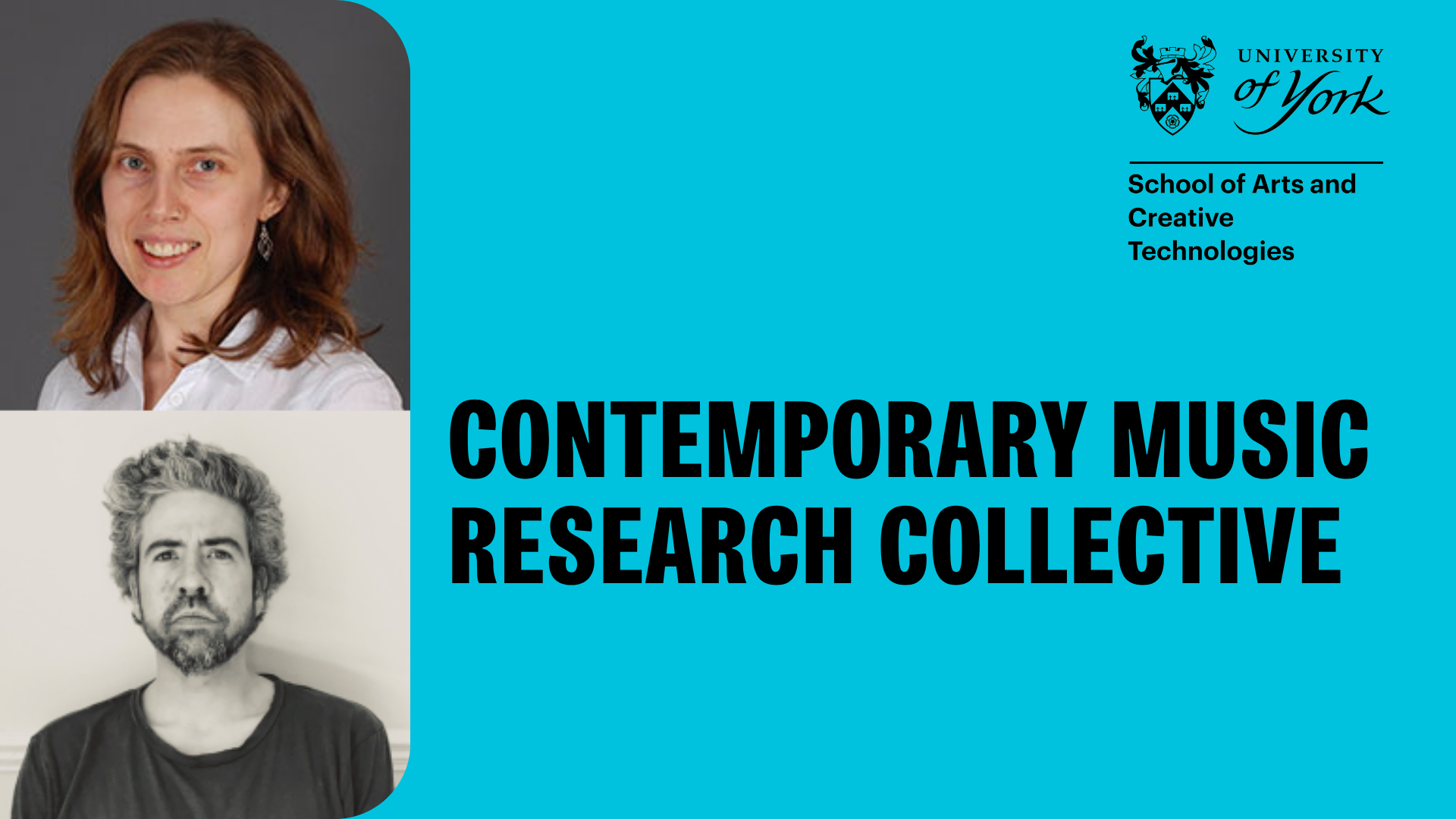
Fiona Keenan is a Lecturer in Sound Production and teaches sound design, Foley practice and sound production/postproduction in the School of Arts and Creative Technologies at the University of York. IShe is interested in the historical origins and contexts of the creative technologies we use, how we use and learn to use them, and the kinds of practice and thinking they require of us. Her teaching is never far from these critical considerations, even when unpacking the specifics of workflows.
Fiona’s PhD, completed in 2019, focused on historical methods of sound effects design and performance in late nineteenth- and early twentieth-century theatres, framing these as a sonic interaction design practice that could inform the design of new present-day encounters with digital sound.Faiona has an ongoing creative practice in sound and music focused on systems for live performance, and loves exploring ways to bring very different sound sources together (sound props with software, for example). She is autistic, and is in the process of exploring how she can bring critical consideration of technology together with explorations of autistic experience more explicitly. She is also investigating how the potential of new generative AI methods fits with our established workflows for practices like Foley and sound design, bringing some early experiments into her teaching.
Federico Reuben is a composer, live electronics performer and sound artist working in practice research across music and creative technologies. He studied composition at the Royal Conservatoire in The Hague with Louis Andriessen, Richard Ayres, Gilius van Bergeijk and Martijn Padding, alongside human–computer interaction, digital signal processing and algorithmic composition at the Institute of Sonology. He completed a PhD in Music Composition and Technology at Brunel University under the supervision of Richard Barrett and Christopher Fox, and subsequently became a Senior Lecturer and Course Leader in Creative Music Technology at Falmouth University. He joined the University of York in 2015 and was promoted to Professor of Music and Creative Technologies in 2026.
Federico’s work has been presented, performed and broadcast worldwide and featured at leading music and art festivals. He has written instrumental, vocal and mixed media compositions for leading ensembles and soloists. As a laptop improviser and live electronics performer he has played with internationally recognised improvisers including Phil Minton, Elliott Sharp, Ingrid Laubrock, John Edwards, Mark Sanders, Rachel Musson, Alexander Hawkins, Steve Noble, and the London Improvisers Orchestra. Recent group projects include Sveið with James Mainwaring and Emil Karlsen; Xatarata with Paulina Owczarek; Perro-chimp with Javier Carmona; Cranky Ego with Carmona and Owczarek; and a quartet with Mark Hanslip, Paul Hession and Dominic Lash. As a sound artist, he has worked with artists including Stelarc, Trisha Donnelly, Rachel Rose and Bruce McLean. He is also co-founder of squib-box with Adam de la Cour and Neil Luck. squib-box is an artist-led organisation and netlabel promoting avant-garde music and interdisciplinary performance.
Federico's research addresses complex problems in AI for automatic music generation and live performance; interactive and algorithmic music systems; human–computer co-creativity and improvisation; telematic and distributed performance; and interactive sound and multimedia installation. His practice investigates under-explored creative applications of emerging technologies, including neural audio synthesis in live performance, symbolic music generation, data-driven computer-assisted composition, laptop improvisation and live coding, interactive synthesis and processing, and telematic composition in latency-rich environments.