
Official Launch of The British Egyptian Centre of AI and Virtual Heritage (BECAIVE)
Posted on Wednesday 9 September 2026
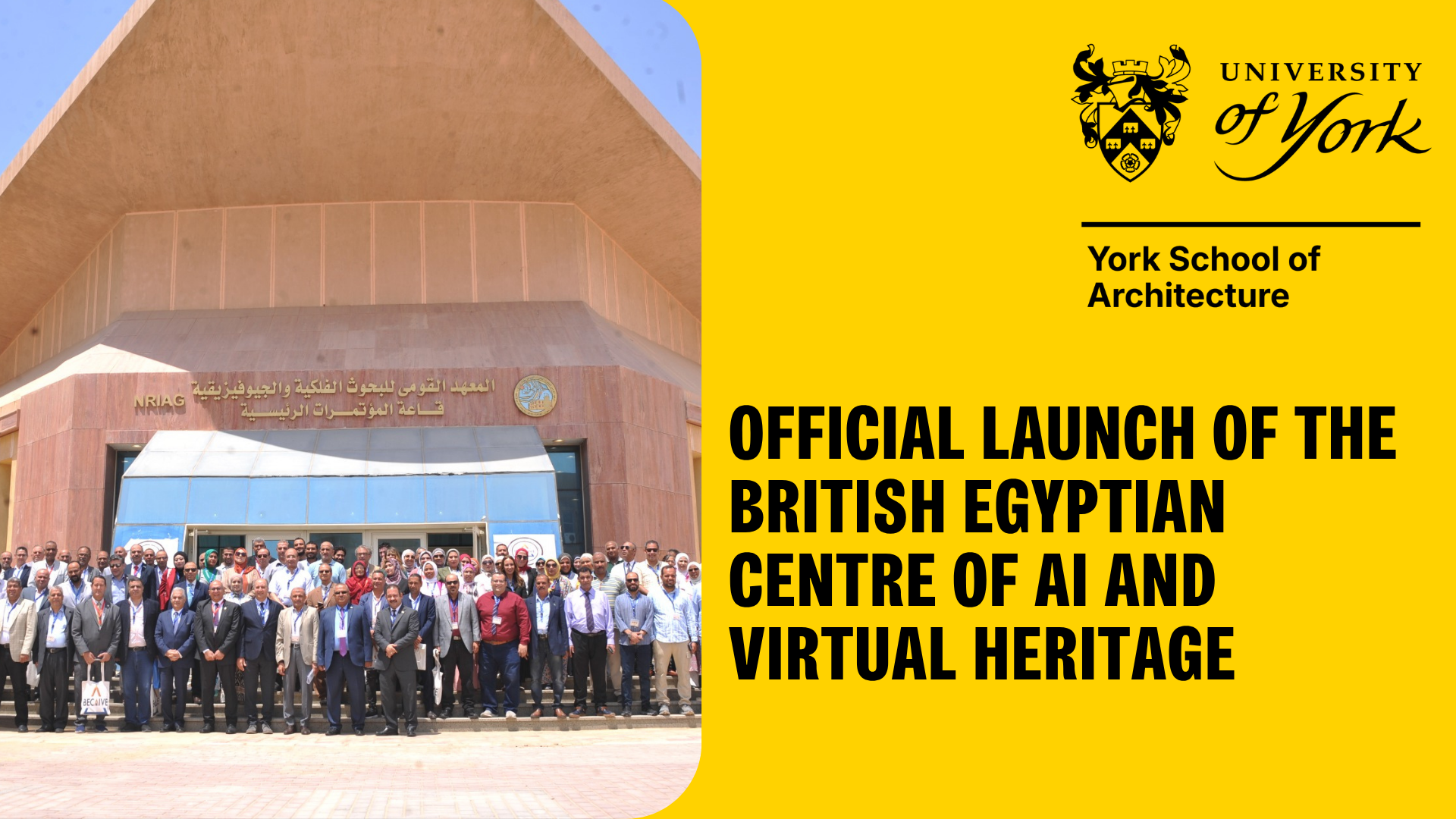
The British Egyptian Centre of AI and Virtual Heritage (BECAIVE) was officially launched at the National Research Institute for Astronomy and Geophysics (NRIAG) in Cairo, Egypt, on Monday 17 August 2026, with the official representation of the British Council, the Ministry of Tourism and Antiquities and the Ministry of Higher Education and Scientific Research. The Ceremonial event was attended by over 100 delegations and included a tour of the Centre facilities and virtual Tours of the Ancient Hawara Pyramid Site.
Jointly managed by the University of York and the National Research Institute of Astronomy and Geophysics (NRIAG), BECAIVE supports capacity building in specialist equipment, software, digital systems, knowledge exchange, and training programmes. The Centre is led by Professor Mohamed Gamal Abdelmonem, the Founding Director of Research and Director of CAUGH at York School of Architecture and Professor Abbas Ali of NRIAG
The Centre explores the potential of artificial intelligence and advanced digital technologies for heritage preservation, conservation, research, interpretation, and public engagement. The project aims to connect heritage sites in Egypt with associated museum collections worldwide through machine learning, AI-enabled applications, and digital frameworks designed to support Egyptology, archaeology, museums, and cultural heritage practice.
The Centre is jointly funded by the British Council's International Science Partnerships Fund (ISPF) Programme and the Science and Technology Development Fund (STDF), under the International Science Partnerships Fund (ISPF), and is the first of its type to focus on AI applications for Egyptian Antiquities.
The Launch was followed by the delivery of the first BECAIVE AI Training Programme for leading heritage professionals and museum curators in Egypt, including exploring the key transformations AI provides and enabling heritage professionals, archaeologists, and museum curators to bring space and time together to merge artefacts with their original archaeological sites. The first of four training workshops will mentor the Centre’s fellows to develop their own AI-led projects, enabling the effective use of digital collections and datasets for preservation, restoration, and public engagement with ancient Egyptian archaeology and history.
For more information about the project, you can visit the BECAIVE website: www.becaive.com