Skip to content Accessibility statement

Amino Acid Analysis at York (NEaar: North East Amino Acid Racemization)

Working collaboratively with a wide range of disciplines, our focus is on the analysis of biomineral organics: their pathways of degradation,  mechanisms of preservation and methods of detection, and how these molecules can inform our understanding of an organism’s life history, evolutionary relationships and time since death. Based at the University of York since 2003 as part of BioArCh, our core research is in amino acid geochronology (covering the Quaternary period), palaeoproteomics and biomineralisation.

NEaar is dedicated to providing world class amino acid racemization analysis as a tool for geochronology & understanding protein breakdown.  Hosted in the Chemistry department and part of BioArCh, it became the NERC-recognised facility for chiral amino acid analysis in 2008.

Amino acid geochronology is a powerful technique for dating the Quaternary (last 2.5 Ma), but requires accessing the proteomic content within a closed system, i.e the proteins trapped within a mineral .  Through a combination of bleach pre-treatment and analysis of multiple chiral amino acid analysis, we isolate and measure the "intra-crystalline protein decomposition" (IcPD) of a fossil sample (e.g. shells, eggshell, tooth enamel), which is affected only by the time and temperature of its burial conditions. This means we can create a relative chronology framework allowing for important archaeological sites to be accurately dated.

Amino acid analysis can provide key information on protein breakdown and allows for successful screening of archaeological material for further proteomic studies,  as well as providing supporting data to confirm studies are accessing original proteins from fossils as old as 20 million years.

NEaar has three main scientific objectives:

  • to continue actively pioneering analytical advances in chiral amino acid research;
  • to welcome visiting researchers and students, giving them the opportunity to learn the technique and analyse their own samples whilst supporting them in data interpretation;
  • to provide a “Pay-As-You-Go” chiral amino acid analysis service for the earth science and archaeological science community.

Our people

Photo Name Role
 

Professor Kirsty Penkman

Professor in Analytical Chemistry 

Dr Samantha Greeves

Technical Specialist

Marc Dickinson, NERC Independent Research Fellow, Chemistry

Dr Marc Dickinson

NERC Independent Research Fellow

Sheila Taylor, Research Support, Chemistry

Sheila Taylor

Research Support

Prof. Kirsty Penkman at the microscope in the NEaar lab

Focus areas

We are interested in molecular diagenesis (breakdown), which has applications in:

  • Geochronology
  • Quaternary science
  • Archaeological science
  • Palaeoclimate
  • The Palaeolithic & human evolution
  • Biomineralisation
  • Protein stability & breakdown in vivo

Please contact us if you have an interesting project to discuss, and we do offer a commercial service as well as working on a collaborative research basis.

Current projects

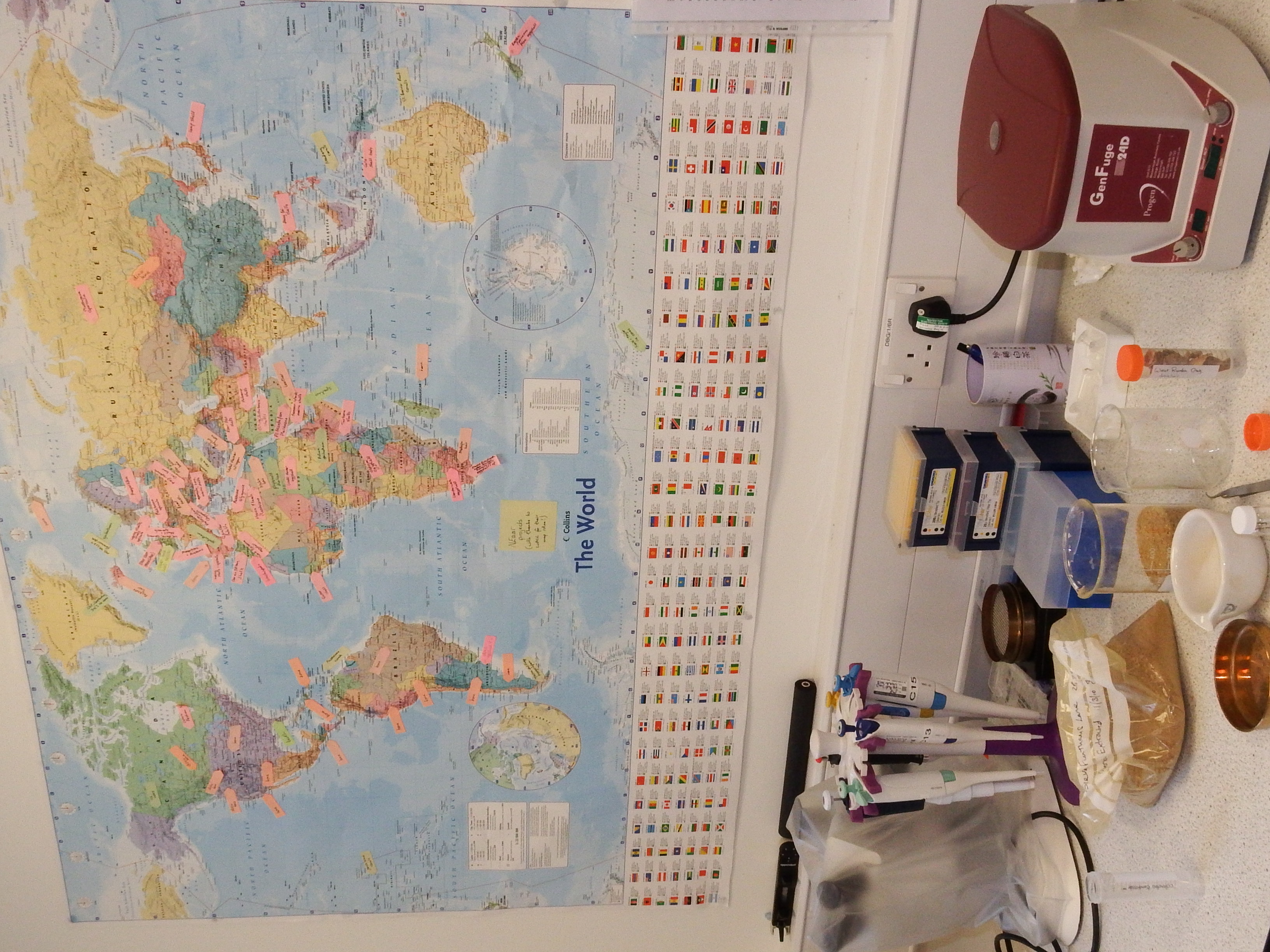
A world map showing the NEaar global projects

Collaborations

The NEaar lab has hosted over 120 researchers, from undergraduate students to international academic staff.  We have worked on a wide range of archaeological/geological materials for dating (e.g. shells, corals, eggshell, teeth, ostracods, foraminifera) and palaeoproteomics / biomineralisation (e.g. shells, bones, teeth, ceramics, plant material, foodstuffs). We welcome research visitors and collaborations; please contact kirsty.penkman@york.ac.uk.

Facilities

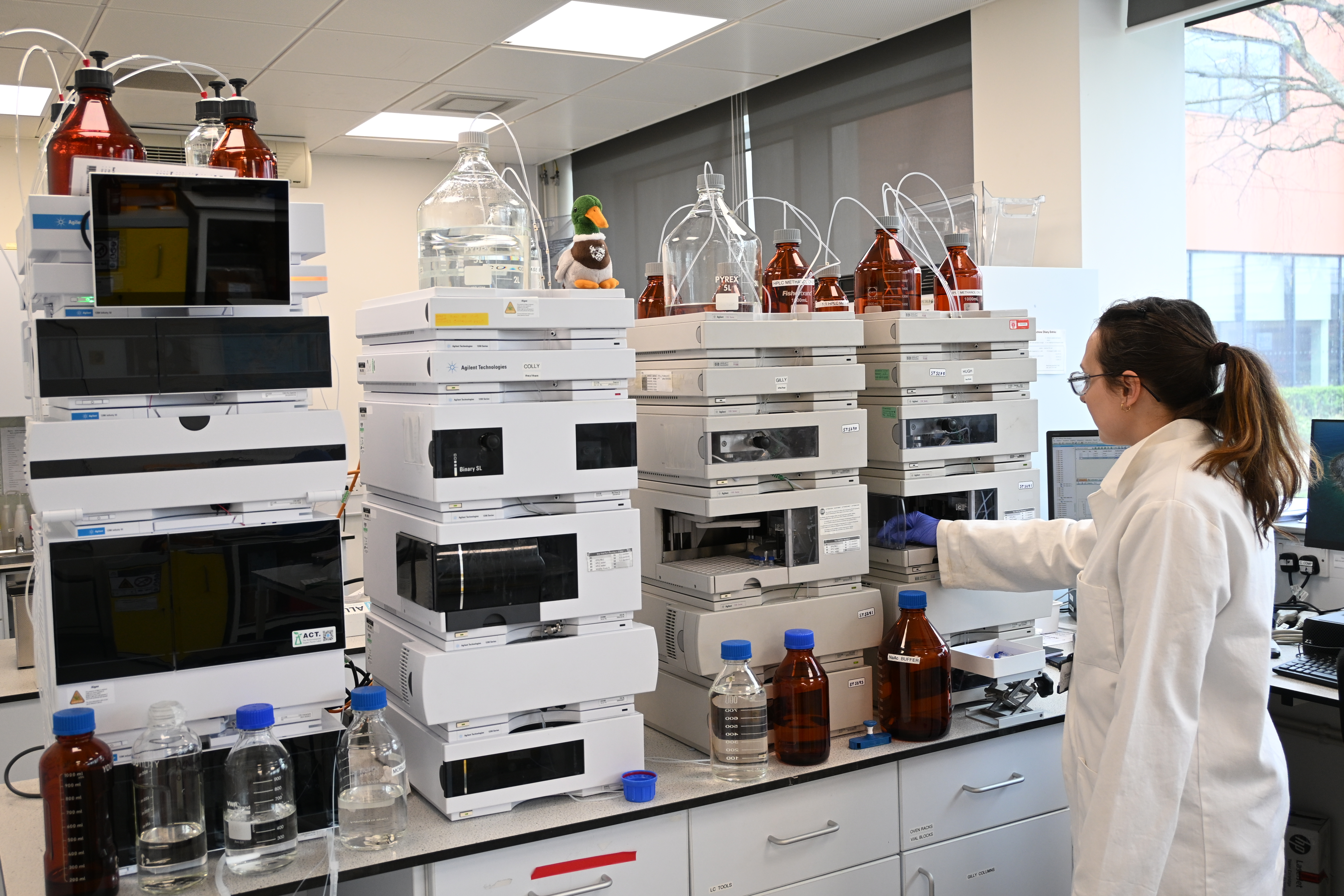
We have dedicated clean lab space for preparation and analysis, with microscopes for imaging samples.  Amino acid enantiomers are separated by reverse phase high pressure liquid chromatography (HPLC), following a modified method of Kaufman & Manley, 1998) or UHPLC (Crisp, 2013; Conti et al., 2024). We have two Agilent 1100 HPLCs (Hugh & Gilly), and two UHPLCs: a 1200 Rapid Resolution (Colly) and a 1260 Infinity III (Finn).

Example Agilent 1100 chromatogram

An example chromatogram from an Agilent 1100 instrument

Contact us
Our people