
Extinction and the archive
Posted on Tuesday 9 June 2026

As Greg Garrard has noted, one of the tasks of ecocritical scholarship is to study the rhetorical devices used in the construction and representation of ecological issues in literature and other forms of cultural media.1 My current working chapter studies the rhetoric of extinction in Irish tradition over the past century, with particular reference to the work of the Irish Folklore Commission (An Coimisúin Béaloideasa Éireann) whose collecting work carried out from 1935 to 1970 has resulted in the archive known today as the National Folklore Collection.
For the Commission extinction was primarily understood as a cultural phenomenon. If we consult the Handbook of Irish Folklore (a text central to the collecting and archival work of the Commission), the only references to ‘extinction’ relate to cultural traditions including ‘patterns’ (local festivals celebrated in honour of the patron saint), personal names, and ‘shebeens’ (illicit drinking establishments).2 Though various ecological species had become extinct in Ireland by the time the Commission was founded - including bears, wolves, and eagles for example - the term ‘extinction’ only appears in relation to cultural as opposed to ecological phenomena.
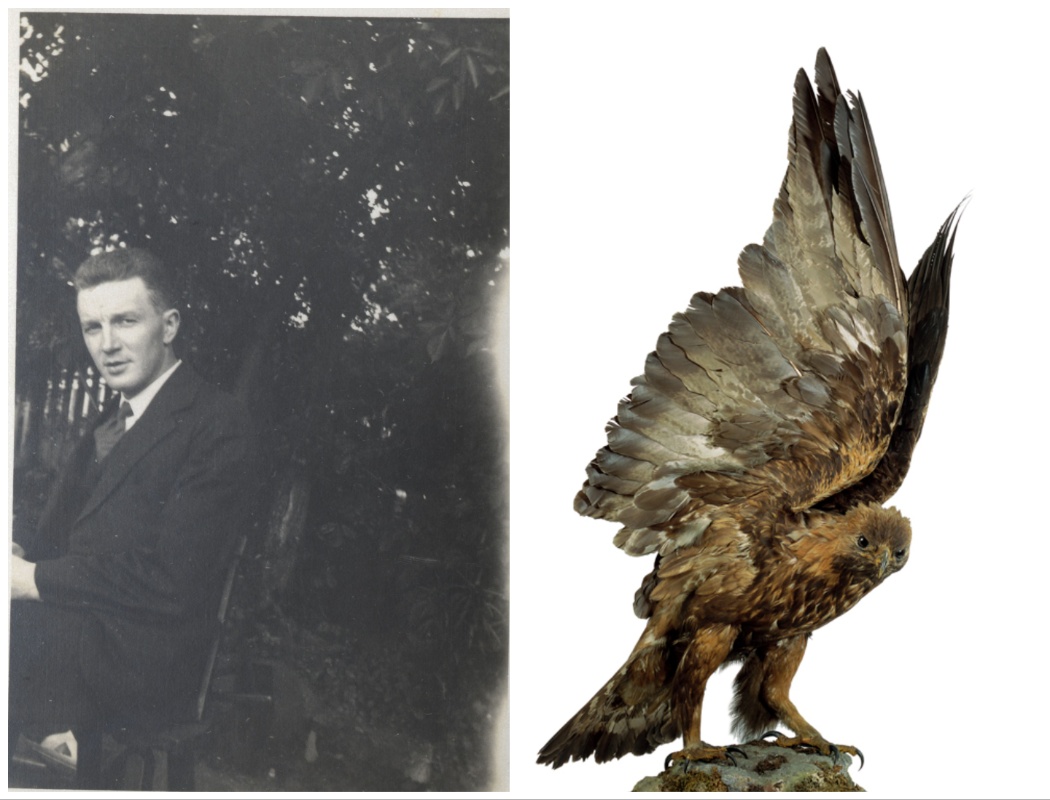 From left to right: Picture of Séamus Ó Duilearga,' Sweden, 1928. National Folklore Collection, Mounted skin of Golden Eagle (Aquila Chrysaetos), National Museum of Ireland.
Indeed, the fear of the demise of folk tradition was central to the ideology of the Commission and other folkloristic organisations in early twentieth century Ireland. This is made manifest in the motto of The Folklore of Ireland Society (An Cumann le Béaloideas Éireann), which appears on every edition of the journal Béaloideas3 since it was founded in 1927: ‘Colligite quae superaverunt fragmenta, ne pereant’ (‘Collect the remnants, lest they perish’). Indeed, in the editorial address of the first edition of the journal published in June 1927, Séamus Ó Duilearga (later Director of the Commission) declares the motto of the Society as such: ‘Chun an oighreacht luachmar so a shábháil ó’n mbás isea bunuíodh An Cumann le Béaloideas Éireann.’ (‘The Folklore of Ireland Society was established to save this valuable heritage from death.’)4 For Ó Duilearga and many of his contemporaries, the pressing contemporaneous threat of extinction related to folk traditions, which needed to be saved and preserved for posterity.
When the Commission was set up in 1935 the last of Ireland’s eagles had been extirpated for at least two decades; Golden Eagles are believed to have been extinct in Ireland by 1912, and White Tailed Eagles from 1898.5 Thus some of the tradition-bearers who were interviewed by the Commission would have had living memories from a time when eagles were still extant in the Irish landscape, and the archive therefore affords an interesting opportunity to ascertain popular perceptions of these birds in the moment following their eradication. If the role of the archive is to preserve cultural traditions, what can they tell us about extinct creatures? And what are the challenges of seeking out the extinct in the archive? These are some of the guiding questions of my PhD research, which investigates the folk perceptions and traditions related to eagles as documented in Ireland’s National Folklore Collection.
References
1 Greg Garrard, Ecocriticism, 2nd ed. (Routledge, 2012) 3, 6-8, 16.
2 Ó Súilleabháin, Handbook of Irish Folklore (Singing Tree Press, 1970), 141, 147, 321, accessed 23 April 2026, https://archive.org/details/handbookofirishf0000osui/page/n30/mode/1up
3 ‘Béaloideas’ is the Irish word for ‘folklore’.
4 Séamus Ó Duilearga, ‘Ón bhFear Eagair,’ Béaloideas 1, no. 1 (1927): 3, accessed 29 April 2026, https://www.jstor.org/stable/20521411.
5 Lorcan O’Toole et al., ‘Re-introduction of the golden eagle into the Republic of Ireland,’ Biological Conservation 103 (2002): 303, accessed 26 May 2026,https://doi-org.libproxy.york.ac.uk/10.1016/S0006-3207(01)00141-0; Brian J. Burke et al., ‘Reintroduction of white-tailed eagles to the Republic of Ireland: A case study of media coverage,’ Irish Geography 47, no. 1 (2014):97, accessed 26 May 2025, https://doi.org/10.55650/igj.2014.451