
POLLEN 2026: Diverse Origins, Multiple Futures
Posted on Tuesday 7 July 2026
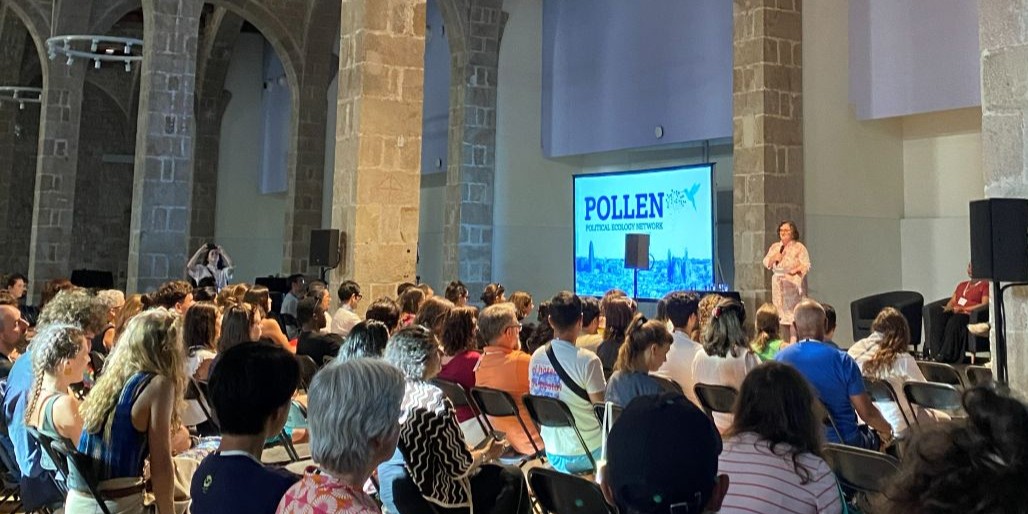
Themed around ‘Diverse Origins, Multiple Futures: The stories of Political Ecology,’ it was a vibrant, engaging week which provided an inspiring and grounding segue into the final three months of my PhD. On the opening day of the conference, I co-convened a session with my collaborator Safi Bailey, a PhD student at Cardiff University. Our session was titled ‘Flowing together – the potential of revitalising more-than-human riverine relations,’ and brought together five talks from early career researchers working at the intersections of more-than-human and multispecies research and rivers. Our panel engaged with the polluted, over-extracted waters of the Anthropocene, sharing stories which were gathered through embodied, creative methodologies. As a collective, we questioned the story that continues to be told about rivers – that they are resources and repositories for waste – and asked whether reimagining and reframing our relations with rivers holds hope for new ways forward.
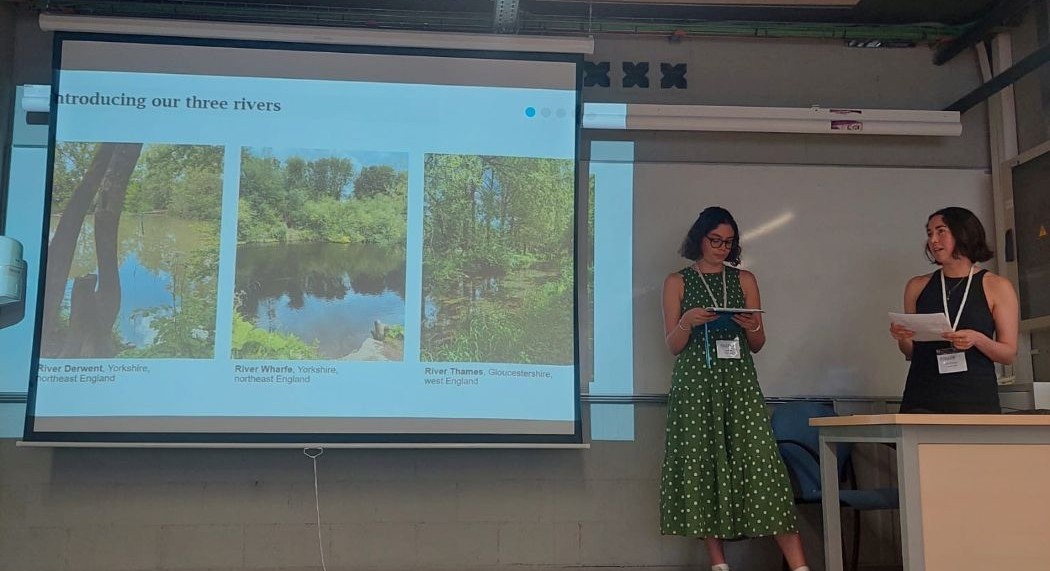
Safi & I spoke about our respective PhD projects, which both approach outdoor swimming from ecofeminist and more-than-human perspectives. We wove together insights from our different fieldwork contexts to share stories about swimmers’ relations to three of England’s rivers: the Derwent, the Wharfe, and the Thames. Focusing on swimmers’ encounters and entanglements with pollution, we drew on Astrida Neimanis’ Bodies of Water (2017) to explore the ‘unknowability’ of what the waters that swimmers immerse their ‘porous’ bodies into contain. We highlighted that for some swimmers, reckoning with pollution in visceral, sensorial ways has catalysed a shift in how they relate to the river, whereas for others this ‘unknowability’ perpetuates an imaginary in which the rivers are clean and safely swimmable.
Ella Hubbard and Julian Dobson, postdoctoral researchers from Sheffield Hallam University, spoke next with a talk titled ‘From sewage to stewardship.’ Their research focuses on the River Don, a notoriously polluted river in South Yorkshire, which is contaminated with the waste from abandoned mines as well as by ongoing sewage releases. They discussed their involvement with the River Dôn project, which explores river rights as well as the possibilities afforded and foreclosed by the creation of a ‘digital twin’ of the river. As part of their work they asked participants the thought-provoking question ‘what would the river say to you?’
Nada Rosa Schroer, a PhD student from Technical University Dortmund, shared a talk titled ‘Walking with water ghosts, cyborgs and monsters.’ Nada spoke from an hydrofeminist perspective about attuning to the ghosts of the disrupted Rhenish mining district in Germany. In this, she shared insights from a practice of ‘walking-with’ the river; a series of participatory walks in which attendees learned to open their attention and consider how waters can be related to differently.
Carlota Houart, a PhD student from Wageningen University in the Netherlands, spoke about ‘Multispecies justice in river defence movements.’ She drew on her research with two rivers: the Maas in the Netherlands, and the Piatúa River in Ecuador. While very different rivers in farflung contexts, each shares a history of extractivism. Taking a multispecies justice perspective, Carlota looked to understand what it means to engage with the river as a community of living beings. She drew on her experiences of multispecies counter-mapping and a week on ‘Maas watch’, spending time with the river to
Samuel Pinjon (PhD student, Université Lyon) and Suzanne Husky (Artists & Mouvement d'Alliance avec le Peuple Castor) closed the session with their talk ‘Transforming river imaginaries and practices.’ They discussed their involvement in a river regeneration movement in France which is inspired by beavers. As part of their project, Suzanne’s art illustrates the ‘deep time journey’ of the river, from its geological origins, to the emergence of beavers, and through to the extractive practices of the present. The intention is to think with rivers differently and challenge dominant practices of river management.
Huge thanks to all the speakers involved for their contributions, to the audience for their engagement and thoughtful questions, and to the Leverhulme Centre for Anthropocene Biodiversity for funding my participation in the conference.