Fusion offers the prospect of an effectively limitless supply of energy which is relatively clean and produces no greenhouse gases. Fusion research is focused around two main concepts: magnetic confinement fusion (MCF) and inertial confinement fusion (ICF). Both will be covered in this MSc course. The field is entering an exciting new era with the construction of the ITER tokamak in the South of France. There are also large ICF projects on the horizon, such as NIF and HiPER.
The University of York now provides a taught MSc in Fusion Energy, in response to an international need to train physicists for this recent growth in fusion energy research activity. This Master's course provides a firm foundation to fusion physics and give introductions to some of the more advanced topics. It is an ideal course to prepare students for a PhD in fusion energy; it will also equip students who decide not to pursue fusion further with a range of important generic skills applicable in many sectors of employment.
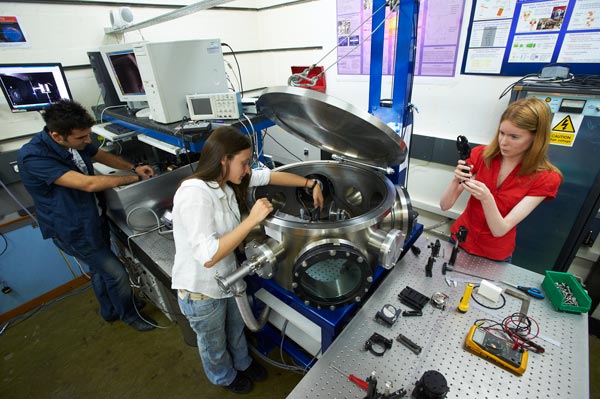
This Fusion Energy MSc includes lectures, laboratory classes and a major research project which will be carried out over the summer months and assessed by dissertation. For more detailed information click on the "Course Details" tab.
All work will be supervised by the Plasma Physics and Fusion group at York. The group has four academic staff involved in ICF research and four in MCF research, with both theoretical and experimental expertise. The group has established one of the biggest university fusion groups in the UK, with six post-doctoral research staff and over twenty PhD students. Through our strong links with the Rutherford Appleton Laboratory and the Culham Centre for Fusion Energy it has access to world-leading fusion facilities, including the MAST and JET tokamaks and large laser facilities.
The Plasma Physics and Fusion group were awarded a Vice-Chancellor's Teaching Award in 2011, recognising the quality of the MSc Fusion Energy and the Fusion Doctoral Training Network.
If you have any enquiries about the Fusion MSc, please contact:
phys-fusion-msc@york.ac.uk
Department of Physics
University of York
Heslington
York YO10 5DD
Tel: +44 (0)1904 322236
The Course Director is Professor Greg Tallents.
Many of our students are offered PhD positions following the MSc - in both Fusion Energy and other subject areas. Students from the first two MSc cohorts have gone on to PhD study at Oxford, Imperial, Liverpool and York. Other destinations have included teaching and positions in industry.
Several students from the 2011/12 cohort have already secured PhD positions, and will go on to study Fusion Energy at York, Complexity Science at Warwick, and Applied and Computational Mathematics at Edinburgh.
"I have really enjoyed the MSc - it is a challenging, but very rewarding course. I have found the quality of teaching very high, and I have received a huge amount of support from academic members of staff. I have also really enjoyed the camaraderie and atmosphere in the York Plasma Institute." - Jonathan Skipp, MSc student 2011/12
Applications are invited now for October 2013 entry to this Master's programme from UK/EU and international students. Applicants are encouraged to use the Online application for MSc in Fusion Energy.
A minimum entry requirement is a lower second class degree (or equivalent) in physics or a related discipline.
If you wish to apply for postgraduate study at the University of York, you will find the application procedure outlined on our How to apply page.
The tuition fees for the 2013/14 academic year are £5,900 for home/EU students and £17,650 for overseas students. See the University's Fees for Postgraduate Study page for more information.
The University is able to offer scholarships of value up to £10,000 to academically strong overseas students accepted for study onto the MSc in Fusion Energy; certain conditions apply. The Department of Physics will in addition offer three bursaries of value £1,000 to either home or overseas students based on a competitive evaluation of the academic standing of applicants. For further information regarding the bursaries, please contact the Department of Physics.
There is University funding available for overseas students who perform well on the MSc programme to proceed to PhD studies. A new University scheme seeks to help students progressing from MSc to PhD studies by providing a one-off payment of £5,000. Overseas Research Studentship awards for PhD study are also available and give a full waiver of fees and £5,000 living expenses per year.
Entente Cordiale scholarships provide funding for French students taking a one-year postgraduate course in the UK. The scholarships provide £10,000 towards fees and living expenses, and applications can be made through the British Council.