Japanese collector donates Medieval manuscripts
Posted on Tuesday 2 September 2014
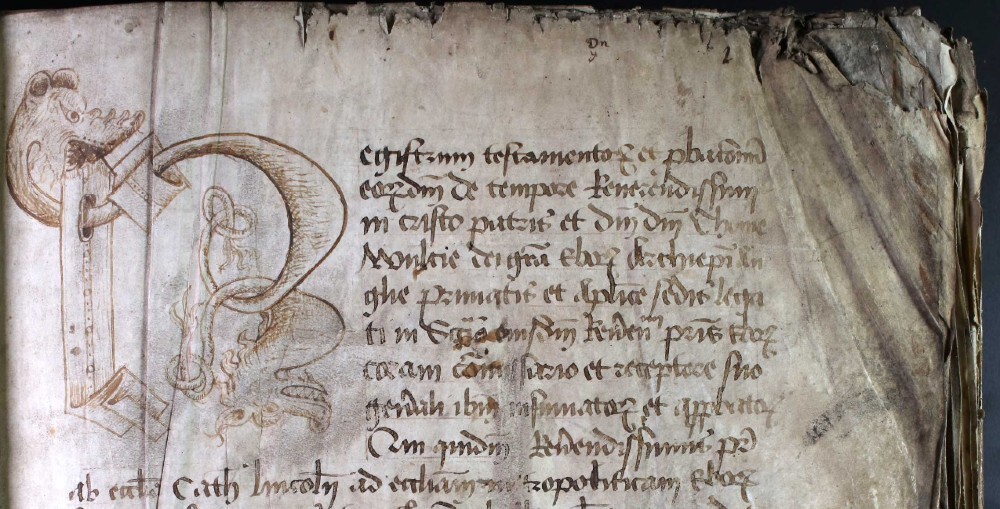
Each fragment consists of one or two leaves (pages) from a medieval manuscript or early printed book, of dates ranging from the 10th to the 16th centuries. Many include coloured or gold-leaf decorated initials.
Professor Toshiyuki Takamiya, of Keio University in Tokyo, presented the box of fragments to Linne Mooney, Director of the Centre for Medieval Studies and Professor of Medieval English Palaeography in the Department of English and Related Literature at York.
He said: 'I recognized that there were few original medieval manuscript sources in York in relation to the numbers of faculty and graduate students studying the Middle Ages at the University, so I thought these fragments would be a welcome addition to the University's collection.'
Professor Takamiya’s manuscripts will join the thousands of archival medieval records at the Borthwick Institute for Archives at the University. The University is home to the largest concentration of medieval scholars in the UK: 36 staff and over 120 postgraduate students at York study the literature, history, art and archaeology of the Middle Ages.
Professor Mooney said: “We are tremendously grateful to Professor Takamiya for this generous donation to the Centre for Medieval Studies and the University of York.”
The collection, to be known as the Takamiya Manuscript Fragments Collection, will be kept at the Borthwick Institute for Archives on the University of York campus and will be made available for study in the Borthwick searchroom. An exhibition focusing on the manuscripts will be held later this year.
Staff and students in the Centre for Medieval Studies, particularly those studying palaeography (the reading and dating of medieval handwriting), will welcome the Takamiya Manuscript Fragments Archive. Fittingly, twenty-eight manuscripts of Professor Takamiya’s collection had been originally assembled in the 19th century for exactly this purpose.
The manuscript fragments came from the library of the 19th century medieval manuscript collector, Sir Thomas Phillipps, part of a larger collection of fragments bought by the booksellers William H. Robinson Ltd. of London from the sale of Phillipps manuscripts in 1946. The collection donated by Professor Takamiya was assembled by the booksellers as a sample of styles from several centuries of the Middle Ages.
The larger collection belonged in the first half of the 20th century to Estelle Doheny, a Californian collector. Similar sets of specimen fragments assembled by Robinsons are now in the Lilly Library at the University of Indiana and the Bodleian Library of the University of Oxford, while other sets remain in private ownership.
Last year, Professor Takamiya placed the bulk of his collection of medieval English manuscripts on long-term deposit at the Beinecke Library at Yale University in the USA. It was the world's largest private collection of medieval manuscripts written in English.
Further information
- For more information about the Centre for Medieval Studiers at the University of York, please visit http://www.york.ac.uk/medieval-studies/
- For more information about the Department of English and Related Literature, please visit http://www.york.ac.uk/english/
- For more information about the Borthwick Institute for Archives, please visit http://www.york.ac.uk/borthwick/