
Waterways to Resilience
Context
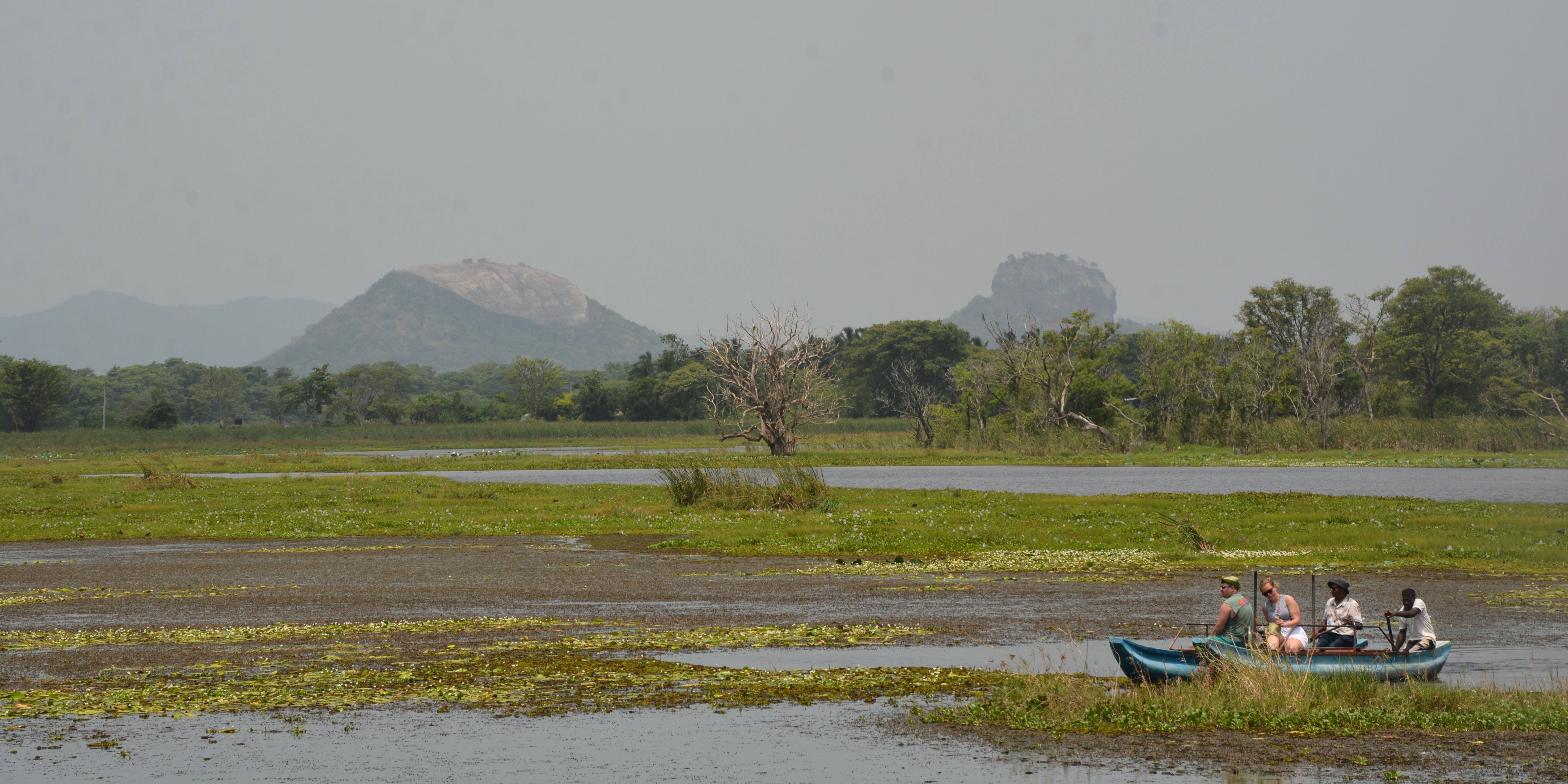
Rural areas in Sri Lanka’s dry zone have long relied on Small Tank Cascade Systems (STCS) to manage water scarcity and climate variability. However, over time, STCS have become less extensive and increasingly undervalued in decision-making. We want to explore how and if we can address this issue.
Aims and Objectives
Rural areas in the dry zone of Sri Lanka have a traditional approach to managing climate variability and water scarcity through Small Tank Cascade Systems (STCS), which have become less extensive over the centuries. STCS consist of engineered channels and ponds and supporting natural capital assets (e.g., tree lines to protect channels against extreme weather, reed beds to purify water flows, natural sediment traps). These systems help capture and store water from the rainy season into the dry season. Therefore, STCS are multifunctional systems that, if revitalized, could transform the dry zone landscape, allowing both the ecosystem and the communities that rely on them to become resilient in the face of a changing climate. Recognizing the importance of the socio-economic and ecological dimensions, STCS were designated as Globally Important Agricultural Heritage Systems by the Food and Agriculture Organization of the United Nations in 2017.
However, while STCS are multifunctional, local decision-makers tend to focus only on the market value from the STC irrigation benefits of induvial tanks and conclude STCS is not often economically feasible. This perspective is especially problematic because we must consider the entire catchment/cascade, as these systems were designed to function as interconnected networks
To encourage thinking across the entire socio-ecological system, we will explore Payments for Ecosystem Services (PES) mechanisms to enhance STCS as a Nature-based Solution (NbS) to changing environmental conditions and enhance rural livelihoods. NbS and PES are still in the early stages in Sri Lanka, and there are significant gaps in Sri Lankan research and practice regarding the design and application of such schemes for improved socio-ecological resilience, with space to learn from experiences in the UK.
It is expected that the month-long (~May 2025) visit will consolidate efforts in the preceding months to establish
the groundwork for a productive visit regarding the design of a potential STC PES scheme.
Project Outputs
Professor Sisira Rajapakshe presented his research at the YESI International Fellows seminar: Revitalizing Sri Lanka’s Village Tank Ecosystems during his visit to the University of York.
Since the visit, the project has progressed significantly and new funding has been successfully secured to extend its impact. An additional key output is the preparation of a research manuscript for submission to a journal. This work explores how local knowledge and everyday practices fit into Payments for Ecosystem Services (PES) schemes, using Village Tank Cascade Systems (VTCS) as a primary framework.
The team has also been awarded a twelve-month research grant from the Gamani Corea Foundation in Sri Lanka. The new project, which began on 18 December 2025, focuses on the revitalisation of village tank cascade systems to improve climate-resilient livelihoods in rural areas. This study combines economic and social sciences to address socio-economic challenges and support sustainable development in Sri Lanka. These outcomes build directly on the foundations established during the YESI Fellows collaboration.
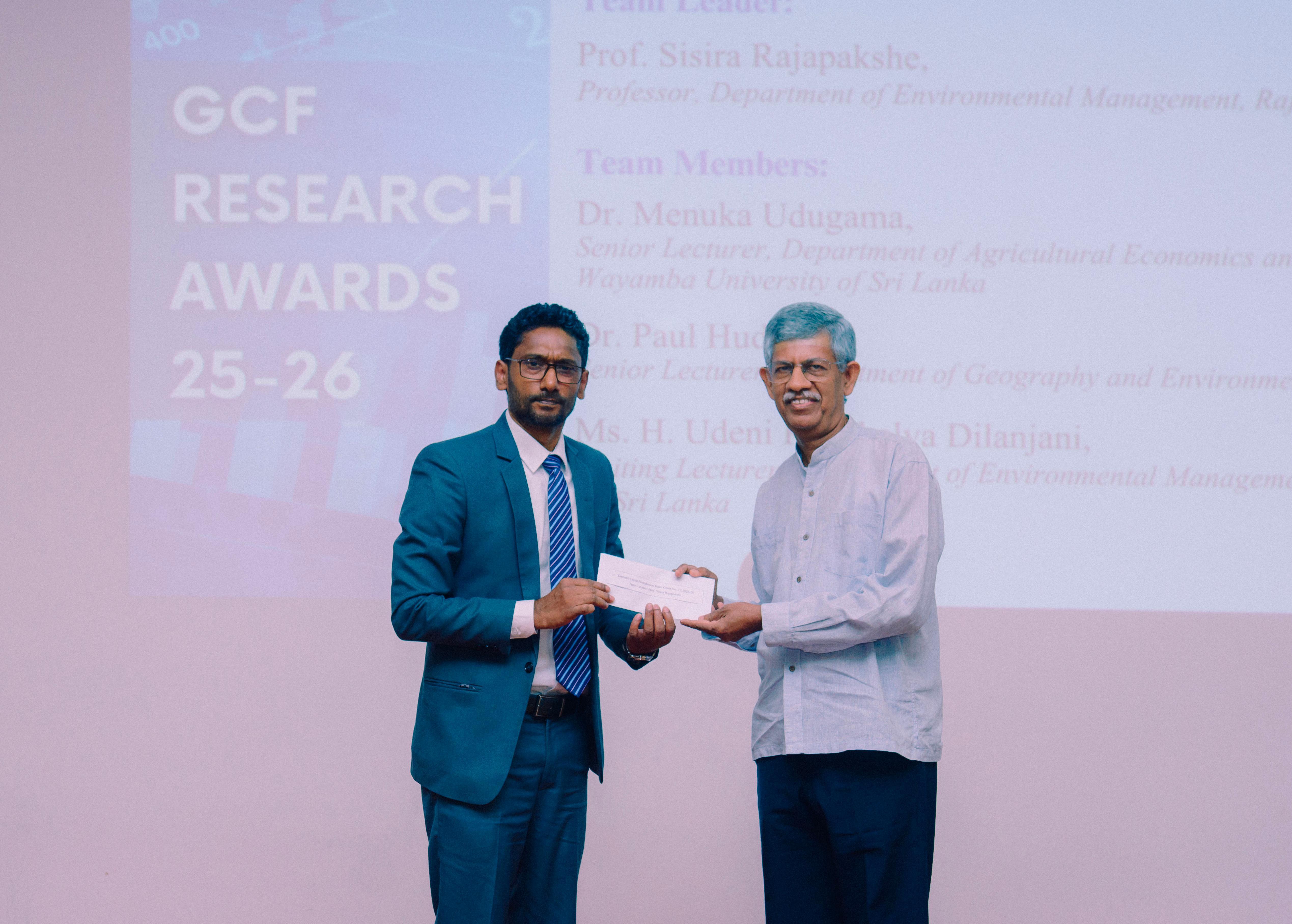
Professor Sisira Rajapakshe receiving the Gamani Corea Foundation research grant award on behalf of the project team.
Project Partner

University of York Collaborator

Paul Hudson, Department of Environment and Geography
Dr Paul Hudson is a Senior Lecturer in Environmental Economics, in the Department of Environment and Geography, University of York.
Paul is an interdisciplinary social scientist focusing on multiple aspects of disaster risk management (mainly flooding) and climate change adaptation, ranging from insurance, human behaviour, nature-based solutions, measuring and evaluating interventions, and overall risk assessment. His research focuses on exploring the interconnected complexities of how best to manage the uncertain threats that we face from extreme weather and a changing climate. Paul has a particular interest in the use of insurance as a key metric of disaster risk management and adaptation and the tole of behavioural theory in explaining disaster outcomes. He has an interesting understanding how we can best use and support nature in helping us adapt to climate change.
International Collaborator
Speaker Bio
Sisira Rajapakse (PhD), Department of Environmental Management, Rajarata University of Sri Lanka
Sisira Rajapakse (PhD), Senior Lecturer in the Department of Environmental Management at Rajarata University of Sri Lanka. Graduated with First Class Honors in B.A. (Hons) in Environmental Management and subsequently an MSc in Environmental Economics from Sri Lanka. He completed his PhD at the Sustainability Research Institute, School of Earth and Environment, University of Leeds, UK, where he was awarded the Commonwealth Scholarship. His doctoral thesis, was titled ‘Economic Valuation of Water Service Improvements in the North Central Province of Sri Lanka. Additionally, he had the opportunity to study at the Department of Environmental Science at Aarhus University, Denmark, as a visiting research scholar.
At both national and international levels, he has been actively involved in and managed various research projects, collaborating closely with policy-making bodies and international organisations. He specialises in Environmental Economics, with teaching and research focusing primarily on environmental valuation, environmental policy analysis, environmental accounting, sustainable financing, Nature-based Solutions (NbS), environmental impact assessments, and cost-benefit analyses.