Skip to content Accessibility statement

Creative scholarship

Arts-research collaboration to imagine proenvironmental behaviour change in human-wildlife contexts

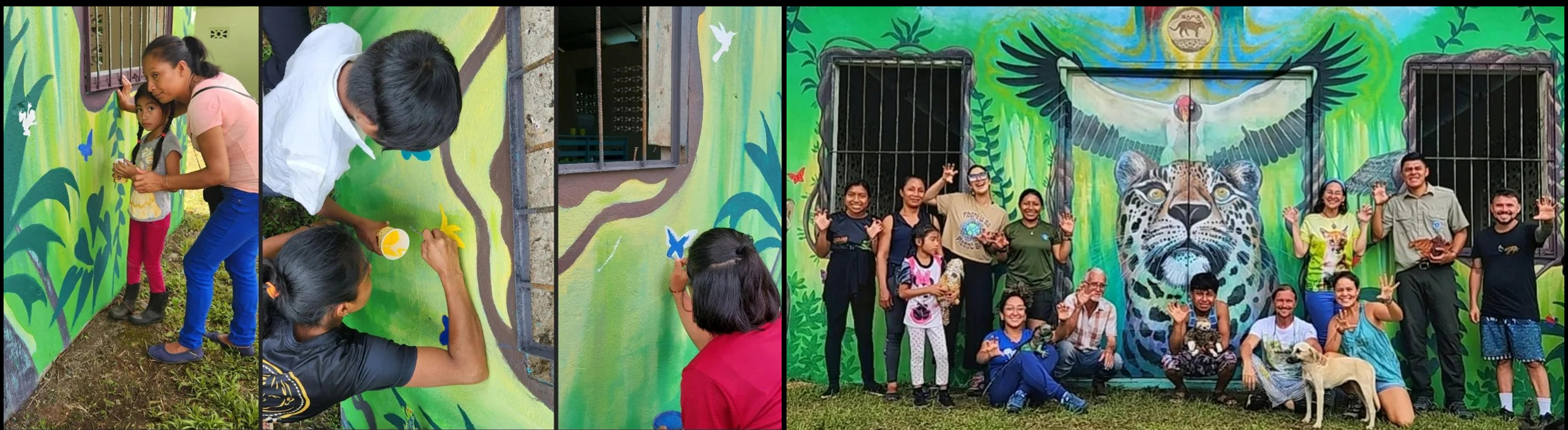
Despite much research on what is needed to conserve biodiversity and promote human-wildlife coexistence, we struggle to achieve positive outcomes in practice. We believe one reason is that researchers do not work together with sufficient creativity across disciplines, to imagine projects or convey findings in engaging ways that spur proenvironmental action. This project will fill a research gap by building a new inter- and transdisciplinary bridge between conservation science, social science, and the arts to explore how incorporating engaging art into research can lead to proenvironmental behaviours in human–wildlife coexistence contexts. Both applicants, one from natural, one from social science, have previously collaborated with artists (visual, music, storytelling, mural art, zines) and across disciplines on human-wildlife coexistence, producing high-quality artistic and research outputs. Both institutions host vibrant art–nature initiatives and everyday encounters with wildlife—from trees and ducks on the UoY campus celebrated through e.g. the ‘Longboi’ art and tree trails, to sloths and raccoons at UCR. Our collaboration would allow fruitful experimentation at small scale to examine how art-led (re)imagining in research design, data collection and outputs could promote emotional and social learning and shift behaviours toward more harmonious shared spaces.

Objectives 

Engage social scientists, conservationists and three artists each in Yorkshire and Costa Rica to reflect on, experiment with and imagine art-led environmental research and actions for just human-wildlife coexistence, and obtain initial public responses. - Co-produce an inter- and transdisciplinary bridge integrating social and natural science with art in research design, data collection and outputs. - Co-develop a detailed joint grant proposal to upscale this project’s experimental artistic interventions for behavioural and policy change in human–wildlife coexistence.

Timings 

University of Costa Rica, ca. May: Field-based sessions with artists and conservation practitioners to garner insights from tropical and community-based contexts. Activities will include a “creative lab” workshop on inter- and transdisciplinary arts-research collaboration for human–wildlife coexistence and a public seminar on arts and sustainability research. - University of York, ca. July: Seminar and meetings with YESI ‘Environmental artivism’ and ‘Play for the Planet’ networks. A participatory “think-tank” half-day workshop with scholars and artists will give input on how visual/audio/performance art can help imagine better research and outputs for empathy and proenvironmental behavioural change.

Expected Outputs 

Scoping paper linking art with human-wildlife coexistence conceptually and methodologically across disciplines. - Application for a major international grant. - Two joint seminars (English at UoY, Spanish at UCR); half-day workshops at UoY/UCR with artists - Audiovisual materials documenting collaboration, including artists’ initial outputs, for YESI webpages; facility (e.g. brief surveys) to capture initial public responses on learning and behavioural change.

Knowledge Exchange Outcomes

Build long-term capacity between Global South and North in integrating the arts, natural and social science for sustainability transitions. - Strengthen inter- and transdisciplinary dialogue between artists, conservation biologists, social scientists. - Promote UoY and UCR as leading institutions building experimental, creative, and equitable approaches to human–wildlife coexistence.

University of York Collaborator

Judith Krauss, Department of Politics and International Relations/YESI

Bio: I teach in the Department of Politics on global development, inequalities and sustainability. With diverse colleagues, I do interdisciplinary research on global value chains, conservation and the Sustainable Development Goals in terms of how environmental concerns such as protecting nature intersect with economic questions on who benefits, and socio-political issues such as decoloniality and justice. I am an associate editor for the Journal of Political Ecology, a volunteer-based, diamond open-access publication. Moreover, I am passionate about making research accessible to the wider public e.g. through games such as the 'Cocoa Sustainability Challenge', and research storytelling.

View ResearchGate page

International Collaborator

Ronit Amit, CIBET and School of Biology at the University of Costa Rica

Bio:  I am an interdisciplinary biologist at the University of Costa Rica, working at the intersection of human–wildlife coexistence and behavioural change. I research how people experience and interpret wildlife, and how pro-environmental decisions emerge from emotional, cultural and relational dynamics. Under a human dimensions of wildlife approach, my work spans coexistence governance, incentive-based interventions, and mixed-methods research with rural and peri-urban communities. I am also committed to making science meaningful and accessible through creative formats such as contests, community storytelling and art-based engagement. I am excited to explore how arts and behavioural science together can inspire fairer and more optimistic conservation futures.

View ResearchGate page