
Urban Labor-a-tree
It was an incredible opportunity to reimagine one of my games in a different context, extend and explore its potentials and impacts.
- Prasad Sandbhor
Project Outputs
The Urban Labor-a-Tree YESI Discipline Hopping Fellowship set out to translate research from the Branching Out project into a playful and accessible format to support public understanding and dialogue around urban treescapes. The main output was a prototype board game designed to reflect the diverse social, cultural, and ecological values of urban trees, while inviting players to explore the trade-offs and opportunities involved in growing and managing city treescapes. The project demonstrated the potential of serious games as tools for engagement, education, and collaborative decision-making - useful across schools, community groups, and planning contexts.
The game has received positive responses from a range of audiences, with participants expressing interest in using it in classrooms, community centres, and even within local council consultation processes. Plans are underway to further develop the game through additional funding, which will support the co-creation of facilitation materials with end-users and help define clear use cases through a series of game sessions. These sessions will also generate insights for future academic publication.
The fellowship also opened up new creative avenues for researchers involved in the project. It highlighted the value of design and applied gaming approaches, such as iterative playtesting, role cards, and structured storytelling - for co-production, knowledge exchange, and public engagement. One element of the project involved reimagining a previous game focused on urban birds to suit the theme of urban trees, adapting gameplay to incorporate elements like future visioning and collaborative storytelling. These innovations helped stretch the boundaries of what board games can do in environmental contexts, offering new tools for creative dialogue and inclusive planning.
This Fellowship scheme opened up a new avenue for me, translating our research in new, engaging ways.
- Dr Joanne Morris
People have always had a connection to trees. Reflect on the tree you climbed as a child, the one that held your favourite swing, or the tall oak that shades a cherished bench in the park. Trees are not just part of the landscape but are woven into memories. They offer cool refuge on hot days, places to gather, reflect, and dream. Across cultures and generations, trees have been silent companions in our lives.
But what does the future hold for the trees in our towns and cities? In the UK, where urbanization is rising and green space is shrinking, a unique game called Urban Labor-a-tree is imagining a new kind of treescape, one that includes everyone, from city planners to school kids, birds to board game enthusiasts.
European Forum on Urban Forestry conference in Zurich (3-7 June 2025)
The prototype game Urban Labor-a-Tree: treescape board game for facilitating participatory visioning was presented at the Urban Forestry Conferench in Zurich.
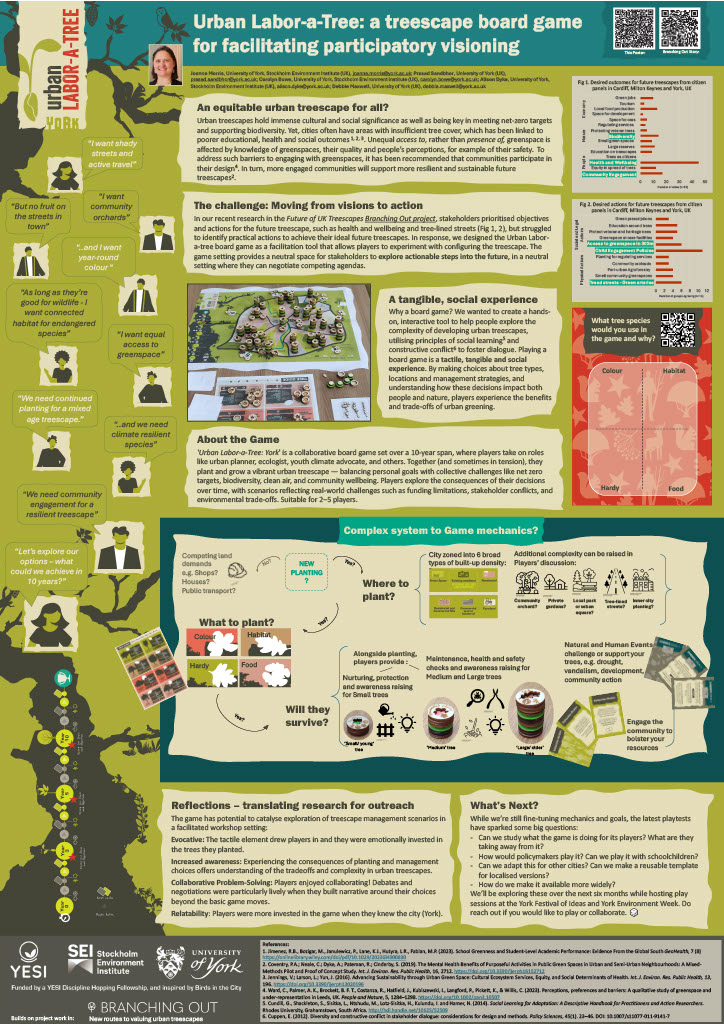
Interactive event: Urban Labor-a-Tree – Growing York’s Treescape (16 May 2025)
- Plant and nurture different types of trees in parks, along streets, and around homes.
- Navigate real-world challenges like floods, droughts, and even vandalism.
- Collaborate with fellow players to balance priorities: from building green corridors for wildlife to establishing community orchards.
- Explore how urban trees impact public health, quality of life, and environmental resilience.
Principal and Co-Investigators
Principal Investigator
Joanne Morris, Stockholm Environment Institute York
Co-Investigators
Prasad Sandbhor, Intelligent Games and Games Intelligence (IGGI), Computer Science
Alison Dyke, Stockholm Environment Institute York (SEI Y)
Debbie Maxwell, School of Arts and Creative Technologies (ACT, TFTI)
Jon Hook, School of Arts and Creative Technologies (ACT, TFTI)