
Hope in Creation
Project Outputs
The “Hope in Creation” project hosted a two-day interdisciplinary workshop at the University of York (30 June – 1 July), exploring how hope can be harnessed through creative methods to communicate environmental research in more inspiring and transformative ways.
Bringing together academics, writers, artists, educators, and performers, the event invited participants to reflect on how creative, hopeful approaches can nurture realistic yet aspirational visions for life on a changing planet. Through storytelling, performance, visual arts, and cross-disciplinary collaboration, participants examined how hopeful narratives can support education, mental health, and collective action towards more just and sustainable futures.
The workshop enabled rigorous discussions around the theme of hope in environmental and intersectional contexts, complemented by participatory sessions using creative research methods such as blackout poetry, photovoice, storytelling, and zine-making. These activities offered a space to test the strengths and limitations of creative methods and to explore how they can bridge disciplinary divides.
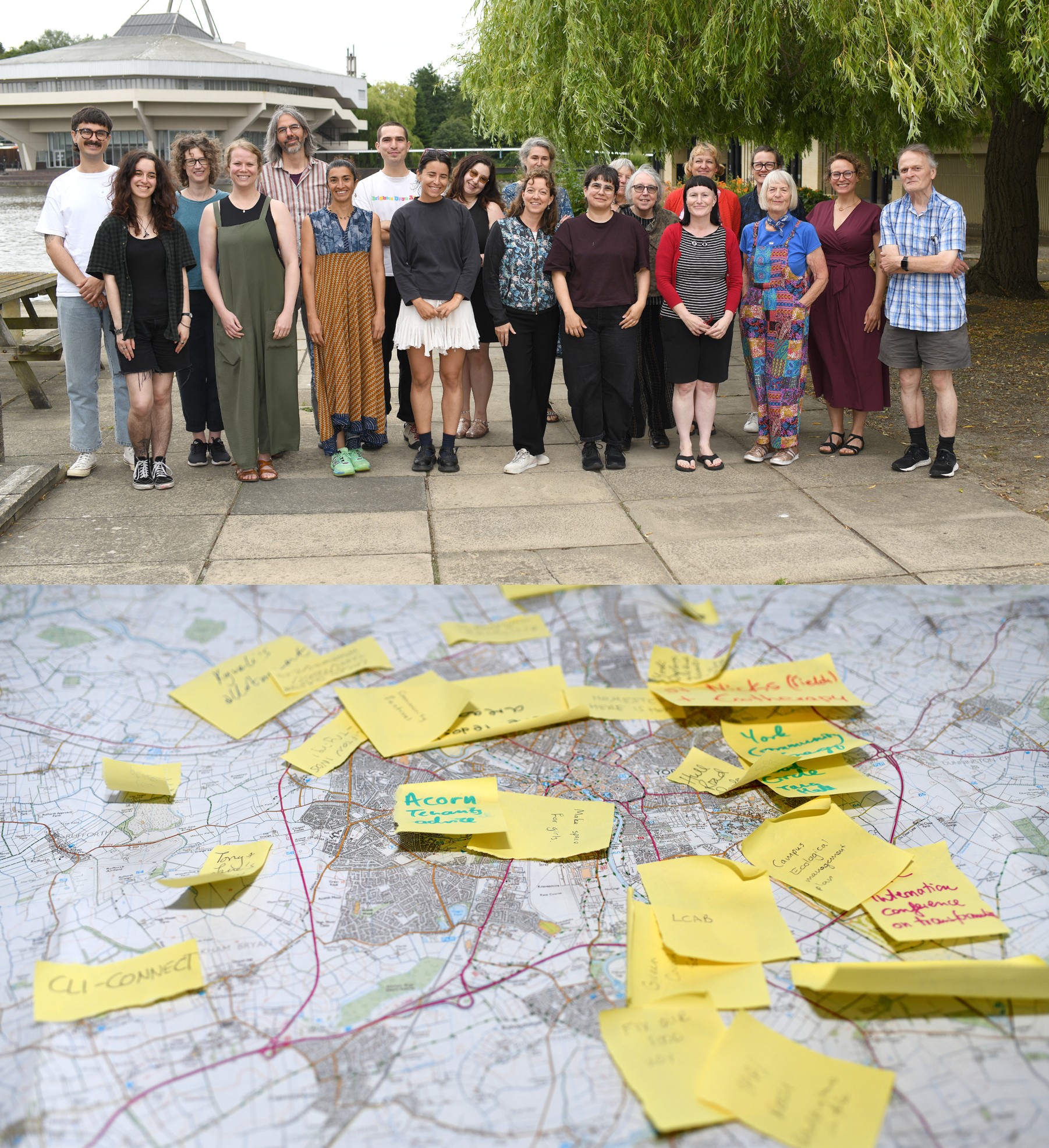
“Hope in Creation” interdisciplinary workshop. Credit: Paul Shields
Feedback from participants and organisers highlighted the experience as both intellectually stimulating and personally transformative. The collaborative format encouraged those from academic and creative backgrounds alike to engage deeply with unfamiliar methods and perspectives. By the end of the workshop, new frameworks for interdisciplinary and mixed-method engagement had begun to emerge – grounded in lived experience and united by a shared commitment to cultivating hope in the face of environmental uncertainty.
This funding allowed us to foster collaboration within and beyond academia. It reminded us how interdisciplinary discussions are invaluable for one’s own research and critical engagement with often abstract ideas.
- Dr Sophie Weeks
Principal Investigator
Sophie Weeks, Department of History
Co-Investigators
Tom Houlton, thomas.houlton@york.ac.uk, Department of English and Related Literature
Christopher Lyon, christopher.lyon@york.ac.uk, Department of Environment & Geography
Kate Pickett, kate.pickett@york.ac.uk, Department of Health Sciences
Smriti Safaya, smriti.safaya@york.ac.uk, between the Environment & Geography, and the Education departments
Peter Sands, peter.sands@york.ac.uk, Department of English and Related Literature
External Partners
Julia Bentz, juliabentz@gmail.com, Centre for Ecology, Evolution and Environmental Changes, University of Lisbon
Kyveli Lignou-Tsamantani, kyveli.lignou-tsamantani@york.ac.uk, Research Associate, Centre for Modern Studies (UoY), & Lecturer in Art History and Theory, School of the Arts, York St John University
Nic Fife, nic.fife@icloud.com, Artist in Residence at the Joseph Rowntree Foundation and Print Technician at Thin Ice Press
Cath Heinemeyer, c.heinemeyer@yorksj.ac.uk, Senior Research Associate in Ecological Justice and Senior Lecturer in Arts at York St John University