
CS Co-labs Clinics
Terms, conditions and boundaries
Driven by our goal to create a shared space where colleagues access tailored support, learn from others' experiences, and explore new approaches, our clinic sessions run according to the following key values: mutual respect, advisee-centred support, and peer learning.
- Mutual respect: to support open discussion in clinic sessions, we expect both advisors and advisees to remain respectful of each other, be considerate with language used, and be sensitive to differing opinions. Please be assured that clinics are a judgment-free space and there are no "silly questions".
- Advisee-centred support: Rather than enforcing a one-size-fits-all approach, we aim to adapt clinic sessions to suit your support needs. For example, you might meet with one or several members of the team, and the advice session could be very practically focused with sharing of relevant templates or resources, or involve more open-ended discussions and reflection.
- Peer learning: While we share insights drawn from our own experiences and recommendations of best practices, you’ll always be the expert in your own context and we recognise that we always have more to learn. We look forward to open discussion and exchange of ideas.
Our expertise
Our expertise covers both the theory of citizen science and the practice of citizen science across a range of topic areas:
| TOPIC | Advice relating to... |
|---|---|
| Inclusion | ensuring citizen science projects are inclusive for participants, considerations of diversity and accessibility |
| Project Management | planning and resourcing citizen science projects |
| Engagement | maintaining engagement of citizen science project participants during and after project lifetimes |
| Communication | communicating with potential and actual participants, including for recruitment, and communicating findings and recommendations to participants, other stakeholders and policymakers. |
| Evaluation | evaluating citizen science projects to understand impacts and effects |
| Digital Citizen Science | online citizen science project opportunities, barriers and engagement |
| Software | using technology to widen and deepen engagement with citizen science projects |
| Schools | engaging with schools, conducting citizen science research projects in schools, producing resources with schools |
| Environmental Education | using citizen science for education, particularly environmental and experiential education |
| Creative Methods | using the creative arts, especially theatre, for engaging in participatory environmental education research |
| Environmental Monitoring | using citizen science approaches for environmental monitoring, including air quality, water and biodiversity |
| Energy Systems | applying citizen science methods to projects exploring alternative energy sources and systems, including community energy, and related considerations including retrofitting |
| Just Transitions | engaging communities and grassroots organisations on initiatives transitioning towards a just society |
Please note that our definition of ‘science’ includes anything with a research question, so we welcome bookings from those outside of traditional ‘science’ fields.
How our clinics run
Our clinics are open to any researcher or practitioner to access, no matter your knowledge of citizen science, or country you are working from.
Clinics are open during the University of York’s term time and only operate during working hours (9-5 GMT/BST), although we will be flexible within this to cater to colleagues in different time zones.
To sign up to a clinic you will complete an online form outlining what help you are looking for. Provided your support request falls within scope for the Co-labs clinics (see more on this below), we will respond to this within 5 working days and either connect you directly with the relevant member(s) of our team for advice or schedule a scoping appointment to find out more about your request.
Subject to the availability of the relevant team member(s), we aim to schedule your appointment within a timely manner and will be guided by your indication of timelines in the form. Appointments up to an hour in duration will be offered, and will take place over Zoom unless otherwise agreed.
If you cannot attend your appointment at the scheduled time please let the team know with as much advance notice as you are able, ideally at least 24 hours notice. In this circumstance, we’ll endeavour to reschedule subject to the availability of our team.
If you provide no advance warning and do not attend your scheduled appointment, you may be offered an opportunity to rearrange, subject to the discretion of the team.
If you would like subsequent sessions, this is not guaranteed but may be possible subject to capacity and at the discretion of the team.
Expectations
Rather than a ‘lecture’, we see clinic sessions as an exchange between peers, and look forward to open discussions. Our team will candidly share personal experiences of citizen science with honest reflection on what has and hasn’t worked in our projects. Please be prepared to share your experiences too.
To tailor support to you, we may ask you to share information prior to or during the session. Please only share what you have the appropriate consent and legal right to share (see confidentiality section).
Limitations
- We are not able to advise undergraduate students.
- We will not complete project work for you - we are advisors rather than project collaborators.
- We do not guarantee that approaching us will lead to project collaboration with us.
- We may redirect you to a more suitable source of information if, following initial discussions, it transpires that your support needs fall outside of our expertise.
- Citizen science is not always an appropriate method. Where circumstances prevent the meaningful involvement of citizen scientists (e.g. due to funding or other logistical constraints), or using citizen science would otherwise be unethical or impractical, we may decline to provide advice.
Liability
Our guidance represents our professional opinions, which are based on our range of experiences. The ultimate decision to implement, follow, or disregard any advice rests entirely with you.
While our advice is tailored to each individual request, our recommendations are formulated on the basis of the facts, documents, and instructions provided to us by the advisee. We cannot accept any responsibility for any inaccuracies, omissions, or undisclosed factors that may affect the validity or outcomes of this advice.
We are not liable for outcomes arising from decisions you take, whether or not they are based on advice we have provided.
The advice given in clinics does not replace legal checks, ethics approval, and other regulatory frameworks.
Confidentiality and ownership
Do not share any confidential, proprietary or sensitive information with us, including third-party personal data. It is your responsibility to confirm that you have the necessary consent and/or legal rights to disclose any information you provide. By sharing any data or files with us, you are confirming that you have the right to do so.
Information you share in your sign up form will only be available to the team who process the requests, and the member(s) of the team if/when assigned to the clinic appointment(s). Beyond this, summary level information will be provided to the team and, at a much broader level, learnings from the project will be shared in publicly accessible spaces. We will not name any individuals or refer to their projects without their explicit prior written permission.
For further information see our privacy notice.
Ownership of any materials or ideas discussed in the clinics remains with you. If you wish to acknowledge us in any outputs, please contact us giving at least 14 working days’ notice prior to any deadlines for publication.
Conduct and complaints
To allow open discussion in clinic sessions, we expect our advisors and advisees to remain respectful of each other, be considerate with language used, and be sensitive to differing opinions. Abusive behaviour will not be tolerated.
The CS Co-labs team will end sessions early if this conduct is not upheld and reserve the right to decline or discontinue bookings at the discretion of the team.
How to raise a complaint: (details will be added shortly)
Clinic process and boundaries
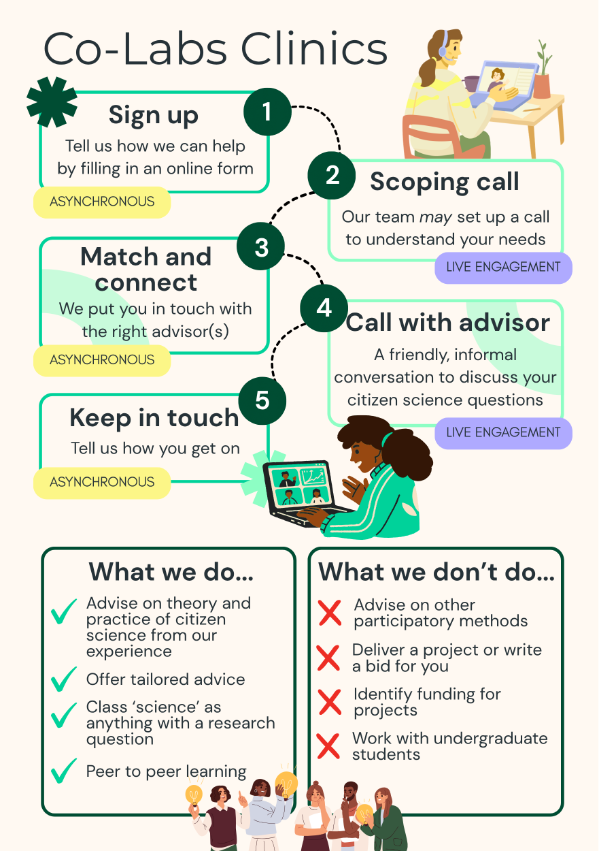
Text description of process and boundaries infographic
The image above is an infographic conveying the following information.
Journey map:
- Sign-up: ‘tell us how we can help’ (asynchronous)
- Scoping call: ‘call to understand your needs’ (live engagement, optional step initiated by us)
- Connect with match: ‘we put you in touch with the right expert(s)’ (asynchronous)
- Call with advisor: ‘a friendly, informal conversation to discuss your CS questions’ (live engagement)
- Keep in touch: ‘tell us how you get on’ (asynchronous, optional for advisees)
What we do:
- Advise on theory and practice of citizen science from our experience
- Offer tailored advice
- Understand ‘science’ in a broad sense of anything with a research question
- Peer to peer learning
- Advise researchers anywhere internationally, PGR and beyond
What we don't do:
- Advice on other participatory methods
- Deliver a project or write a bid for you
- Offer a ‘silver bullet’
- Requests for identifying funding for projects
- Work with undergraduate students