Seabirds could inspire new generation of GPS-free navigation technology
Posted on Monday 23 March 2026
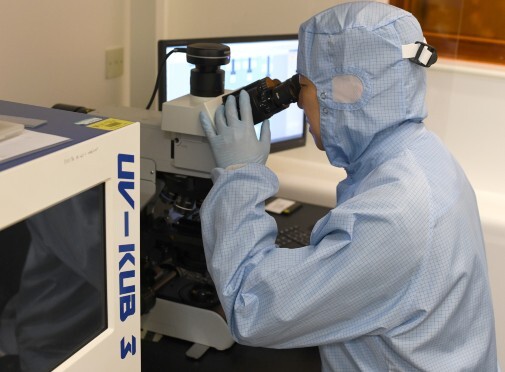
A cross-disciplinary team from the Universities of York and Liverpool is developing novel technology that captures the world through a bird’s-eye view, paving the way for the possibility of navigation systems that don’t rely on GPS.
Seabirds such as the Manx shearwater are famous for travelling vast distances to find food and then navigating back to their nests. Yet it is still not well understood how they achieve this feat.
In this project, scientists will use sensors no bigger than a fingernail and built with the latest semiconductor technology to measure the information birds encounter while they are flying.
Digital brains
These miniature devices will also act like tiny “digital brains”, using machine learning to analyse and interpret sensory information as the birds experience it.
By doing this, the team will be able to discover how the birds combine different environmental signals to make remarkably accurate navigation decisions.
The two-year project, funded by the UK Research and Innovation (UKRI) Cross Research Council Scheme, is led by the University of York, who are developing the next-generation sensor and computing technology, working in close collaboration with animal behaviour researchers at the University of Liverpool.
Natural signals
The project leader, Chun Zhao, a Lecturer at the School of Physics, Engineering and Technology at the University of York, said the project uses technology similar to microchips found in mobile phones but adapted to be smaller, more powerful and robust.
“We plan to use cutting-edge, miniaturised hardware to understand how seabirds make navigation decisions," Zhao said. “The sensors capture natural signals and allow us to process data in real-time to find patterns in how seabirds compile this information to make navigation decisions."
The goal is to transfer this natural intelligence into a digital system to build bio-inspired autonomous navigation systems.
Space exploration
Current aviation and shipping rely heavily on GPS but the signal is vulnerable to jamming and spoofing making locations unavailable or incorrect. This issue currently affects over a thousand commercial flights daily near conflict zones. The technology could also be applied to space exploration where GPS is unavailable.
“On Mars there is no GPS because there are no GPS satellites orbiting it,” Zhao explained.
“Right now, fully autonomous navigation on Mars is an engineering challenge. We think this seabird-inspired technology could one day enable a robot that learns to navigate the planet entirely on its own.”
Dr Ollie Padget from the University of Liverpool, added: “Seabirds achieve unbelievably efficient navigation, even from places they have not previously visited, and do so without the help of satellites through an unknown learning mechanism. This project has the potential to bridge this gap in our understanding.”
Seabird biology
By learning how birds might rely on environmental signals and features, the data will help policy makers to see if renewable energy sites might accidentally disrupt the environmental signals birds rely on, helping to prevent any harmful impact on their journeys.
Professor Samantha Patrick, from the University of Liverpool, said: “We have previously shown that seabirds use an array of cues and being able to pinpoint the scale over which they are most informative will not only improve our understanding of seabird biology, but also the possible implications of marine developments.”
Professor Martin Trefzer, from the York team specialises in unconventional, brain-inspired computing systems.“Our aim is to build machines that sense and think more like living organisms,” he said. “Instead of sending vast amounts of raw data elsewhere, we want the intelligence to sit right on the sensor itself, learning from the environment in real time. Seabirds are showing us what is possible, and we’re translating those principles into a new kind of autonomous technology.”
The project is expected to begin in spring 2026.