York’s medieval Guildhall built on Jewish–Christian cooperation, study finds
Posted on Saturday 7 March 2026
Newly discovered documents suggest York’s Jewish community played a central and previously unrecognised role in shaping the city’s medieval civic life, focused around the construction of the Guildhall.
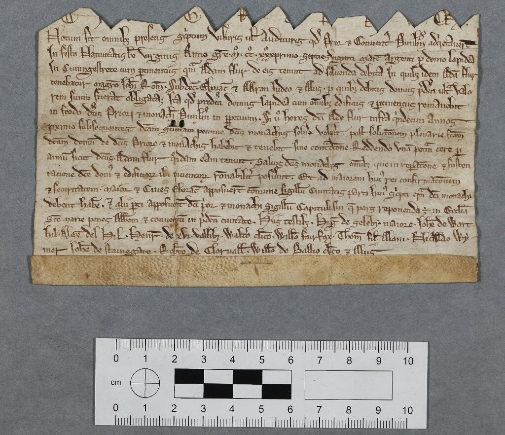
A study by Dr John Jenkins and Dr Louise Hampson at the University of York, published in the Journal of Medieval History, draws on previously unstudied charters found in Durham Cathedral Archives which offer important new information about the city of York in the thirteenth century.
The recent cataloguing of the Cathedral archive made the documents easier to locate than in the past. While a small handful of documents were known to historians, a further nine original charters relating to the city’s town hall (the Guildhall), spanning 1154-1231, show for the first time how this property was acquired by the city.
Constructive cooperation
The final document is a 'chirograph', a type of charter formed of two copies drawn up on one parchment - one for the grantor and one for the grantee - and then cut down the middle in such a way that if they were joined back up, the cutting patterns would exactly match to prevent one party later forging their half.
The research sheds new light on the origins of York’s medieval Guildhall and highlights what the researchers describe as constructive Jewish–Christian cooperation in the 13th century.
Dr John Jenkins, Director of the University of York’s Centre for Pilgrimage Studies, said: “This gives us an extraordinarily rare, perhaps unique, window on to how town councils as we know them today were formed in the twelfth and thirteenth centuries, as well as how Jews could be active in civic affairs at a time we usually think of as wholly exclusionary to the Jewish community.
“The evidence survives from York, but offers a clue into what might be happening elsewhere in England where evidence of how communities worked together hasn’t survived.”
According to the study, by the 1230s York’s Jewish community was embedded at the heart of the city, working alongside Christian neighbours and senior clergy from York Minster. This challenges long-held assumptions that relations remained largely hostile following the violence of 1190.
Symbolic exchange
The documents point to a symbolic exchange of infrastructure in September 1231 involving the Jewish community, the city authorities and York Minster. As part of this agreement, the Jews were granted an extension to their burial ground, the city acquired the Guildhall, and major works at the Minster - including construction of the north transept and the famous Five Sisters window - were funded.
The researchers say the Guildhall, one of York’s most significant surviving medieval buildings, was purchased for the city by representatives of the Jewish community working jointly with York Minster. This is the first time the early history of the Guildhall has been clearly documented.
Dr Jenkins said: “The massacre of York’s Jews at Clifford’s Tower in 1190 has quite rightly been a focus of our historical understanding of the relationship between Jews and Christians, but we know that the Jewish community didn’t end here, and so we wanted to know what the practicalities were of recovering from such a catastrophic event?
“Remarkably, what we see from within just a decade of the massacre is a thriving Jewish community living and working in the city in mostly harmonious relations with their Christian neighbours."
Leading figure
They found that a leading figure in the Jewish Community, known in the records as Aaron of York, cooperated with the senior clergy of York Minster in purchasing the large stone building which became the city’s Guildhall, ensuring that the city had a central meeting-place and contributing greatly to the development York’s city council and its civic history.
Dr Louise Hampson, from the University of York’s Centre for the Study of Christianity and Culture, said: “Aaron of York was the son-in-law of another Jewish community leader, Leo Episcopus, and would have lived on the west side of Coney Street, backing on to the river, where the Next store is now. We know that by the 1230s and 1240s he had a considerable standing in the community, and indeed the country.
“These new documents show us that their success in the community was in part due to the fact that Aaron, and many others in the community, saw the value in working together across religious barriers, despite a painful history for the Jewish community to overcome, to find a common ground that benefitted the whole City of York.”
Fragile relationship
Dr Jenkins and Dr Hampson say these relationships stood in contrast to the antisemitism seen elsewhere in medieval England. While they acknowledge the situation was fragile - and ultimately temporary, with the expulsion of all Jews from England in 1290 - the evidence suggests that cooperation between faith communities helped lay the foundations of York’s civic institutions, many of which still endure today.
The Guildhall went on to welcome Kings and Queens through its doors, serving as a location for entertainment and grand banquets, but also as a ‘common hall’ for the people of York to host events, and council leaders to meet.
Today, as part of the University of York, the Guildhall is a hub for small businesses to come together to share knowledge and support.