Nothing said “love” more than a powder compact, art historians reveal
Posted on Tuesday 14 February 2023
Though now largely redundant, these compacts were once an essential for every woman. These little cases came complete with a puff and fine powder. When dusted on the face this powder achieved a flawless complexion and quickly hid any blemishes. Liquid foundation creams partly made all that redundant because they last all day.
Status symbols
The Digital Museum of Dress Accessories (DMDA) at the University of York is giving visitors to the site the opportunity to travel back in time and view these love tokens.
Dr Cordula Van Wyhe, Senior Lecturer in the Department of History of Art: “These compacts not only powdered noses but were also status symbols, were often lavish and made to be seen and admired. They were also popular as gifts and they could be a lasting tribute of friendship and love, often engraved with sentimental messages.
“With millions of men away during WWII, compacts became the serviceman’s preferred gift to wives and girlfriends. US and British army divisions even ordered them in vast numbers wholesale from manufacturers. The cases were then individualised with various regimental or division insignia and sold at post exchanges at every base.”
Love messages
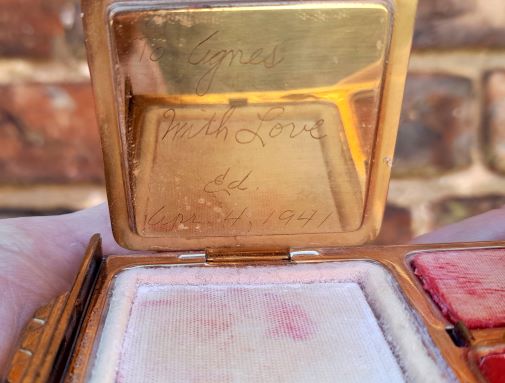
An example that can be found in the museum is the Kolter & Kopit powder compact, which bears the seal of the United States with the motto ‘e pluribus unum’ (‘one from many’) which is also the insignia of the land service branch of the US army. The hand-engraved dedication on the inner lid of the powder compartment reads: ‘To Agnes with Love Ed Apr. 4 1941’.
It is thought that Ed may have been part of the nation’s first peacetime military draft in September 1940, which had swelled the US military to nearly 2.2 million soldiers by December 1941.
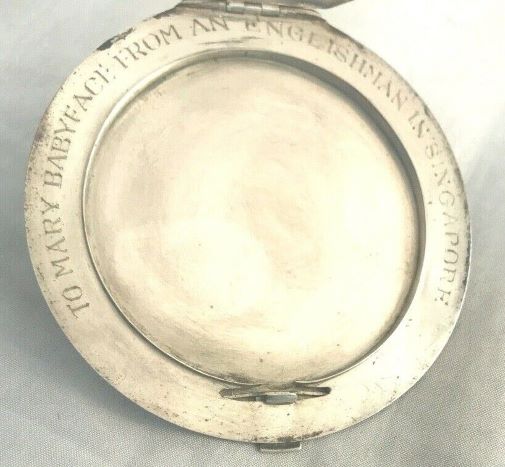
Another example is the solid silver niello compact, made in Thailand between the 1930s to 1950s. The inscription around the mirror reads: ‘To Mary Babyface from an Englishman in Singapore’. Babyface’ is an old-fashioned term of endearment and plays on the idea that Mary was reminded of it each time she looked at her face in the mirror.
Accessories
The Digital Museum of Dress Accessories (DMDA) looks at the often forgotten objects that were once fashionable accessory items; from parasols, to chatelaines, and even hatpins, to explain what they were about and what they can tell us of past people and societies.
Dr Van Wyhe said: “The Museum aims to give new life to these dress accessories, to demonstrate that they have significant stories to tell about a range of issues impacting not only fashion but the more intimate lives of people at the time, such as issues of gender roles, societal expectations, and even health.”
Currently, the project team is preparing a digital gallery on the 200 parasols, housed, but never studied or displayed, at Leeds Museum and Galleries.
To find out more about the Digital Museum of Dress Accessories visit: https://dmda.york.ac.uk/