World-famous Avebury site to be brought to life online for first time
Posted on Tuesday 10 January 2023
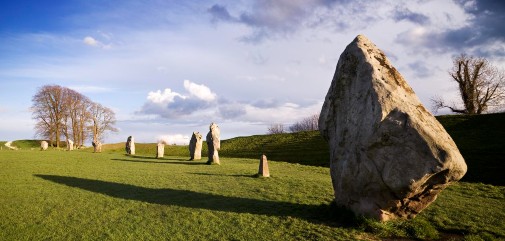
Researchers are working to bring 5,000 years of history to life in a project that will see the archive of the Avebury World Heritage Site open access for the first time.
The team of experts from the University of York, Bournemouth University, the National Trust, and the Archaeology Data Service, with support from Historic England and English Heritage, are creating a public, open access digital archive of Avebury, and the archaeological discoveries made there.
Currently dated to the first half of the 3rd Millennium BCE, the megalithic monuments at Avebury, North Wiltshire, form part of the UNESCO Stonehenge and Avebury World Heritage Site.
Largest monuments
Avebury comprises one of the UK’s largest Henge monuments, containing the world's largest stone circle at almost 350m in diameter, with avenues of paired standing stones that extend out into the landscape for 3.5km to link Avebury to a host of other important prehistoric structures.
The four-year project will analyse, expand, digitise, and share Avebury’s unique multimedia archive, detailing its Neolithic origins, and a history that ranges from a medieval hamlet to a modern site of heritage, tourism, creativity, and spirituality.
Neolithic questions
Dr Colleen Morgan, from the University of York’s Department of Archaeology, said: “Avebury's significance extends far beyond the British Isles, informing research on a range of fundamental questions concerning the European Neolithic, such as why and how people went to the trouble of building such vast monuments.
“By providing a fuller understanding of the history of this World Heritage Site, this research and the multimedia digital archive it will generate will enable more effective heritage management, education, and tourism programmes.”
WWII
The project, called ‘The Avebury Papers’, will add to the archaeological work that was ended by the outbreak of World War Two, bringing together the findings from the 1930s work and other 20th century interventions, and exploring the lives of the people and organisations that made the work possible.The entire archive will be made available online on an ‘open access’ basis for anyone to use for research, enjoyment, and creative projects.
The Avebury estate was sold to the National Trust by Alexander Keiller and the monument placed in the Guardianship of the state in 1944. In 1966, the collection of the Alexander Keiller Museum was given to the nation by Gabrielle Keiller, Alexander Keiller’s widow.
Overarching responsibility for the collection and the paper archives now lies with Historic England, on behalf of the nation. Historic England’s national collection of historic sites and artefacts is managed by the English Heritage Trust and at Avebury the Alexander Keiller collection is on loan from English Heritage to the National Trust, who own and operate the site.
Unpublished
Professor Mark Gillings, from Bournemouth University, said: “Despite its international importance, the only large-scale archaeological excavations to take place at Avebury were concluded just before the outbreak of WWII.
“Whilst a masterful summary of the results of this work was produced in the 1960s, the incredible detail they revealed has remained unstudied and unpublished. We want to open up this work, and allow the public to see this site in a new way for the first time.”
More details about the Avebury Papers project - funded by the Arts and Humanities Research Council (AHRC) - can be found via the website: http://www.aveburypapers.org