Drone study finds killer whales can have close friendships
Posted on Friday 18 June 2021
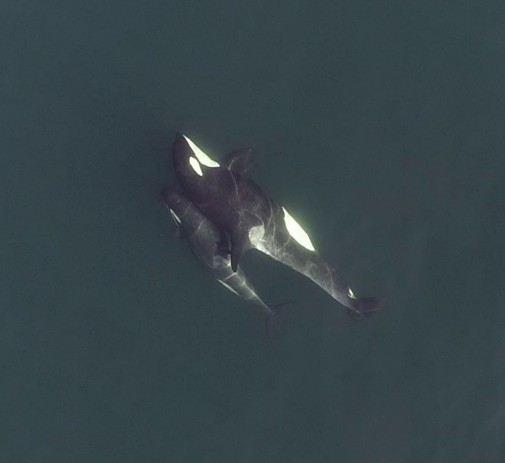
The findings indicate that killer whales spend more time interacting with certain individuals in their pod, and tend to favour those of the same sex and similar age.
The study also found that the whales appear to grow apart as they get older.
Researchers from the Universities of York, Exeter and Washington collaborated with the Centre for Whale Research (CWR) and the Institute of Biophysics on the study.
Killer whale society
The team of researchers, including Dr Dan Franks from the University of York’s Departments of Biology and Computer Science, analysed the 651 minutes of video filmed over 10 days to determine the social structure of the group.
Dr Franks said: “Our analysis indicates that maternal kinship, age and sex are important factors structuring this killer whale society. The study demonstrates the potential power of unoccupied aerial systems for analysing cetacean societies.”
“We have also used drones to examine the potential impact of how respiratory diseases spread in the endangered killer whale population.”
Tight-knit groups
Previously, research on killer whale social networks has relied on seeing the whales when they surface, and recording which whales were together in the same group. This approach has been useful in revealing the general matrilineal family structure of these whales.
The drone footage allowed the team to observe more detail in the social structure, such as interactions and contact between individual whales. Their findings show that, even within these tight-knit groups, whales prefer to interact with specific individuals.
Patterns of physical contact – one of the social interactions the study measured – suggested that younger whales and females play a central social role in the group.
The researchers also found that young individuals and females were the most socially central.
The new research was built on more than four decades of data collected by CWR on southern resident killer whales, a critically endangered population in the Pacific Ocean.