Vesuvius victims suffered a slower death than believed
Posted on Thursday 23 January 2020
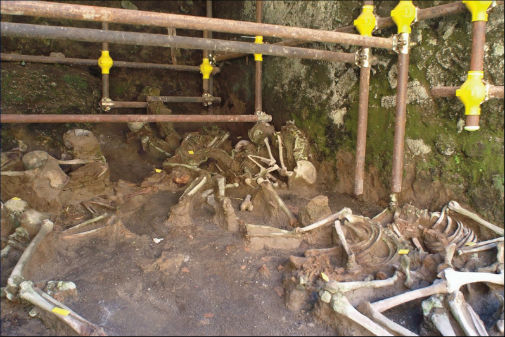
It was initially thought that the residents of the seaside town of Herculaneum, who fled to stone boat houses along the beachfront when disaster struck, were vaporised by the extreme heat of the volcanic eruption.
But new research by archaeologists - including academics from the University of York - challenges this interpretation.
Vaporisation
The study re-examined the victims’ skeletons, revealing their structure and remaining collagen was inconsistent with vaporisation, suggesting that the bodies were not exposed to temperatures as extreme as expected. Instead, they may have lived long enough to suffocate from the toxic fumes of the pyroclastic flow.
One of the academics involved in the study, Professor Oliver Craig from the Department of Archaeology at the University of York, said: “The realisation that collagen was present in the Herculaneum bones was completely unexpected. We realised then that commonly held assumptions regarding the manner of their death could not be true.
“If the bones were exposed to extreme heat then we would expect the collagen to be lost very quickly from the bone. Finding collagen was our first indicator of lower temperature exposure.”
Eruption
This was confirmed by the measurements made on the bone mineral by forensic expert and lead author of the study, Professor Tim Thompson from Teesside University.
The eruption of Mount Vesuvius buried the Roman town of Pompeii and the pyroclastic flow destroyed nearby Herculaneum. More than 340 people who took refuge in the town’s vaulted stone boathouses (fornici) perished.
Tests conducted on the ribs of 152 individuals from the fornici revealed they did not match the patterns expected if they had been exposed to extremely high temperatures (over 300 – 500 °C).
Professor Thompson said: “The people hid for protection, and got stuck. The general theory has been that these individuals were instantly vaporised.
“What was interesting was that we had good collagen preservation but also evidence of heat-induced change in the bone crystallinity. We could also see that the victims had not been burned at high temperatures.”
Pyroclastic flow
Several factors may help explain why the people taking refuge in the fornici experienced lower temperatures than expected. Firstly, the pyroclastic flow may have been relatively cool, with some estimates suggesting it was only 240 °C. The fornici may have also provided some insulation, further lowering the temperature people were exposed to.
As well as shedding new light on the story of Vesuvius, the discovery has also opened up new avenues for research.
Professor Craig added: "Thanks to the collagen preservation in the bones of the Herculaneum victims, we have been able to commence a whole suite of further analyses. For example, through stable isotope measurements we have gained a unique snapshot of Roman diet."