Lighting up the way medical students learn anatomy
Posted on Thursday 10 January 2019
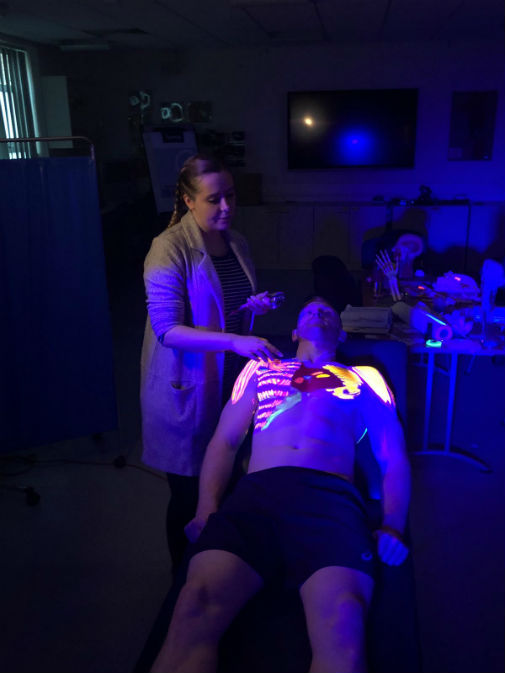
It is also a frequently observed activity within the anatomy classrooms of medical schools around the world.
But now lecturers at Hull York Medical School are pioneering the use of body paint and ultraviolet light to help teach anatomy to students.
Fluorescent colour
Although the use of body paint in medical schools is not new, it is believed the use of ultraviolet light is a first.
UV paint provides a “wet and more visceral look” and coupled with the fluorescent colour provides a striking model for the students to study.
The technique has been piloted at Hull York Medical School and will be fully embedded into a new module in anatomy this term.
Students are taught in groups of 10-12 with the technique applied on a model or classroom volunteer.
Unique view
Professor Gabrielle Finn, Director of the Health Professions Education Unit at Hull York Medical School, said the technique was proving extremely popular with students.
She said: “The use of body paint has been around in medical schools for the past decade, but no-one is using UV.”
“Ultraviolet painting presents a unique view of human anatomy that is visually striking – highlighting muscle tensions and the connections between parts of the body.
“Students are able to visualise the layers under the skin in a way they can’t with normal body paint so when they are examining a patient during their clinical practice then can recall those images of anatomy to better understand what they are feeling and the connections between parts of the body.
“It is a very memorable way to learn and is a lot more fun and students really engage with it."