Drones could protect coffee plants from devastating fungal disease
Posted on Friday 29 March 2019
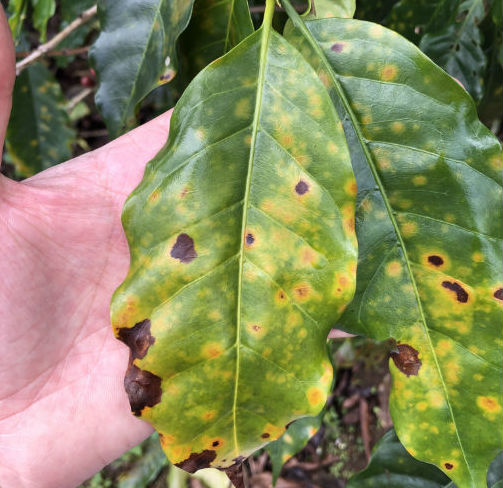
Coffee plants are vulnerable to a fungal disease known as coffee leaf rust, which poses an ongoing problem to farmers in the coffee-growing industry.
Coffee is grown in many areas of the developing world and if a coffee plantation is wiped out by disease it can destroy an entire family’s livelihood. Many farmers can’t afford expensive fungicides that could prevent coffee rust.
Little protection
The research team have been working in the coffee growing regions of Northern Thailand to test how to use drones to spot the disease early and prevent its spread.
There is huge consumer demand for coffee world-wide and, according to the British Coffee Association, we now drink around 95 million cups of coffee a day in the UK alone.
Professor Katherine Denby, Academic Director of the N8 Agrifood Resilience Programme from the Department of Biology at the University of York, said: “80% of coffee is produced by smallholder farmers. We have been working with smallholders in northern Thailand in an area where coffee production has replaced opium.
“The smallholders are growing high quality Arabica coffee, intercropped with fruit trees and vegetables, but they have little protection against coffee leaf rust disease. We are helping these farmers develop methods to rapidly spot infected trees before pustules develop and infection spreads."
Machine learning algorithms
The research project has been funded by the Science and Technology Funding Council (STFC) Food Network+, which brings together researchers (particle physicists, astrophysicists, nuclear physicists) and facilities from STFC with different disciplines in the agri-food sector to solve some of the world’s greatest food sustainability challenges.
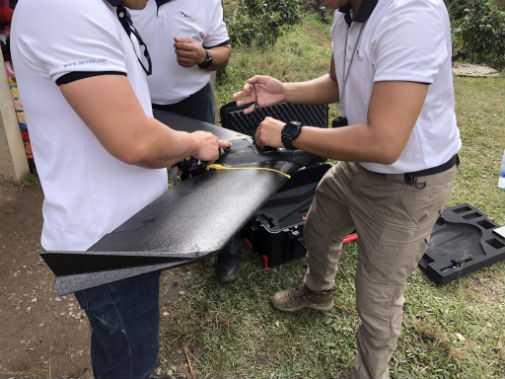
The researchers have been testing how to use drones to spot coffee rust early and prevent its spread. Image credit: Dr Oliver Windram, Imperial College London.
The research team are adapting a technique commonly used in astronomy called multispectral imaging to spot the coffee rust. The technique is used to collect image data at different frequencies in the electromagnetic spectrum, including frequencies beyond visible sight such as infrared.
For the first phase of the project, the team has recently returned from a trip to the Chiang Rai province of Thailand, where they began surveying coffee fields and collecting image data of various crops. They will use this data to start to train machine learning algorithms, with the aim of having an instrument able to recognise and map coffee plants, as the coffee plants are often surrounded by other different crops.
Pathogen spread
Project lead, Dr Oliver Windram from Imperial College London, said: “Having located coffee in the field we would then like to track the spread of coffee leaf rust in coffee plants and as part of this investigate how different intercropping plant community structures influence the spread of this pathogen.
“In terms of milestones we have shown that we can use multi-spectral sensing to differentiate between coffee plants infected with rust and those that are not. We can also distinguish between different types of coffee cultivars using this technology. We have been working in the Chiang Rai coffee-growing region, but if this technology is successful it could potentially be rolled out anywhere the plant is grown.”
The project has now received additional funding from the STFC Food Network+ and will be looking to develop a custom built multi-spectrum camera that will be optimised for differentiating coffee cultivars and coffee leaf rust infections. This will allow the team to gather more data and make the method more robust, before it can be deployed in other countries.

.jpg)