World’s most famous tapestry was made for the town where it was stitched: Bayeux.
Posted on Thursday 24 October 2019
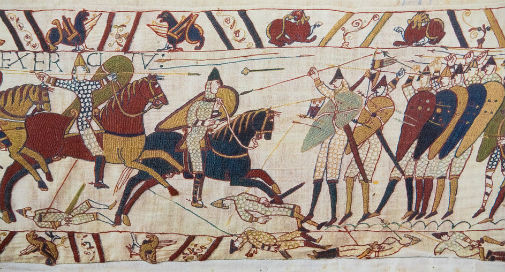
For centuries, debate has raged over where the Bayeux Tapestry was manufactured, who commissioned the embroidery and whether it was originally displayed in England or France.
Now, new research by Professor Christopher Norton, from the Department of History of Art, has shed new light on the mystery.
The research on the tapestry - depicting the Norman Conquest - shows it was designed to exactly fit a space on the walls of Bayeux Cathedral.
Embroidered
It has long been known that the tapestry was hung in the nave from the 15th Century to the French Revolution, but new analysis of the linen strips on which it is embroidered suggests that it was intended to hang there from the moment it was made in the 11th Century.
This new research proves that the designer must have visited Bayeux and known the nave's exact dimensions, adjusting the design accordingly. The tapestry was designed to be hung along the north, south and west sides of the nave of the cathedral, between the west wall and choir screen from the 11th Century when it was made.
Medieval cloth
The study author said: “I have been working on this project for more than 20 years and it arose out of work I was doing on the 11th Century Minster in York which was built by the first Norman Archbishop, Thomas of Bayeux.
"It has always been the case that the simplest explanation is that it was designed for Bayeux Cathedral.
“This general proposition can now be corroborated by the specific evidence that the physical and narrative structure of the tapestry are perfectly adapted to fit the nave of the 11th Century cathedral.”
Professor Norton analysed evidence including that of the tapestry’s linen fabric, and information about the tapestry’s measurements was assessed and compared along with information on medieval cloth sizes, allowing for factors such as shrinkage and missing sections.
Artwork
By studying the cathedral’s surviving architectural features, Professor Norton also established how the nave would have looked in the 11th Century. This allowed him to establish the nave’s original proportions by pinpointing the choir screen’s location. He then discovered the tapestry would have fitted five bays of the nave, with the artwork’s narrative structured in relation to doorways and architectural supports.
Professor Norton is now suggesting that the tapestry, currently kept in a long U-shaped tunnel, should be displayed along three sides of a rectangular space (31.15 m long x 9.25 m wide) as this would enable viewers to appreciate the artwork as intended.
French President Emmanuel Macron pledged last year to loan the tapestry to the UK. It would be the first time in recorded history that it would be seen in Britain.